
Leader of the Opposition (LoP) in Lok Sabha and Congress MP Rahul Gandhi called the ministry of education a “department of disasters” and attacked the BJP-led Central government over the NEET-UG 2026 paper leak, the Central Board of Secondary Education (CBSE)’s use of the on-screen marking (OSM) system and the drop in Class 12 pass percentage compared to last year, as well as the board’s new mandate requiring Class 9 and 10 students to study three languages.

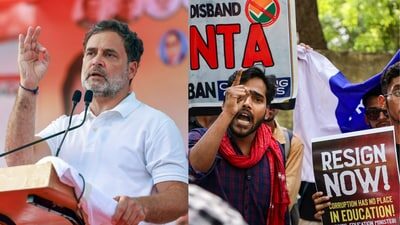
His remarks come amid mounting backlash against the National Testing Agency (NTA) and the education ministry over the NEET-UG 2026 paper leak, an exam for which nearly 23 lakh candidates had registered.
Meanwhile, controversies have broken out around the CBSE for two reasons. One, for using the on-screen marking system to evaluate Class 12 board examination results, which resulted in a huge drop in the overall pass percentage this year to 85.2%, the lowest level seen in the past seven years. Second, for mandating that Class 9 and 10 students study three languages, R1, R2 and R3, where at least two must be national languages.
Rahul Gandhi attacks Centre: What he said
The Congress leader called the ministry of education a “department of disasters” while saying that education minister Dharmendra Pradhan “has failed every single age group of India’s students at once.”
He also targeted Prime Minister Narendra Modi and asked him to apologise for “destroying futures of lakhs of children”.
In a post on X, the Lok Sabha LoP wrote, “First the NEET paper leak affecting 22 lakh students. Then CBSE Class 12 students receiving unexpectedly low marks from a broken OSM system – many losing their college eligibility. Now lakhs of CBSE Class 9 students suddenly asked to learn a new language from July 1, with no teachers, no textbooks, and Class 6 books being handed to 14-year-olds as a “transitional” fix. Three exams. Three age groups. One Minister.”
“Dharmendra Pradhan ji has not failed once. He has failed every single age group of India’s students at once. Every announcement plunges children deeper into uncertainty. Every failure goes unpunished. The Education Ministry has become a department of disasters.”
He added, “Prime Minister Modi ji – can you at least apologise to the lakhs of children whose futures you and your Minister have destroyed?”
The Congress MP ended his post with the hashtag “#SackPradhan”.
Kejriwal’s appeal to NEET-UG students
Joining other opposition leaders targeting the Centre over the paper leak issue, AAP chief Arvind Kejriwal on Sunday urged students in a video message shared on X to “come together and find a way forward”.
“Phone calls are coming in saying that many students are dealing with depression and stress because of the cancellation issue. In the last few days, there have been reports of four students dying by suicide…First of all, I want to request all students that if you are feeling depressed, please share your feelings with me.”
“We will work together to find a solution. You are all educated and sensible people. We will together figure out how to improve NEET,” he urged the students.
What Centre said on all three cases
On Friday, Pradhan announced that the NEET-UG re-examination would be held on June 21 and said the medical entrance test would shift to a computer-based format from next year as part of planned reforms.
“Our topmost priority is the future of the students. I want to appeal to the society, especially to all students, to appear in the examination without fear. The government stands with you. We will not let malpractice happen this time,” he said.
Meanwhile, the Central Bureau of Investigation (CBI) is investigating the paper leak case and has arrested two “masterminds”, PV Kulkarni and Manisha Gurunath Mandhare, both linked to the examination process through the National Testing Agency.
So far, nine people from five states have been arrested. Those arrested include Mandhare, Kulkarni and Waghmare from Pune, Dhananjay Lokhanda from Ahilyanagar, Khairnar from Nashik, Mangilal Biwal, also known as Mangilal Khatik, Vikas Biwal and Dinesh Biwal from Jaipur, and Yadav from Gurugram.
Under fire over the fall in Class 12’s overall pass percentage, the CBSE and the ministry of education have defended the use of the on-screen marking (OSM) system, saying it was brought in to improve “transparency, fairness, and consistency” in the assessment process.
Under the OSM process, answer sheets were scanned and uploaded to a digital platform where teachers checked them on computer screens. The system aims to reduce mistakes in totalling, posting and uploading by making sure each answer is checked according to the prescribed marking scheme, as reported by HT earlier.
Meanwhile, the CBSE is also facing flak from the opposition over the three-language policy, including at least two native Indian languages. The policy, which includes at least two native Indian languages, will become compulsory for Class 9 students from July 1 this year, despite schools already beginning classes and unit tests for the new academic session.
In a circular issued by the board, it said, “In order to adequately address the competencies envisaged at the Secondary Stage, these textbooks will be supplemented with one appropriate local or state literary material, selected by schools, such as short stories, poems, or nonfiction works.”
The board also said that to ensure students remain focused on learning and to avoid placing extra pressure on them, no board examination would be held for R3 at the Class 10 level.
With inputs from agencies
-

-

-

-