The Supreme Court on Monday criticised its January 5 judgment denying bail to former JNU student Umar Khalid and activist Sharjeel Imam in the alleged larger conspiracy case linked to the 2020 Delhi riots, and emphatically held that “bail is the rule and jail is an exception” even in prosecutions under the Unlawful Activities (Prevention) Act (UAPA).
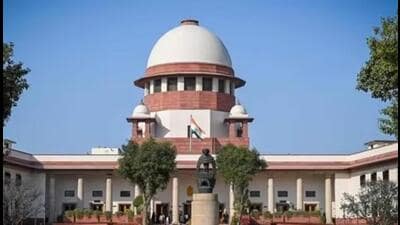
A bench of justices BV Nagarathna and Ujjal Bhuyan, while granting bail to Jammu and Kashmir resident Syed Iftikhar Andrabi in a narco-terror case investigated by the National Investigation Agency (NIA), expressed “serious reservations” about the reasoning adopted earlier this year by another two-judge bench comprising justices Aravind Kumar and NV Anjaria in the Delhi riots conspiracy case.
The court underlined that the January 5 verdict failed to correctly apply the binding principles laid down by a larger three-judge bench in Union of India Vs KA Najeeb (2021), which recognised that prolonged incarceration and delay in trial can override the statutory restrictions on bail under Section 43D(5) of the UAPA.
Reading out the operative portions of the judgment in open court, Justice Bhuyan observed: “Bail is not an empty statutory slogan. It is a constitutional principle flowing from Article 21, and the presumption of innocence is the cornerstone of any civilised society governed by the rule of law.”
The bench added: “Even under UAPA, bail is the rule and jail an exception. Bail can only be denied in a particular case depending on the facts of that particular case.”
The ruling marks one of the sharpest judicial critiques by a coordinate bench of a recent Supreme Court judgment dealing with bail under anti-terror laws.
The court also took exception to the January verdict for directing that Khalid and Imam could revive their plea for bail only after examination of protected witnesses or after one year, whichever was earlier. According to the present bench, such a restriction was in complete derogation of the right of liberty guaranteed under the Constitution.
The January 5 judgment rejected bail pleas filed by Khalid and Imam in the Delhi riots conspiracy case while granting relief to five co-accused — Gulfisha Fatima, Meeran Haider, Shifa-ur-Rehman, Mohd Saleem Khan, and Shadab Ahmed.
At the time, the bench of justices Kumar and Anjaria held that Khalid and Imam occupied a “central and formative role” in the alleged conspiracy behind the February 2020 northeast Delhi riots, and ruled that prolonged incarceration alone could not justify bail in UAPA cases where courts found a prima facie case.
That judgment also relied upon the Supreme Court’s 2019 ruling in NIA Vs Zahoor Ahmad Shah Watali, which significantly tightened bail standards under UAPA by holding that courts must refrain from conducting a detailed evaluation of evidence at the bail stage and instead only assess whether the accusations appear prima facie true.
The bench of justices Nagarathna and Bhuyan held on Monday that subsequent rulings by smaller benches had progressively diluted the constitutional safeguards articulated in KA Najeeb.
“This case raises an important question concerning the interface between Section 43D(5) of the UAPA and the constitutional guarantee of personal liberty under Article 21…More particularly, the issue concerns the propriety of smaller benches progressively hollowing out the constitutional force of a larger bench decision without ever expressly disagreeing with it,” held Justice Bhuyan.
The bench referred to the Supreme Court’s 2024 ruling in Gurwinder Singh Vs State of Punjab and the January 2026 judgment in Gulfisha Fatima and connected Delhi riots cases, observing that both had taken “a somewhat divergent view” from the constitutional trajectory adopted in earlier cases dealing with prolonged incarceration.
In Gurwinder Singh, another two-judge bench had held that the conventional principle of “bail is the rule” had limited application under UAPA and evolved a “twin-prong test” under which courts were first required to determine whether accusations were prima facie true before considering ordinary bail factors such as flight risk or possibility of tampering with evidence.
On Monday, the Supreme Court strongly disapproved of that formulation.
“With respect, this test flows neither from the text of Section 43D(5) of the UAPA Act, nor from Najeeb. In fact, on the contrary, it is in Najeeb where it is categorically stated that Section 43D(5) provides no more than another possible ground for refusing bail, in addition to the well-settled considerations like possibility of tampering with evidence,” noted Justice Bhuyan.
The bench stressed that judicial discipline required smaller benches to follow larger bench decisions.
“A decision made by a bench of lesser strength is bound by the law declared by a bench of greater strength. Judicial discipline mandates that such a binding precedent must either be followed in full or, in case of doubt, be referred to a larger bench. A smaller bench cannot dilute, circumvent, or disregard the ratio of a larger bench,” it held.
The court reiterated that the ruling in KA Najeeb continues to govern the field.
In the Najeeb case, the Supreme Court had granted bail to a UAPA accused who had spent over five years in custody, noting that 276 witnesses remained to be examined and that the trial was unlikely to conclude within a reasonable time. The court held that constitutional courts could grant bail notwithstanding statutory embargoes where prolonged incarceration violates Article 21.
The observations came in the course of granting bail to Andrabi, who has been in custody since 2020 in a narco-terror case registered by the NIA in Jammu and Kashmir. While the Jammu and Kashmir and Ladakh High Court had denied him bail in August 2025, citing the seriousness of the allegations and alleged links with cross-border terror operatives, the Supreme Court noted that no contraband had been directly recovered from him and that he had already undergone nearly five years of incarceration.
The bench also referred to official conviction statistics under UAPA.
“From 2019 to 2023, NCRB data show the conviction rate in Jammu & Kashmir stood at 0.89% in 2023… All-India figure is between 2% and 6%. The annual rate of acquittal in Jammu & Kashmir is therefore nearly 99%,” Justice Bhuyan observed.
The court ultimately held that Watali could not be invoked to justify “indefinite incarceration” and emphasised that constitutional courts must remain alive to the realities of prolonged undertrial detention even in terrorism-related prosecutions.
“The position of law emerging from Najeeb and Sheikh Javed Iqbal is therefore clear. Watali cannot be invoked to justify indefinite incarceration of the accused under the UAPA,” the bench held.
-

-

-

-