
Around 40% of the world’s population, approximately 3.4 billion people, are impacted by a housing crisis that includes affordability, shortage and poor quality of homes, as well as poor access to clean water and sanitation, a United Nations report released Tuesday.

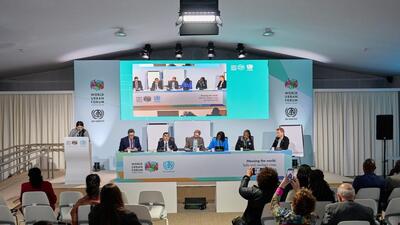
As cities are expected to absorb an additional two billion people by 2050, the World Cities Report 2026, released by UN-Habitat at the World Urban Forum in Baku, Azerbaijan, highlighted the intense pressure on housing, which is already strained by urbanisation, rising land prices, widening inequality and climate change.
Housing prices have risen faster than incomes globally, the report states.
The price-to-income ratios increased from 9.3 in 2010 to 11.2 in 2023, reaching 16.8 in central and south Asia, including India. Rental affordability is also worsening, with 44% of households worldwide spending more than 30% of their income on housing.
Citing reports by the property consultancy firm Knight Frank and the real-estate service provider Magicbricks, the UN report noted that the affordable housing segment in the eight largest Indian cities declined from 52% of new builds in 2018 to just 17% in 2025. This is due to developers prioritising mid and high-end units where profit margins are higher.
Mumbai and Delhi have price-to-income ratios of 14.3 and 10.1, making home ownership unaffordable for households earning the median income. Only a small number have access to formal mortgage finance, which prevents families from buying homes or relying on savings, informal borrowing or extended family networks.
Scale of homelessness quite significant
Quoting data from the Institute of Global Homelessness, the report highlighted homelessness rates translating to 21 per 10,000 people in China, 13 per 10,000 in India, 20 per 10,000 in the United States, and 11 per 10,000 in Brazil.
Climate change: A looming threat
The report states that in 2023 alone, natural catastrophes generated US$280 billion in global economic losses, most of which were uninsured.
Also Read:Iran war diminishes the idea of America, and UN’s relevance
By 2040, climate shocks could destroy 167 million homes.
However, the housing sector has major economic potential.
In India, an additional ₹100,000 in demand for residential construction generates an estimated 2.61 new informal and 0.04 formal jobs, rising to 4.06 jobs (3.95 informal and 0.11 formal) when induced effects are included. This is much more than the United States, where building a typical single‑family home is estimated to support 2.9 jobs, while an average rental apartment generates 1.25 jobs.
Also, as many parts of the world struggle with high or rising construction costs, the per-square-meter costs in India and China are lower, due to economies of scale, than in Chad, Zambia, or Ghana, where construction industries and supply chains are less developed, the report highlighted.
Also, there are indirect impacts through the supply chains that provide materials, services and intermediate inputs; and induced impacts, arising from the re‑spending of income generated by direct and indirect activities. In South Asia, for instance, every US$1 spent in the housing sector can generate up to US$5 in income.
The report stressed the need for the state to deliver affordable housing for all.
During the COVID-19 pandemic, India, Australia, Canada, France and New Zealand implemented housing-focused initiatives as part of their fiscal responses.
According to the report, in India, the national Pradhan Mantri Awas Yojana (PMAY) programme expanded subsidised housing from 0.3% of households in 2010 to 7% in 2023, highlighting supply-side measures mainly beneficiary-led construction and the affordable rental housing scheme, with 12 million houses sanctioned.
The Slum Networking Project in Ahmedabad has been an effective demand-side measure, demonstrating how microfinance contributions and in situ upgrading can enhance ownership and lessen the need for public subsidies.
“A new social contract for adequate and affordable housing is required – a sense of shared responsibility among governments, the private sector and communities to mobilise investment and align the social and economic functions of housing,” said Anacláudia Rossbach, Executive Director of UN-Habitat.
Commenting on the findings, Parul Agarwala, former country programme manager at UN-Habitat India, said the report makes a good case for many measures not yet tested in India, such as pay-as-you-go, rent-to-buy, community cost-sharing, non-profit affordable rental, and others, to transition from informal to formal housing. India’s policymakers and practitioners must recognise the significance of community institutions that support housing delivery, which may lack the scale but have the potential to help plug the growing housing gap, she said.
-

-

-

-