
India and Italy upgraded their relations to a special strategic partnership and pledged to expand two-way trade to €20 billion by 2029 as Prime Minister Narendra Modi and his Italian counterpart, Giorgia Meloni, held talks to strengthen cooperation to bolster the rules-based order amid conflicts and geopolitical turbulence.

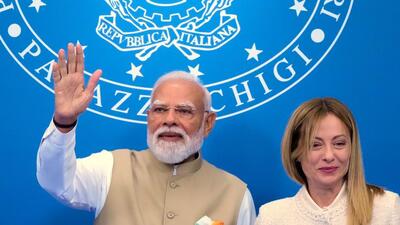
The two leaders expressed concern at the conflicts in Ukraine and West Asia and their impact on the world and emphasised the need for de-escalation and diplomacy to ensure lasting peace. They also called for freedom of navigation and the resumption of shipping through the Strait of Hormuz.
Modi arrived in Rome on Tuesday for the final leg of a five-nation tour aimed at enhancing India’s energy security and bolstering cooperation in key areas such as defence and security, trade and investment, emerging technologies and critical minerals. Modi and Meloni held talks on Tuesday and Wednesday, during which they agreed to leverage the India-European Union (EU) free trade agreement to be signed later this year.
“I am delighted that we are upgrading our relations to a special strategic partnership,” Modi said at a joint media interaction. “The India-Italy joint strategic action plan for 2025-29 provides a practical and futuristic framework for our partnership. We are progressing on it in a timely manner.”
Both leaders emphasised the importance of increasing trade from the current level of €14 billion to €20 in 2029.
Meloni underlined the importance of Italy and India working together to promote freedom of navigation in the Indo-Pacific, as well as to connect this region with the Mediterranean through the India-Middle East-Europe Economic Corridor (IMEC).
Modi noted that India and Italy have been in regular contact over the crises in Ukraine and West Asia and other tensions, and said: “India’s stand is clear – all problems should be solved through dialogue and diplomacy.”
Meloni underscored the need for a lasting and fair peace in Ukraine and expressed the hope that peace negotiations will continue to address the Iran crisis and reach a positive conclusion.
The two sides agreed to establish a mechanism, led by the foreign ministers, to review the joint strategic action plan for 2025-29 and provide strategic guidance for the special strategic partnership. Modi and Meloni also agreed to expand collaboration in trade and investment, defence and security, science and technology, innovation, space, energy, AI, critical technologies, education, and people-to-people ties, the external affairs ministry said.
“Technology and innovation are the engines of our partnership. There is immense potential for cooperation in areas such as AI, quantum, space and civil nuclear energy,” Modi said. “We are working on the India-Italy Innovation Centre to connect startups, research centres and industries of both the countries.”
He added, “Cooperation is increasing between the defence industries of both countries as well as between our militaries. Our defence industrial roadmap has paved the way for co-development and co-production.”
The two leaders welcomed the adoption of a joint declaration of intent and a defence industrial roadmap that will promote partnerships for technological cooperation and co-production and co-development projects, including helicopters, naval platforms, marine armament, and electronic warfare.
Both sides also agreed to launch a dialogue on maritime security to enhance coordination and information exchange. Modi also said both sides will work on shipping, port modernisation, logistics and the blue economy. “We also discussed expanding our win-win partnership to third countries. Moving forward in this direction, we agreed to work on concrete projects in Africa,” he said.
Modi added that India and Italy are unanimous that terrorism poses a serious challenge to humanity and that a joint initiative against terror financing has set an important example for the world. “India and Italy have sent a clear message that responsible democracies not only condemn terrorism but also take concrete steps to disrupt its financial networks,” he said.
The two sides agreed to enhance the mobility of students, researchers and skilled workers, particularly in STEM sectors, and to expand cooperation on skills development in line with labour market needs, including a joint declaration of intent to facilitate the mobility of nurses from India to Italy.
-

-

-

-