
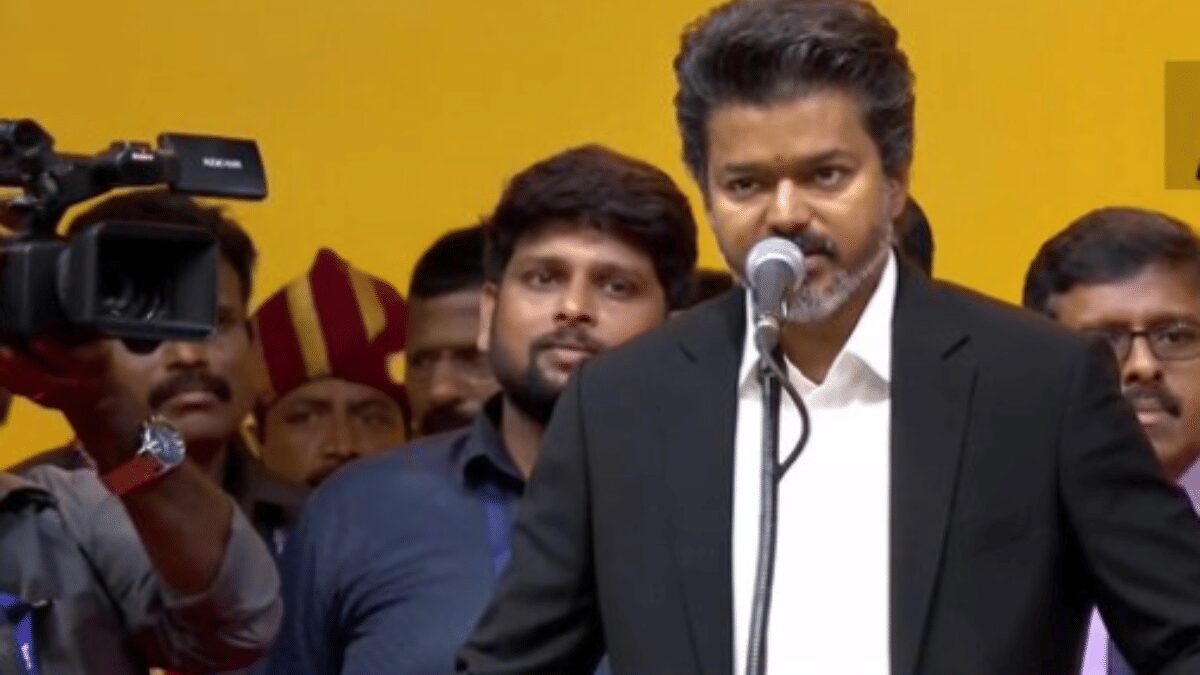
Hyderabad: The elevation of C. Joseph Vijay from actor to chief minister on 11 May has sparked widespread debate in Tamil Nadu among the Tamil and Dravidian intellectuals. On television debates and in Tamil periodicals, the conversation is about whether Vijay is the ideological heir to the Dravidian movement or the harbinger of a modernised variant of this ideology, representing Generation Z and the realities of their times.
While politicians and the public remain at odds over what he stands for and who he represents, the dramatic manner in which he took the oath at the swearing-in ceremony dispelled doubts about whether he would carry forward the charismatic appeal of former actor-chief ministers M.G. Ramachandran and J. Jayalalithaa.
But, the Dravidian establishment is closely watching to see if he has any ideological traces of E.V. Ramasamy Naicker, or Periyar, considered the architect of the Dravidian movement in Tamil Nadu.
Their anxiety is palpable because political history suggests that the rise of every Tamil Nadu chief minister—from the days of the British-ruled Madras Presidency to the post-Independence period—has often been tied to Dravidian ideology.
For the first time since 1967, a fledgling political outfit has outmanoeuvred its political majors, the Dravida Munnetra Kazhagam (DMK) and the All-India Anna Dravida Munnetra Kazhagam (AIADMK).
The Tamilaga Vettri Kazhagam (TVK), the party Vijay founded in 2024, won 108 of the 234 seats in the Tamil Nadu Assembly, dismissing the DMK-led government and leaving the AIADMK in a shambles.
“For the first time, the threat is from within. Until now, it was the Hindi heartland-headquartered Bharatiya Janata Party (BJP) or the archaic Congress who were portrayed not just as rank outsiders but also those who threatened the Tamil language, identity, and social order,” said B.R. Sreenivasan, a commentator on Dravidianism.
Together, the Tamil language, identity and its distinct socio-political order form the core of the Tamil psyche. The pride in this trinity is rooted not just in their 2,500-year-old language and culture but also in the century-old complex, multi-layered consciousness called Dravidianism, said analysts and commentators who spoke to ThePrint.
The Dravidian movement started as a deliberate push to assert the Tamil language, and oppose Brahminical dominance in pre-Independence years.
It later metamorphosed into a broader ideology advocating social justice issues, including gender equality, educational reforms, and economic redistribution.
Pre-Independence: the British, Adigal, and Periyar
Contrary to popular belief, the history of Dravidian thought did not begin with the fiery iconoclast Periyar.
“The intellectual foundations of this movement were established in the latter half of the 19th century by a Saivite intellectual named Maraimalai Adigal,” Dr Arvind Kaushik, a PhD in Philosophy and Religious Studies, wrote in a five-part series in on Dravidianism in Indica Today.
Adigal, born in 1876 in Nagapattinam in Tamil Nadu, and educated in Christian missionary schools, is considered one of the foundational thinkers of the Dravidian movement.
He regarded Saiva Siddhantam as the original Dravidian religion and propagated it as Tamil monotheism, asserting that Saivism formed the basis of Tamil civilisation.
Adigal also sought to de-Sanskritise the Tamil language by spearheading the Thani Tamil (stand-alone Tamil) movement and was one of the first proponents of Tamil Nationalism throught which he who sought to de-Brahminise Tamil society and assert Tamil supremacy over Sanskrit.
But, Kaushik, an Assistant Professor at the Amrita Vishwa Vidyapeetham, says Adigal’s political theory of Tamil exclusionism and Dravidianism was shaped by the British understanding of India.
“Adigal, who studied under Christian missionaries, imbibed the ‘nation-language-religion’ hypothesis from British missionary Robert Caldwell and civil servant Francis Whyte Ellis, who went one step further in postulating and espousing the Aryan-Dravidian theory to divide Indians, making them easier to convert and rule,” Dr Kaushik writes in the second part of his Dravidian series.
To Adigal’s de-Sanskritisation and ideological distancing of Brahmins from Tamil society, Periyar added anti-Hindi sentiment.
Periyar, who was just three years younger than Adigal, met him during the first anti-Hindi agitation in 1938, when C. Rajagopalachari, the then Premier (prime minister) of the Madras Presidency, imposed compulsory learning of Hindi in all schools. At the iconic Marina Beach in Madras (now Chennai) on 11 September 1938, Adigal and Periyar raised the slogan “Tamil Nadu Thamizharukke”, which means Tamil Nadu is only for Tamils.
A year-long protest and agitation that followed is often referred to as a watershed moment in Tamil Nadu’s history for two reasons.
It was during this movement that Neelambigai Ammaiyyar, Adigal’s daughter, conferred the title “Periyar” (The Elder) on E.V. Ramasamy, and Periyar took forward the Dravidian movement, which until then was only a Tamil renaissance and reform movement.
Periyar, who had already spearheaded the ‘Self-Respect Movement’ in Tamil Nadu in 1925, joined the Justice Party in 1939 to lead the Dravidian movement.
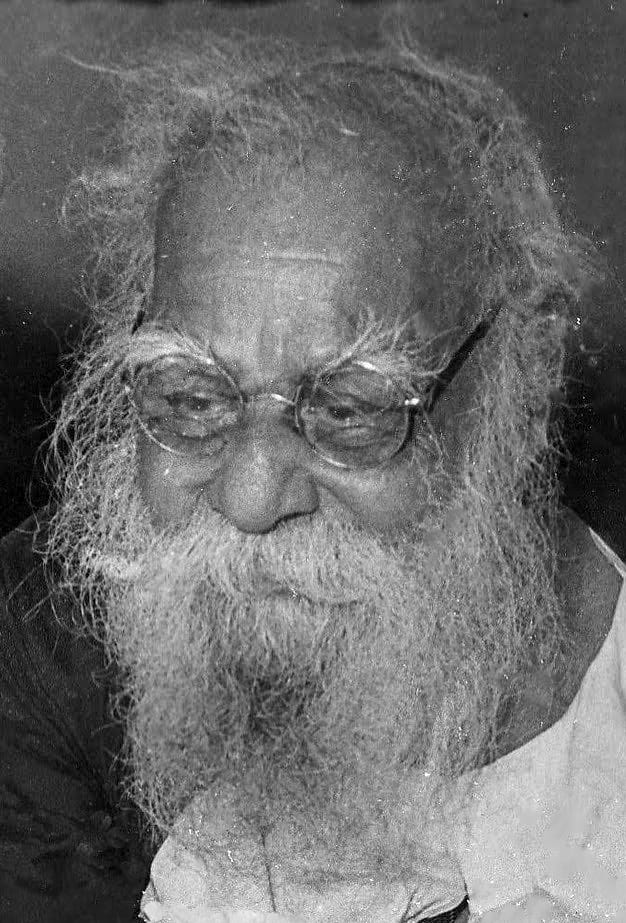

The Justice Party and its role in Tamil Nadu’s politics sit as a powerful interlude between Adigal’s powerful Saivaite Tamil Nationalism and Periyar’s Social Reform Movement (SRM).
If the SRM challenged caste discrimination, promoted social equality, gender rights, and rational thought, the Justice Party, or the South Indian Liberal Federation, as the party was originally called, was established in Madras (now Chennai) on 20 November 1916, as a political outfit to represent the interests of Non-Brahmins in the Madras Presidency.
It was the first political outfit formed by 30 individuals to counter the Brahminical dominance in politics. Justice was the first newspaper the party had as a propaganda tool.
The Justice Party dominated politics in the Madras Presidency for 17 years from its first election in 1920 to 1937, representing the interests of non-Brahmins, until it lost the 1937 election in Tamil Nadu and the Congress regained ground under Rajaji.
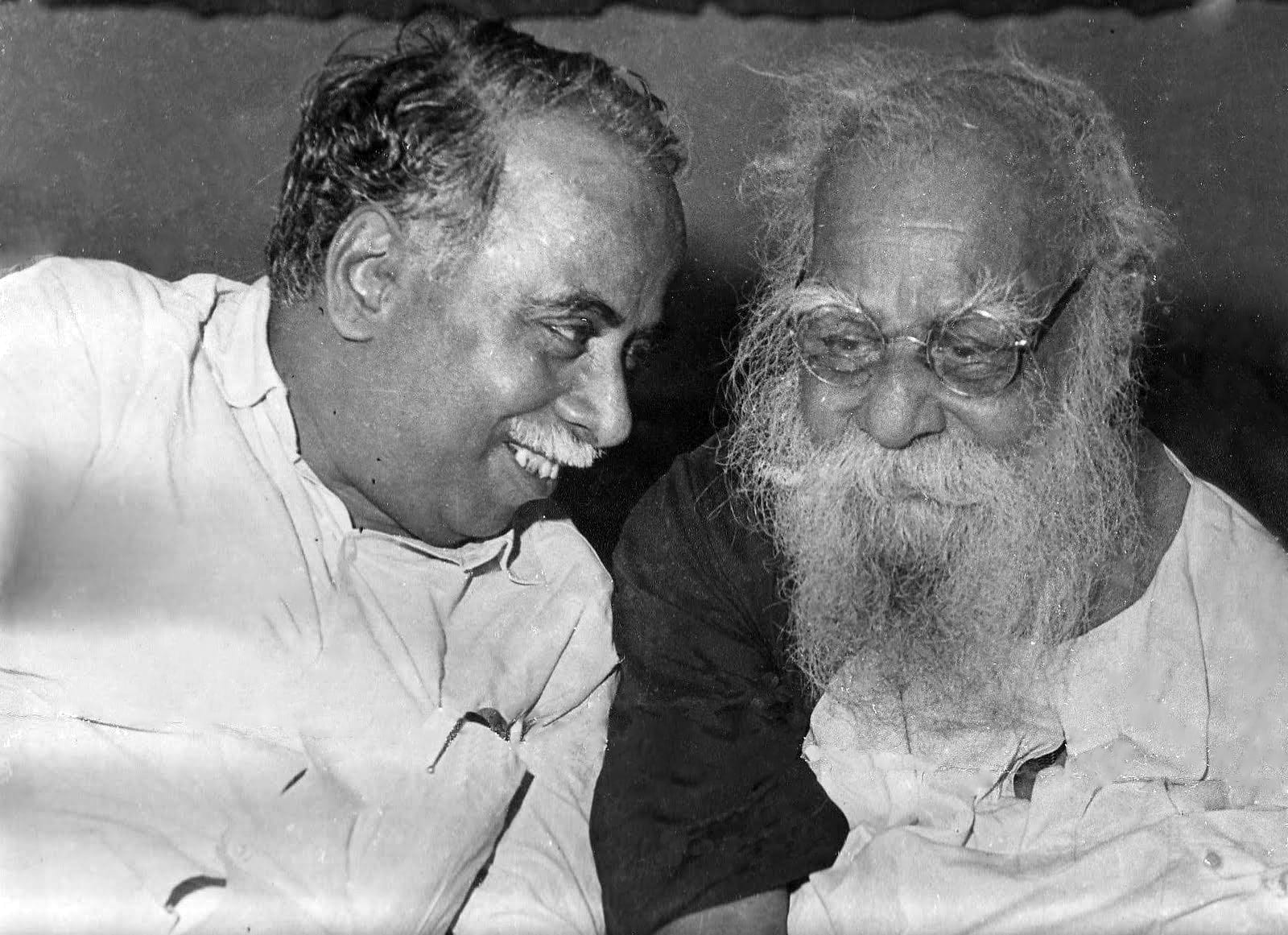
Around the same time, Periyar found an apprentice in C.N. Annadurai (Anna) and recruited him into the Justice Party.
Though Anna considered Periyar a mentor, embraced Dravidianism, and even edited the party’s periodicals, Viduthalai and Kudi Arasu, he fell out with Periyar over ideological differences. He was opposed to renaming the party Dravida Kazhagam and disagreed with keeping it as a radical, reform-oriented social outfit rather than a political party aimed at democratic participation. Eventually, in 1949, Anna transformed the Dravida Kazhagam, established the Dravida Munnetra Kazhagam, and became its first general secretary.
Where Tinseltown met political Dravidianism
When Anna broke away from Periyar’s radical DK to the politically aspirational DMK, he successfully moderated the DK’s radical ideology.
In 1957, in the first election after the reorganisation of states based on language, the DMK won 14 seats in the 205-seat Assembly, and in the 1962 election, it won 50 seats, with the Congress still firmly intact under K. Kamaraj. The total number of seats was 206 in 1959.
Anna, who until then championed the cause of Tamil separatism, had to abandon the demand. He had to contend with a more feasible claim for greater state autonomy because India was already fighting China. Also, when the Indian Constitution came into effect in 1950, it laid down rules for all political parties to conform to the idea of India as a nation, thereby forcing Annadurai to abandon all claims for a separate state.
“Anna was forced to drop the idea of a separate Dravida Nadu because the then Indian PM Pandit Jawaharlal Nehru threatened to wage a civil war if there was any attempt by the South to secede. India was going to war with China, and in 1962, Nehru did not want any demands for further Balkanisation of the country,” said political scientist Vignesh Karthik, author of The Dravidian Pathway.

Nehru’s firm warning, India’s loss to China, and the Congress party’s subsequent defeat to the DMK in Tamil Nadu led Anna to revise the Dravidianist ideology once again.
Vignesh Karthik says the compulsion of electoral politics made Anna change tack. Rather than dismiss religion outright, as Periyar did, he began espousing rationality in belief.
Murasoli, the DMK’s mouthpiece, started promoting the idea of “Onnre Kulam Oruvaney Devan” (One community, one God) and stopped attacking belief in God. Anna realised that in a state with more than 38,000 temples, “one could ill afford to be anti-Hindu”.
“Anna even aligned with Rajaji’s right-wing Swatantra Party to defeat the Congress, something Periyar would never have done. The DMK swept the 1967 election in Tamil Nadu, and there was no looking back after that,” Vignesh said.
Once it came to power, the DMK merged cultural populism with Dravidian ideology, presenting it through the framework of Tamil cultural nationalism and effectively disseminating its ideas through Tamil cinema. The DMK came to power for the first time in 1967 with an alliance of six parties, achieving an absolute majority in the 234-member House and trouncing the Congress led by K. Kamaraj, which was in power.
But, less than two years into his office, Annadurai died in February 1969. M. Karunanidhi, all of 45, was unanimously elected DMK Legislature Party leader, paving the way for him to succeed Annadurai as chief minister.
The DMK government, which began in 1969 under M. Karunanidhi, continuously ruled Tamil Nadu for nearly seven years before being dismissed by the Central government in January 1976.

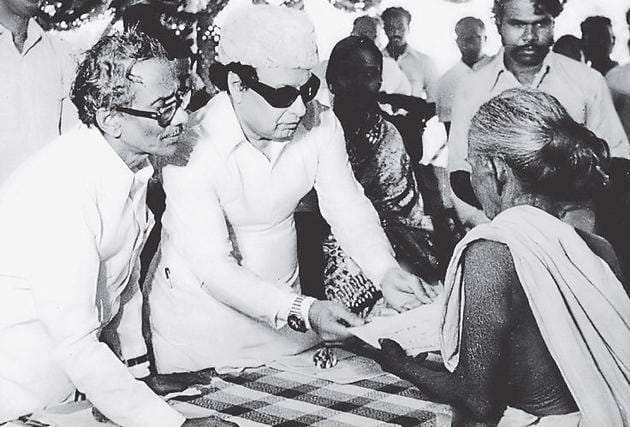
Anna and M. Karunanidhi, both lyricists and screenplay writers celebrated for their command over the Tamil language, lent their voice to movie star M.G. Ramachandran, who used his popularity to amplify the Dravidian political ideology.
The party strategically used cinema as a powerful medium of mass propaganda to communicate its messages of social justice, anti-Brahminism, and Tamil pride to the people, helping the DMK evolve into a broad-based mass movement.
During the early propaganda era of the 1950s and 60s, Annadurai scripted Velaikkari (house help), a film that directly critiqued the zamindari system and the greed of the rich, introducing elementary principles of social equality and self-reliance to theatre audiences.
Then came Parasakthi, often considered a watershed moment of Dravidian political cinema.
Scripted by M. Karunanidhi and starring the famous Sivaji Ganesan, the film featured a legendary courtroom monologue that fiercely condemned religious hypocrisy, casteist social hierarchies, and blind faith.
Later, MGR’s Nadodi Mannan, Enga Veettu Pillai, and Aayirathil Oruvan were massive commercial hits. They heavily integrated DMK party symbols (the Rising Sun), its red and black colours, even as the egalitarian dialogues served as de facto election manifestos.
Even as Kamaraj mocked the presence of actors in governance, Murasoli Maran, a former central minister from the DMK, said that the DMK’s movies reflected the faces of both the past (the rich language and culture of Tamils) and the future (with social justice).
Marrying ideology to cinema helped Anna and his colleagues simultaneously implement social reform, economic development, and welfare measures, helping Tamil Nadu rise in all parameters.
“Together, C.N. Annadurai, M. Karunanidhi, and MGR transformed the Dravidian movement from a social reform crusade into a dominant political force by enacting populist social justice reforms and advocating for state autonomy,” S. Narayan, a former IAS officer who was economic adviser to former Prime Minister Atal Bihari Vajpayee and also served in key positions in Tamil Nadu, told ThePrint.
“While Annadurai pivoted towards electoral politics, Karunanidhi institutionalised social justice via policy, and MGR popularised the ideology through cinema and welfare schemes,” he added.
After Anna died in 1969, Karunanidhi took over as the elected leader of the DMK party and was sworn in as chief minister in a few weeks. MK, as Karunanidhi was called, had the support of MGR, who played an active role in MK’s rise.
But, the victory did not last long.
In the aftermath of the 1971 victory, the party experienced an important split when MGR was suspended from its primary membership because of internal clashes and his public demands for the party to disclose its financial accounts.
MGR, who understood party structure and organisation building, went on to found a new outfit named after Anna, signalling that he was the right heir to Annadurai’s legacy. Also, the dismissal of firebrand actor Sivaji Ganesan from the DMK after he visited the Tirumala shrine did not go down well with a faction of the DMK, who preferred MGR over Karunanidhi.
The era of DMK’s offspring and offshoots
When the AIADMK came to power in its very first election, MGR proved to be the champion of the poor people and a saviour, roles he portrayed to perfection in his films. The AIADMK won three elections on the trot in 1977, 1980, and 1984. It positioned itself as a dominant party among the people, particularly among the underprivileged sections and women.
MGR and his protege Jayalalithaa, the convent-educated film star, who took over from her mentor and former fellow actor in 1987, stabilised the AIADMK, rendering it a credible alternative to the DMK.
“MGR and Jayalalithaa’s brand of Dravidianism was remarkably different from Anna’s and Karunanidhi’s. For starters, MGR and Jayalalithaa were devoted to both the Hindu gods and to the nation. That MGR decided to prefix his party’s name with the words All-India was an indication that he did not imbibe the secessionist idea from Periyar and Anna,” political commentator B. Saravanaprasad told ThePrint.
“While MGR was often seen at the Kollur Mookambika temple in Karnataka, Jayalalithaa, being a Brahmin, was deeply devoted to the Vaishnavite shrine in Srirangam and sanctioned grants for preserving its heritage,” he added.

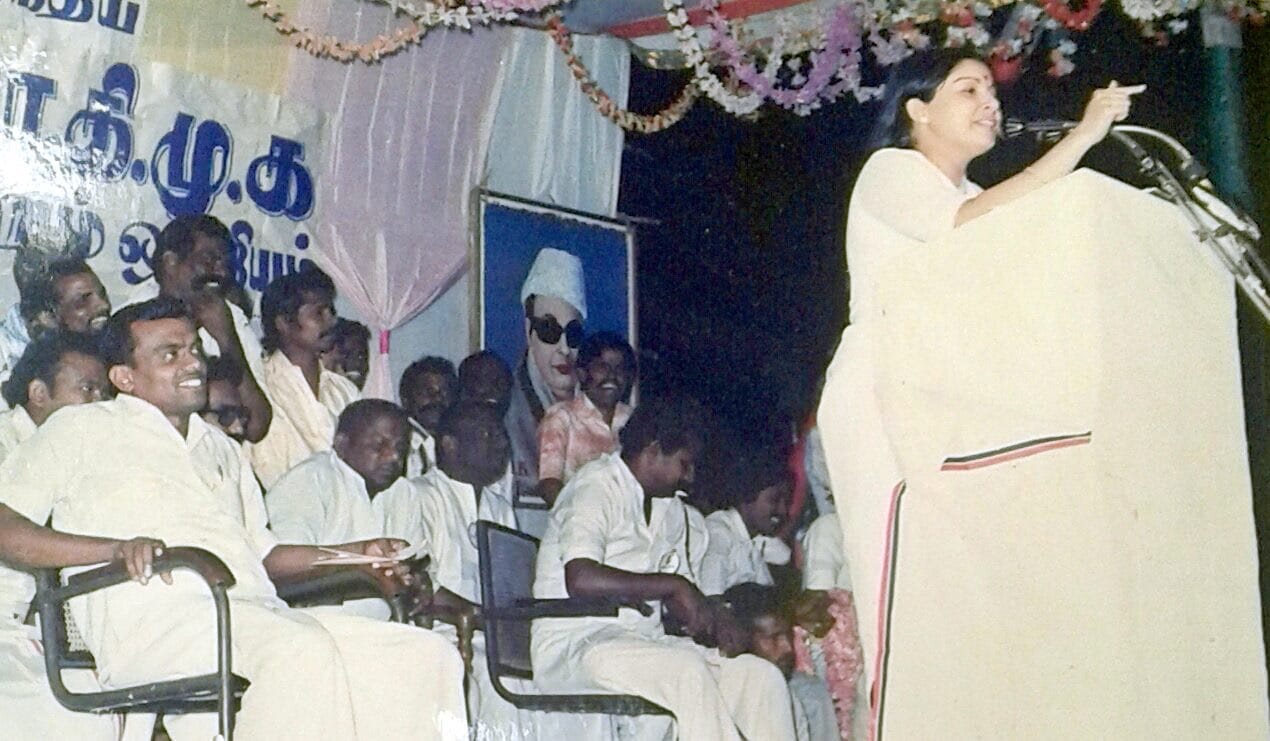
During her rule and her firm term from 1991 to 1996, Jayalalithaa openly advocated building the Ram temple in Ayodhya, even as Karunanidhi mocked the Ram Setu bridge believed to connect India and Sri Lanka. Departing from the decades-old anti-Centre stance, Jayalalithaa, like her mentor, MGR, believed in cordial Centre-state relations.
During the Bharatiya Janata Party’s rule, Jayalalithaa passed the Tamil Nadu Prohibition of Forcible Conversion of Religion Act in October 2002, only to repeal it in 2004 because of pressure and intense backlash from Dalit and minority groups.
Jayalalithaa is remembered even today for the ‘Annadanam’ food distribution scheme she reinstated in Tamil Nadu’s famous temples.

“By the late 1990s and the 2000s, the era of stable alternation between the DMK and the AIADMK, there was little scope for any anti-Hinduism because the era of welfare politics took over completely. With Tamil Nadu being one of the most industrialised and literate states, there was little scope for social justice to be an electoral issue anymore,” Narayan said.
Beginning in the late 1990s, the Centre’s suspicion over Tamil Nadu’s secessionist demands softened, with both the DMK and AIADMK forming alliances with the BJP and the Congress, signalling a further dilution of the Dravidian ideology.
However, Tamil Nadu has periodically seen political players since the 1990s seeking to capitalise on the shortcomings of the legacy Dravidian parties and present an alternative, Dravidian commentator Subagunarajan said.
Thol Tirumavalavan took charge of the Viduthalai Chiruthaigal Katchi (VCK) during the Sri Lankan LTTE movement in the early 1990s and advocated the cause of Tamils in the island nation even as he stood for Dalit causes in Tamil Nadu.
Vaiyapuri Gopalsamy (Vaiko) established the Marumalarchi Dravida Munnetra Kazhagam (MDMK) in May 1994 after he was expelled from the DMK. Vaiko’s MDMK was set up purely to resist Karunanidhi’s efforts to anoint his son, Stalin, as his heir.
In the 2000s, actor Vijayakanth, a Telugu Naidu, followed the footsteps of his senior actors and established the Desiya Murpokku Dravida Kazhagam (DMDK) in 2005.
While he was successful in capturing the votes of a significant section of Telugus who settled in Tamil Nadu, his party could not sustain itself in the years thereafter.
Tamil filmmaker-turned-politician Sebastian Simon, also known as Seeman, established the Naam Tamilar Katchi (NTK) in May 2010, bringing back the issue of Tamil nationalism.
“From Tamil separatism to a separate Tamil nationalism, the entire cycle played itself out like a cinema reel. The smaller political parties, called ‘Half Party’, tried at best to provide some respite but no permanent resolution to the dominance of the two Dravidian majors,” said Subagunarajan.
However, 60 years later, the so-called “Two-and-a-Half Party System” and the era of stable alternation were broken by actor Vijay’s TVK, leaving not just the Dravidian majors but also the BJP and the Congress searching for answers.
Cult figures
That the BJP won just one seat and the Congress finished poorly with just five seats has once again raised questions about the relevance of national parties in Tamil Nadu.
“What have they to offer?” asked S. Narayan.
“The BJP’s brand of Hindutva and development will not work in Tamil Nadu since it is an industrialised state. It was never invaded by the Mughals, so the Hindu-Muslim divide card cannot be played here. Second, both the national parties will have to change their constitution to allow a cult-like figure to rise and capture the imagination of the people,” he added.
Many political observers say that the absence of a cult figure from 2016 to 2026 also contributed to Vijay’s rise in the state.
“In Tamil Nadu, the cult trumps ideology; it trumps welfare politics, and all ideas of religion, caste, and nation are done away with,” said Saravanaprasad.
However, with Vijay’s rise, the debate on ideological preservation has resurfaced.
Some said Vijay’s emergence suggests the dilution of the Dravidian ideology. But, traditional Dravidians rooted in the system declare the new party’s electoral alliance a signal of a slow disintegration and discontinuation of the ideology.
Commentators ThePrint spoke to said the relevance of the ideology in the changed socio-economic landscape of an industrialised and urbanised Tamil Nadu is being questioned.
Renowned development economist A. Kalaiyarasan said Vijay’s win represents a mandate against the previous government for losing touch with the people, not an end to the “Dravidian model” ideology.
However, there is staunch opposition to this idea.
Subagunarajan called Vijay neither a rationalist nor a nationalist. He said the actor-chief minister epitomises the failings of the Dravidian movement and projected himself as a messiah, taking advantage of a weakened order.
That Vijay is a worshipper has unsettled many within the Dravidian ecosystem. And that his electorate comes from across faiths has only added to their unease.
Vijay’s political contest was about ending what he called the “evil DMK rule” to describe the party that ruled until the April 2026 election.
Editors of both the Dravidian mouthpieces, their television channels, and production houses are wary of Vijay’s appeal among the youth and women, and believe that welfare removed from ideology may not stand the test of time.
However, political experts said the fact that the TVK depended on the support of the DMK-led Secular Progressive Alliance (SPA) to prove its majority could be a sign that Dravidianism is still relevant, even if it remains on the margins.
(Edited by Sugita Katyal)
-

-

-

-