
Foreign ministers of Quad member states will gather in New Delhi on Tuesday for a key meeting against the backdrop of heightened geoeconomic churn due to the West Asia conflict and uncertainty over the grouping’s summit, with a focus on advancing cooperation to ensure the Indo-Pacific region remains free and secure.

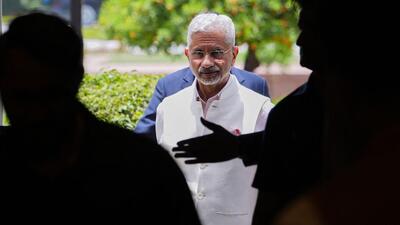
External affairs minister S Jaishankar will join Australian foreign minister Penny Wong, Japanese foreign minister Toshimitsu Motegi and US secretary of state Marco Rubio for the first Quad foreign ministers’ meeting in almost a year, and the four countries will seek to impart fresh momentum to the grouping’s activities, people familiar with the matter said.
Ahead of the Quad meeting, Jaishankar held bilateral talks with Motegi on Monday to review bilateral cooperation, especially on economic security, and to assess regional and global developments, including the West Asia crisis that has disrupted energy supplies for both India and Japan.
Jaishankar said in televised remarks at the start of the meeting that developments in West Asia are important because India and Japan are energy-importing, major trading nations with maritime interests. Economic security issues have become a concern for all major economies, he said.
Motegi noted that the world is facing the “most significant structural change” since World War 2 because of a “shift in the balance of power and the intensification of conflicts”. He noted that India and Japan share an obligation and responsibility to shape the international order.
He also referred to Japan’s recent update of its “Free and Open Indo-Pacific” policy that is aimed at helping countries “obtain resilience and capabilities” to decide for themselves in domains such as economy, security and society, and said Tokyo will advance cooperation so that the entire region can become more resilient and prosperous.
“To that end, Japan and India need to serve as the driving force of such an initiative, and I look forward to working closely with you and also through the Quad framework,” Motegi said.
Wong, ahead of her arrival in India, described the Quad in a statement as a “vital partnership” of four nations shaping a peaceful, stable and prosperous future for the Indo-Pacific in uncertain times. The four Quad member states are “delivering concrete outcomes” on shared interests such as maritime security, critical minerals supply, infrastructure development and disaster relief, she said.
The Albanese government, she said, will work even harder in new and existing coalitions such as the Quad to build “Australia’s future in an ever less stable world”.
Wong will also participate with Jaishankar in the Australia-India foreign ministers’ framework dialogue to deepen cooperation in trade, investment, defence, maritime security, the climate transition, strategic technology, and education and skills.
India last hosted a Quad foreign ministers’ meeting in 2023, and the four ministers most recently met in Washington in July 2025. Though Rubio’s first official engagement after becoming secretary of state last year was a Quad foreign ministers’ meeting, the Trump administration’s interest in the grouping has wavered, especially after a downturn in India-US ties over differences on trade and tariff policies.
The last Quad Leaders’ Summit was held in the US in September 2024, and India had to postpone a summit planned for last year because President Donald Trump did not commit to travelling to the country for the meeting. Convening the Quad Leaders’ Summit will be one of the key issues on the agenda of the foreign ministers’ meeting, the people said.
Jaishankar told a joint news conference with Rubio on Sunday that it is important for cooperation among the four “maritime democracies” in the Quad to continue, as they want “business to be conducted and life to run on the basis of international law and market practices”.
-

-

-

-