This sponsored article is brought to you by Master Bond.
Outgassing is the release of volatile substances from a cured adhesive over time. These released materials, which may include residual solvents, unreacted monomers, or other chemical species, can deposit on nearby surfaces, causing contamination that interferes with sensitive components.
What Is Outgassing and How Is It Measured?
The industry standard for measuring outgassing is ASTM E595, developed by NASA. This test exposes a cured sample to 125 °C at high vacuum (10⁻⁵ to 10⁻⁶ torr) for 24 hours, measuring Total Mass Loss (TML) and Collected Volatile Condensable Materials (CVCM). To meet NASA low outgassing requirements, materials must exhibit less than 1 percent TML and less than 0.1 percent CVCM.
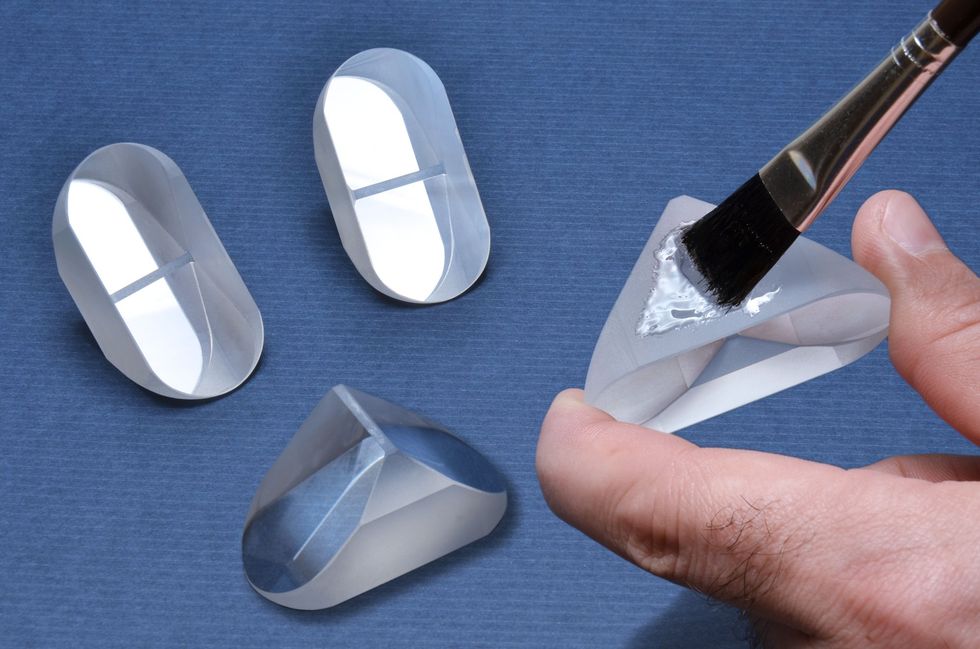
Optical assemblies need contamination-free bonding and prevention of fogging the optics to maintain clarity. High-vacuum scientific equipment, semiconductor manufacturing tools, and aerospace electronics also demand low outgassing materials.
Key Applications
Low outgassing adhesives are essential wherever contamination could compromise performance and this is particularly relevant for space and satellite systems. Optical assemblies, including cameras, telescopes, and laser systems, need contamination-free bonding and prevention of fogging the optics to maintain clarity.
High-vacuum scientific equipment, semiconductor manufacturing tools, and aerospace electronics also demand low outgassing materials. Even terrestrial optical devices benefit from reduced outgassing to ensure long-term reliability.


Ensuring Low Outgassing Performance Through Proper Handling
Achieving specified outgassing performance requires attention to storage, mixing, and curing. For two-part systems, use the correct mix ratio and mix thoroughly to ensure complete reaction. Follow recommended cure schedules — adding heat, even at modest temperatures of 150-200 °F, significantly improves cross-linking and reduces outgassing. For UV-curable adhesives, ensure complete cure by using the correct lamp wavelength (typically 365 nm), adequate intensity, and proper exposure time with no shadowed areas.
Troubleshooting Outgassing Issues
If contamination appears on optical surfaces or outgassing test results are higher than expected, an incomplete cure might be one of the root causes. The first step is to verify that the adhesive has fully hardened to its specified Shore hardness. The next step is to consider adding or extending heat cure to improve cross-linking.
Master Bond Product Recommendations
Master Bond offers a range of adhesives meeting NASA low outgassing requirements. EP30-2 and EP21TCHT-1 are some examples of two-part epoxy systems that have been successfully deployed in demanding vacuum applications, including ultra-high vacuum environments.
For applications requiring UV cure, Master Bond provides specialty UV formulations such as UV16 meeting ASTM E595, as well as dual-cure systems (UV plus heat) such as UV22DC80-10F for assemblies where shadows prevent complete UV exposure. These dual-cure products initiate with UV light and complete curing with heat as low as 180 °F (80 °C).