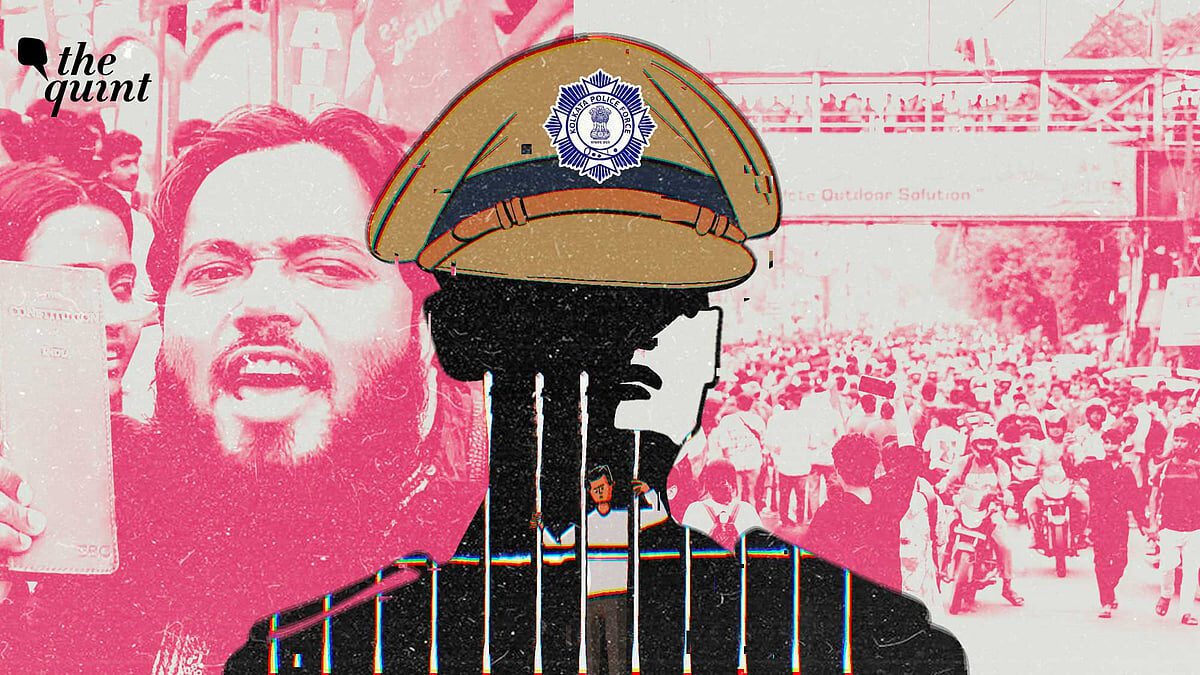
Certain he hadn’t been involved in any violence, Hussain accompanied the cop to the police station on his own bike. But, once he got there, he wasn’t interrogated. Instead, he was straighatway given an arrest memo. “They asked me to sign a document, clicked (my) photos, and sent me to lock-up,” he recounted.
Hussain was among the 18 persons arrested by Kolkata Police in wake of the march. Incidentally, 17 of the 18 arrested persons were Muslim.
On 27 July, Hussain and four others were taken to Dorina Crossing by the police to “reconstruct” the incident. Hussain alleges that he and the others were paraded barefoot on the streets.
A total of seven FIRs, accessed by The Quint, have been lodged pertaining to the incidents of 24 July. The first was filed suo motu by Hare Street PS based on a forwarding report by the police.
An eyewitness, who spoke on condition of anonymity, told The Quint, “The march had been going peacefully until one chunk of the protesters reached Dorina Crossing. The police used lathi charge, batons, and tear gas to disperse the crowd. It was chaos, and several persons got injured.”
Other FIRs were filed by journalists from Ei Samay, R Plus News, Aaj Tak, TV9, and News18 channels who sustained injuries and were treated at SSKM Hospital. Defending lawyers pointed out that the alleged assault of the journalists wasn’t mentioned in the original FIR.
“I saw a journalist get heckled and harassed by a group of protesters—not visibly identifiable with any group, and without any visible provocation on the former’s part. But he was also saved by other members of the protest itself, not the police,” independent photographer Shubhadeep Dey, who had been covering the protests, told The Quint.
Dey and others who attended the protest believe these “outsiders” were politically motivated to cause ruckus at the protest. “Many of us strongly feel there were agents of the ruling party in the crowd who instigated the agitation.”
The 18 protesters have been booked under several sections of the Bharatiya Nyaya Sanhita (BNS), pertaining to rioting, obstruction in public way or line of navigation, voluntarily causing hurt to deter public servant from duty, punishment for unlawful assembly and being armed with a weapon, among others.
“We have gone through photos, videos, and CCTV footage. Thorough forensic investigation has been done. Some people who are known anti-establishment elements were part of the march. We are only after them, not students,” an officer from Hare Street PS said, requesting anonymity.
However, the political response to the arrests immediately took on a communal colour, raising questions on the neutrality of the investigation.
Announcing the names of the first five accused, West Bengal Chief Minister Suvendu Adhikari alleged in the state Assembly that those arrested were not “students” or related to the CJP protests, but “anti-national elements” and “foreign-funded Jamatis” who were behind the clashes with police. He also called the protesters “shukravar-vari” (Friday community), a reference to the fact that the protests were being held on Friday, the weekly day of Jumma prayers for Muslims.