
Thanks to La Nina conditions – it is the cyclical cooling of the equatorial Pacific Ocean that has a cooling effect on global average temperature – the global average temperature was not ranked very high in the December-February period. Each of the three months from December 2025 to February 2026 was ranked only the fifth warmest. This relatively cool period is now coming to an end, an HT analysis of temperature data for March and April suggests. This is because the impact of La Nina conditions is now wearing off.

That the latest December, January, and February months were ranked fifth warmest would not, under normal circumstances, suggest cool weather. But they are likely to have appeared cooler than the immediately preceding December, January, and February months. This is because every month from June 2023 to November 2025 is so far ranked among the top three warmest on record.
However, the three-month cool weather streak ended in March, which was ranked the fourth warmest March month, according to the ERA5 dataset published by the European Centre for Medium-Range Weather Forecasts (ECMWF). This is also the case for the April so far. The first 25 days of April this year are ranked fourth warmest in the ERA5 data.
To be sure, although April is ranked the same as March, there has been a shift in April as compared to March. As the accompanying chart shows, March 2026 was 0.09°C cooler than the third ranked March month (recorded in 2016). April 2026, on the other hand, is much closer to the third ranked April month (also recorded in 2016): just 0.01°C cooler.
Chart 1
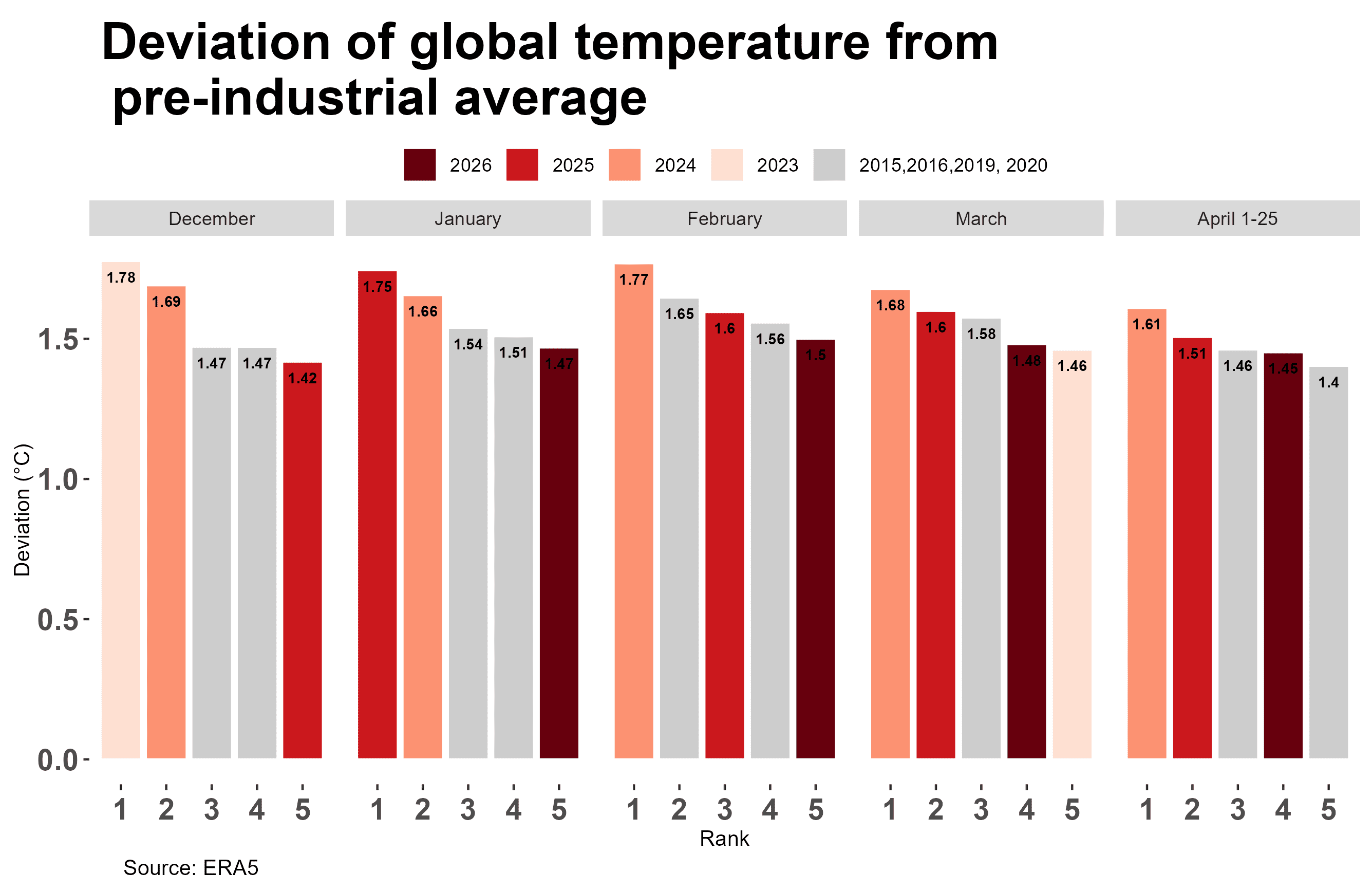
In fact, it is possible that by the time the month ends, April 2026 is ranked the third warmest April month. This is because April 2016 overall was 1.44°C warmer than the pre-industrial average, while April 2026 so far is 1.45°C warmer than the pre-industrial average. This means that the remaining five days of April need to average 1.38°C deviation from the pre-industrial average for April 2026 to be tied with April 2016. Averaging this level of warming is within the realm of the possible given the trends in the past week.
Chart 2
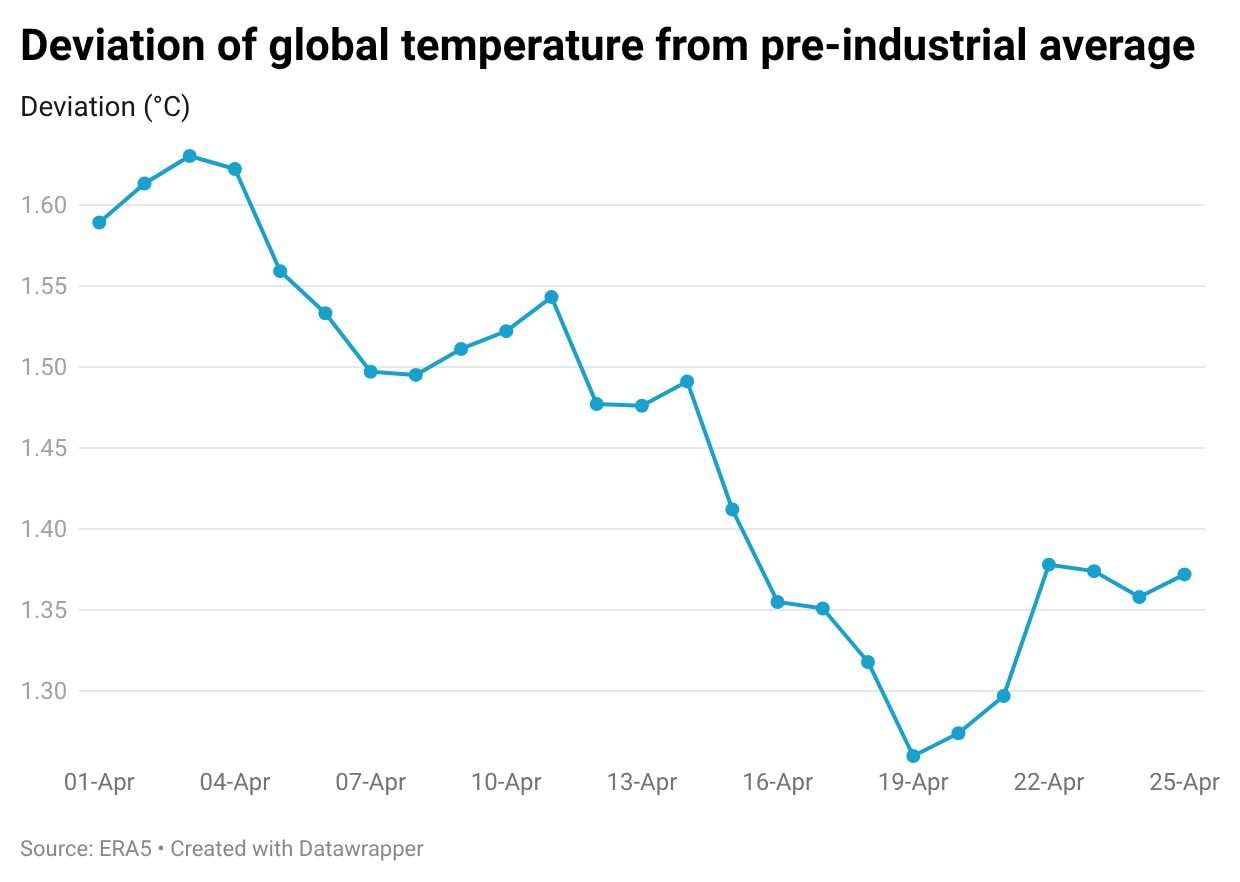
Why is warming relative to pre-industrial average inching up again? One possible reason is that the impact of La Nina is wearing off.
La Nina conditions are tracked by measuring the average deviation of sea surface temperatures (SST) in the 5N-5S, 170W-120W region (Nino 3.4 region) from a 30-year average. When this region shows a negative deviation of 0.5°C or more, La Nina conditions are said to be in place. When the region shows a positive deviation of 0.5°C or more, El Nina conditions are said to be in place, which has the opposite impact of La Nina, a warming in global average temperature. When the deviation is under 0.5°C, neutral conditions are said to be in place.
Data Shows that the Nino 3.4 region had entered neutral conditions towards the end of January. This did not lead to an immediate spike in air temperatures because it takes time – around two-four months — for changes in SSTs to impact air temperatures. April temperature data suggests that that the lingering impact of La Nina is now coming to an end.
Chart 3
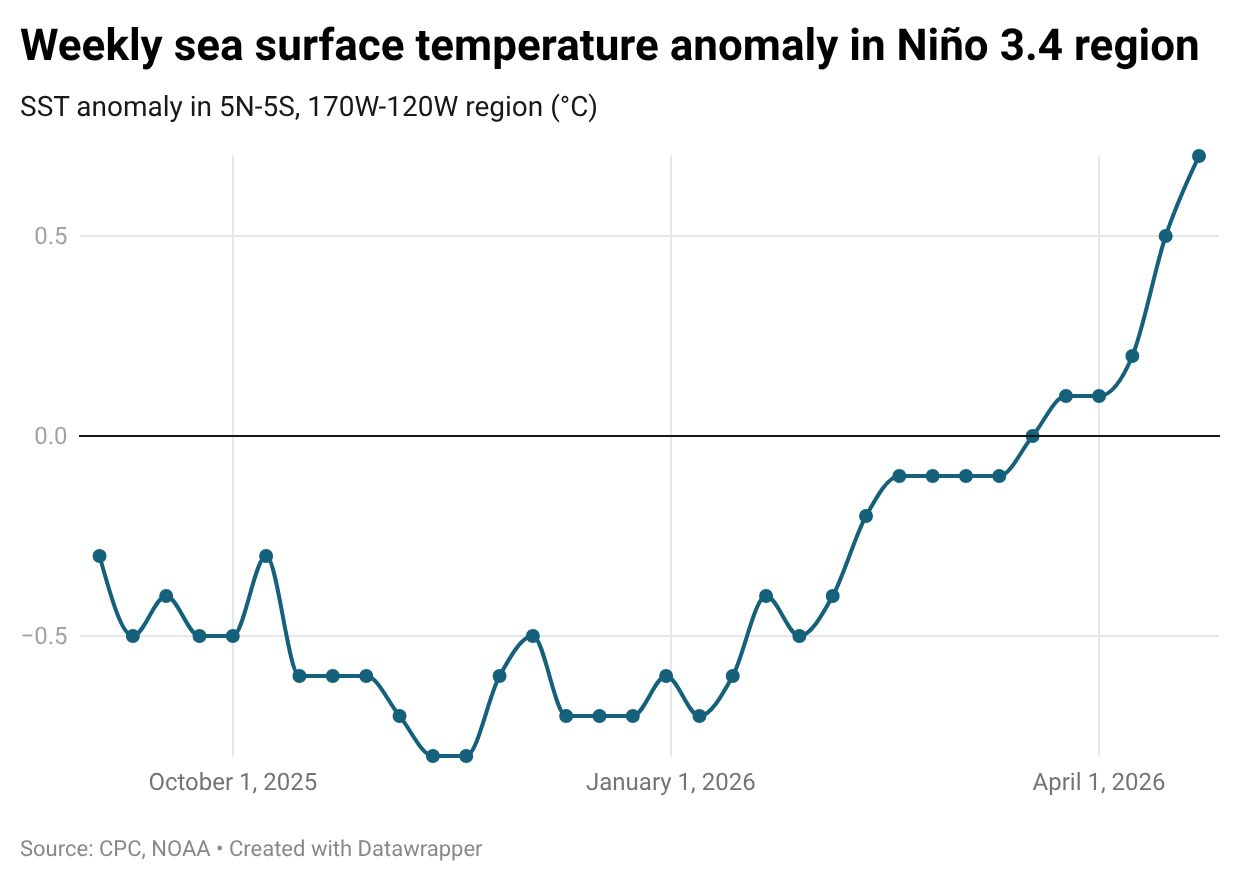
To be sure, the latest Nino 3.4 temperature data shows that even neutral conditions have likely ended. El Nino conditions were in place in the two weeks ending April 22. If these conditions persist, an El Nino might take hold a month earlier than expected in the early April forecast. This could mean new temperature records being made as soon as June.