

New Delhi: The Congress-led alliance has returned to power in Kerala. But it appears to be only a minor deviation in an otherwise largely consistent, downward trajectory of its presence in state assemblies, shows ThePrint’s analysis of the party’s MLA strength across states post 2007—the year Rahul Gandhi began calling the shots after his appointment as All India Congress Committee general secretary.
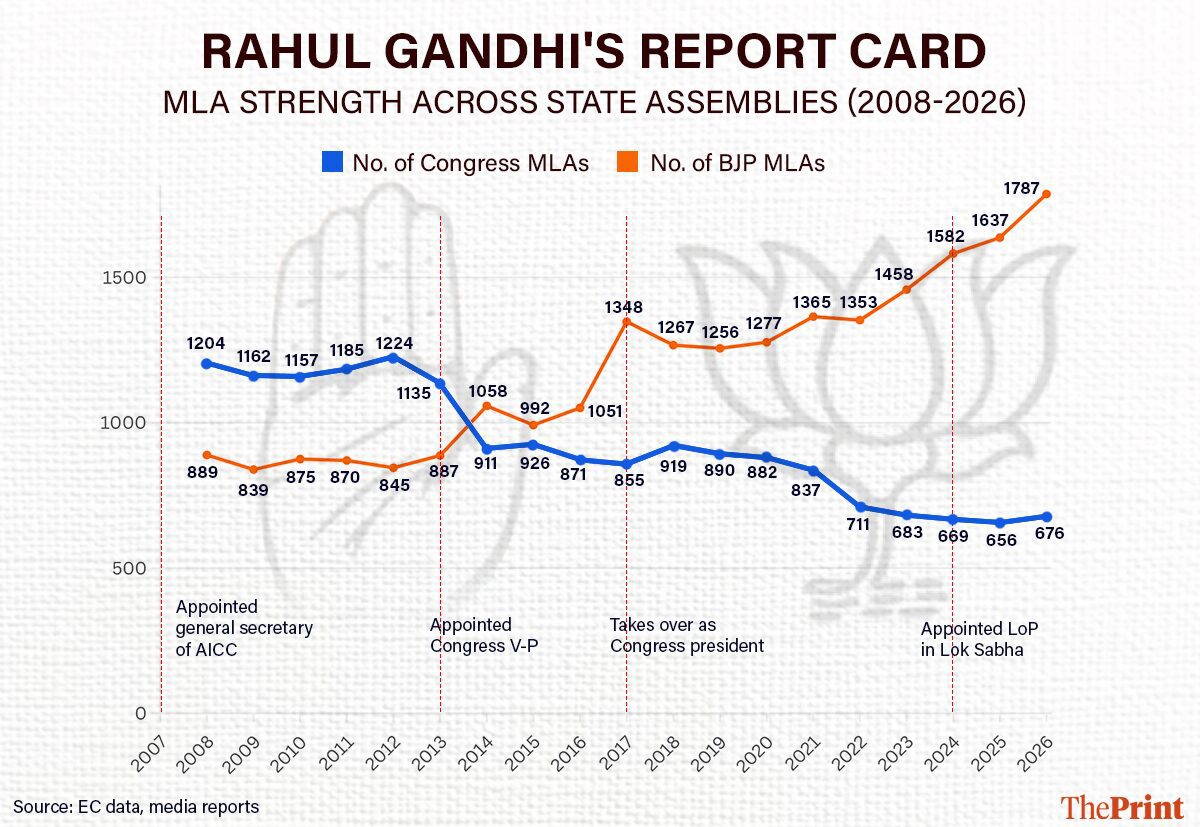
In 2008, the party had 1,204 MLAs pan-India. However, data collated by ThePrint shows that the number of Congress MLAs has shrunk by almost 44 percent since then—down to around 676 MLAs in 2026. Parallely, the BJP has seen a 101 percent increase from 889 MLAs in 2008 to 1,787 in 2026.
Of the total 4,120 MLAs in India, every second MLA now belongs to the BJP, while only one in six is from Congress.
The data analysed by ThePrint is based on the party affiliation of candidates who won assembly elections over the years. It does not include subsequent defections or bye-elections.
Although Rahul was given direct charge of Indian Youth Congress and National Students’ Union of India in 2007, he started playing a crucial role in the decision-making process of the party, with his mother and then party president Sonia Gandhi virtually giving him a free rein. She formally handed over the mantle to him in 2017.
Since 2008, the party breached the 1,200-mark only in 2012, when it had 1,224 MLAs, before seeing a 25 percent decline to 911 MLAs in 2014. The graph for number of Congress and the BJP MLAs intersects, and reverses in 2013-14 with the latter on a path of ascent since.
Rahul was appointed the vice president of the Indian National Congress in January 2013, when he began largely running the organisation, with Sonia playing a rather ceremonial role. He replaced her as Congress president in 2017, only to resign after the 2019 Lok Sabha debacle, which forced her to return to the helm as interim chief.
In October 2022, Mallikarjun Kharge took over as president. But while Rahul has not taken up any formal role since 2019, he has been the de facto party chief in terms of decision-making. Rahul has been a Member of Parliament for 22 years, and is currently the Leader of Opposition in Lok Sabha.
Chandrachur Singh, professor of Political Science at University of Delhi, lays the responsibility for Congress’s decline solely on Rahul. “He does not have an understanding of how politics operates, simple as that… His political culture is very alienated from the political culture in which we live,” he tells ThePrint.
However, Rahul Verma, a fellow at Delhi-based think tank Centre for Policy Research, does not hold the MP solely responsible for this drop in Congress’s assembly-wise presence, since the party has witnessed a structural decline.
“If you draw a graph from 1952 to 2024 every decade, Congress is losing seats and vote share in state assemblies,” Verma points out.
“Where you can hold Rahul Gandhi also accountable is that in some ways, he has been the face of the party for at least 12-15 years. While one can’t put the entire blame for the decline on him, he will definitely be held responsible for not being able to reverse this trend,” he adds.
The plunge
Verma explains the graph clinically, noting that the point where the graph reverses for Congress and BJP comes in 2013-14—by when the Congress had faced losses in several states.
“This is the moment when Narendra Modi takes over as campaign committee chief of BJP in some ways. And after that, BJP has been adding more states to its kitty every year. Congress in those states is getting marginalised,” he elaborates.
For instance, Haryana, where BJP could win only four seats in 2009, had 47 MLAs in 2014.
Similarly, in Assam, the Congress had been in power for 15 years, with the BJP winning only five seats in 2011. However, the gears shifted in 2016, when the BJP won 60 seats.
In 2017, the BJP had its most resounding and significant win in Uttar Pradesh, securing a landslide of 312 seats. It saw a 28 percent rise from 1,051 MLAs in 2016 to 1,348 MLAs in 2017.
“So, what you see is the first phase of BJP expansion between 2013 and 2018, and that’s the first phase of Congress decline—under Rahul Gandhi,” Verma asserts.
Over the few years after Rahul’s appointment as party president in December 2017, up until 2021, the graph shows both Congress and BJP plateauing in their reach across states. This is because post 2018, BJP lost some of the states it had won, like Rajasthan, Chhattisgarh, and Madhya Pradesh, or that Congress got almost a similar number of seats in a few states.
“However, after 2022-23, the second phase of expansion for the BJP begins under PM Modi,” Verma further explains.
In 2024, the year that Gandhi was appointed as the Lok Sabha LoP, Congress had 669 MLAs—its lowest tally in the party’s history. The number plunged even further in 2025, limiting the party to 656 MLAs in the entire country. The 2026 assembly polls have added 20 MLAs to its count.
Wipe-out in some states
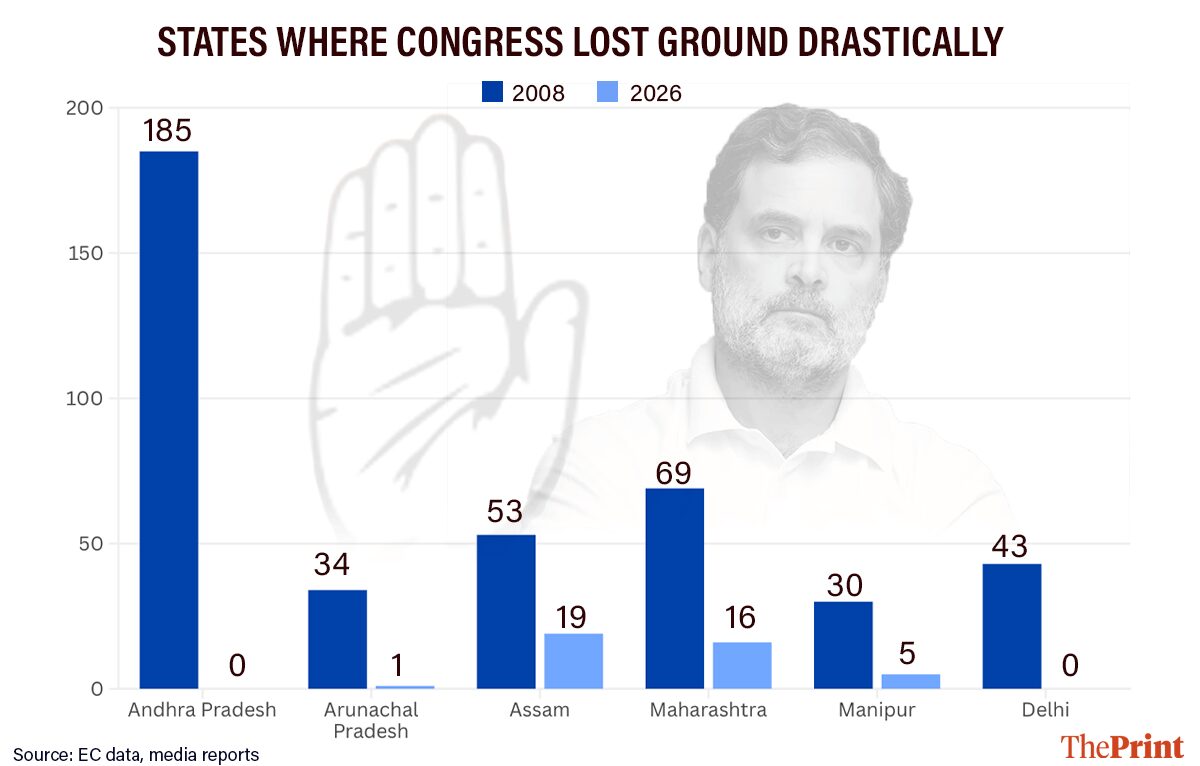
Over the years, the Congress has witnessed total collapse in certain states.
For instance, in Gujarat, it gave a tough fight to the BJP in 2017, winning 77 seats in the 182-constituency assembly versus BJP’s 99, only to be restricted to 17 seats as against BJP’s 156 in the subsequent 2022 polls.
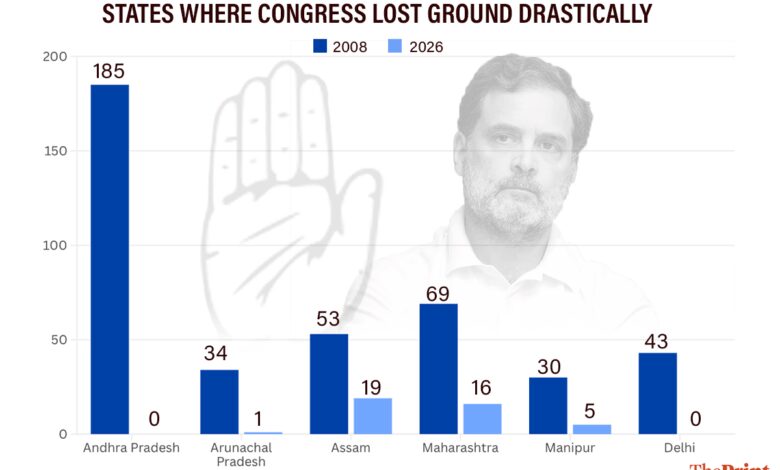
In Andhra Pradesh, while it had 185 MLAs in 2008, it was decimated there post its bifurcation in 2014. In Maharashtra, it went from winning 82 of 288 seats in 2009, to just 16 in 2024.
The Congress-led United Democratic Front’s Kerala win earlier this month makes Kerala the fourth state where the Congress has its CM, after Karnataka, Telangana and Himachal Pradesh.
The victory has, however, come alongside the reduction of the party to single digits in West Bengal, Tamil Nadu and Puducherry. The party also fell short in Assam—a state it ruled for 15 consecutive years till mid-2016. BJP, on the other hand, took a giant leap in West Bengal in a span of 10 years—from winning its first 3 seats in 2016, to 207 now.
Analyst Chandrachur Singh opines that Rahul’s strategic approach is not rooted in the Indian political system.
“For example, look at how the BJP started campaigning…it started with the younger people. Rahul does not seem to be approaching the younger people, particularly in the heartland. He is comfortable with the younger people in the south in Kerala. He is very comfortable with younger people in Tamil Nadu, maybe. But you will not find him in the same comfort zone in the northern part of the country, particularly the cow belt,” he asserts.
(Edited by Mannat Chugh)