The Supreme Court on Tuesday refused to modify its November 2025 directions mandating the removal of stray dogs from institutional areas such as schools, hospitals, sports complexes, railway stations and bus depots, adding that such dogs cannot be released back into these locations even after sterilisation.
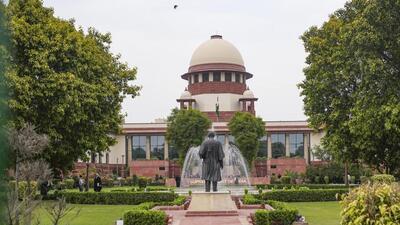
A bench of justices Vikram Nath, Sandeep Mehta and NV Anjaria dismissed all applications seeking modification of the November directions and also rejected challenges to the 2025 standard operating procedure framed by the Animal Welfare Board of India (AWBI), citing “deeply disturbing” incidents of dog bites across the country.
The court also authorised authorities to take legally permissible measures, “including euthanasia in case of rabid and dangerous dogs”, to curb threats to human life.
“The problem has assumed deeply disturbing proportions,” observed the bench while reading out its operative directions in open court, adding that reports of dog-bite incidents were occurring with “alarming frequency and severity”.
The court underlined that the issue had spread beyond residential localities into airports and other public institutional spaces. Referring to reports placed before it, the bench noted: “The very occurrence of repeated dog bite incidents in the country’s busiest airports (IGI) demonstrates grave inadequacy.”
The apex court also referred to incidents involving international travellers, including a German tourist allegedly bitten in Surat, observing that such occurrences adversely affect public confidence in “urban governance and civil administration”.
“Right to life with dignity encompasses the right to live freely without threat of harm of dog bite attack. State cannot remain a passive spectator,” said the bench.
The court said the Animal Birth Control (ABC) framework, introduced in 2001, had suffered from a “discernible absence of efforts” by states to expand sterilisation and vaccination infrastructure in proportion to the rising stray dog population.
“Sterilisation and vaccination drives have taken place without planning. It defeats the object of the framework. Had states acted with due foresight, the present situation would not have assumed such alarming proportions,” it added.
Highlighting the gravity of the situation, the court cited data indicating that 1,084 dog-bite incidents were reported in a single month in Sri Ganganagar in Rajasthan, while Tamil Nadu recorded over two lakh cases in the first four months of the year.
“Young children suffered grievous injuries, including mauling of their faces,” it noted.
Calling the harm “not merely statistical but unfathomable”, the court lamented that despite its August and November 2025 orders, the intended impact had not percolated to the ground level.
“Any non-compliance to the directions of this court shall be viewed seriously. Contempt proceedings, disciplinary proceedings and tortious liability shall be initiated against states for non-compliance,” it warned.
The bench directed all states and Union territories to take “decisive steps” to strengthen and implement the ABC framework and ensure the establishment of at least one fully functional ABC centre in every district, equipped with trained personnel and logistical facilities for sterilisation and vaccination.
Having regard to population density, states were further asked to expand ABC centres and ensure adequate availability of anti-rabies medicines at government pharmacies and hospitals.
In an important protection for officials tasked with enforcement, the bench directed that no FIRs or coercive action should ordinarily be initiated against municipal officials or authorities implementing the court’s directions, unless malafide or illegality is writ large.
“Officials of municipal authorities, states etc entrusted with implementation of directions of this court shall be entitled to due protection in the acts performed by them,” said the court, adding high courts could quash criminal proceedings initiated wrongly against officials and other persons.
The Union and state governments were also permitted to take “informed and reasoned decisions” to extend the November directions to other high-footfall public spaces and transit hubs in a time-bound manner.
The court additionally directed all high courts across the country to initiate suo motu proceedings for monitoring compliance with the Supreme Court’s August and November 2025 directions. Chief secretaries of states have been asked to submit status reports before the respective high courts, while consolidated compliance reports are to be placed before the apex court in November this year.
The directions came in continuation of the Supreme Court’s ongoing suo motu proceedings initiated last year amid rising dog-bite incidents nationwide. In its November 2025 order, the same bench had directed all states and UTs to remove stray dogs from institutional premises and prohibited their re-release into such locations after sterilisation, holding that allowing their return would “frustrate the very object” of ensuring safe public spaces.
The November order had expanded an earlier August 2025 direction requiring civic authorities in Delhi-NCR to round up stray dogs and place them in shelters, effectively suspending the catch-neuter-vaccinate-release model in institutional areas.
The proceedings have since evolved into a nationwide audit of stray dog management, with the court repeatedly flagging deficiencies in sterilisation infrastructure, vaccination coverage, shelter capacity and data accuracy submitted by states.