India and the Nordic countries on Tuesday established a Green Technology and Innovation Strategic Partnership to drive cooperation in areas ranging from energy security to digital infrastructure as Prime Minister Narendra Modi and the five regional states underscored the importance of trust-based ties in an era of geopolitical turbulence and uncertainty.
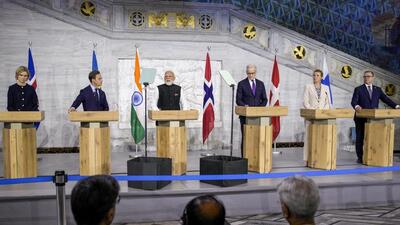
Modi joined his counterparts from Denmark, Finland, Iceland, Norway and Sweden for the third India-Nordic Summit in Oslo during the penultimate leg of a five-nation tour, with the focus on combining India’s scale and talents with the individual strengths of the Nordic states in areas such as renewable energy, digitalisation, defence, maritime security and shipping.
The new Green Technology and Innovation Strategic Partnership, announced at the conclusion of the summit, will complement India’s similar partnerships with Denmark and Norway and drive cooperation in the blue economy and digital infrastructure, and open new avenues for collaboration in climate action, energy security and water management.
Also Read: Expect India to push Russia towards ceasefire in Ukraine, says Norwegian PM
Modi said at a joint media interaction with the five Nordic leaders that the partnership seeks to link India’s scale with Iceland’s expertise in geothermal energy and fisheries, Norway’s blue economy and Arctic expertise and the maritime and sustainability experience of all Nordic states to help create a better future for the world.
The partnership will also help combine India’s talent with Sweden’s advanced manufacturing and defence capabilities, Finland’s telecom and digital technologies and Denmark’s cyber security and health technologies to develop trusted solutions.
Modi referred to the Trade and Economic Partnership Agreement (TEPA) India has signed with the European Free Trade Association, which includes Iceland and Norway, and the proposed free trade agreement with the European Union, which includes Denmark, Sweden and Finland, and said: “With these ambitious trade agreements, we are ushering in a new golden era in relations between India and the Nordic countries.”
He added that in an era of global tensions and conflicts, India and the Nordic countries will advocate for a rules-based global order. “Whether it is Ukraine or West Asia, we will keep supporting efforts for peace and a swift end to conflicts,” he said, speaking in Hindi.
Norwegian Prime Minister Jonas Gahr Støre, who hosted the summit after a four-year gap, emphasised the need for greater collaboration among democracies in an unpredictable world.
The leaders, Støre said, discussed global security, economic cooperation and growing geopolitical challenges faced by all of them, and “focussed on support for international law, a rules-based order that needs reforms and progress, and…the need for a just and lasting peace in Ukraine, and finding a way diplomatically on the ongoing conflict in the Middle East”.
Finland’s Prime Minister Petteri Orpo pointed to the need for partnerships based on trust, mutual respect, and shared democratic values in a world marked by geopolitical shifts, turbulence and uncertainty, while Denmark’s acting Prime Minister Mette Frederiksen called for greater cooperation between India and the Nordic countries to navigate a rapidly changing world.
“The Nordic countries, when united, are a middle power. Working together with one of the greatest powers on…ideas and values can bring stability, prosperity and unity in a world that is changing rapidly and, unfortunately, not in the right direction,” she said.
Frederiksen said Tuesday’s discussions looked at how the countries can further integrate on defending democracy, governing AI and new technologies, defence and security. Sweden’s Prime Minister Ulf Kristersson said the six countries are bound by their focus on innovation, scale and long-term reliable relations, while Iceland’s Prime Minister Kristrún Frostadóttir said India and the Nordic states can show the world that diverse countries can cooperate while displaying a “sense of respect between nations in dialogue and trade”.
According to the external affairs ministry, India and the Nordic countries agreed to leverage the TEPA and the upcoming FTA with the EU for greater trade, technology and investment linkages, and to launch joint climate action initiatives that merge Nordic innovation to create large-scale solutions anchored in India.
The two sides agreed to enhance cooperation in the Arctic, especially in polar research and environmental issues, and to launch joint research projects in STEM areas and next-generation communications technologies, such as 6G. They further agreed to promote a free, open and peaceful Indo-Pacific and promote the mobility of talent, including students and professionals.
They also agreed to build up defence-industrial collaboration, including through 100% FDI for Nordic defence firms in India’s defence industrial corridors.
Despite the geographical distance between the two sides, Modi noted that bilateral trade had increased fourfold in the past decade, and that the Nordic countries had become important partners for India, with their investments increasing by almost 200% in the same period.
“We agree that reform of multilateral institutions is necessary and urgent, and on terrorism, we have a clear and united stand — no compromise, no double standards,” he said.
Modi departed for Italy, the final leg of his tour, soon after the conclusion of the India-Nordic Summit.