
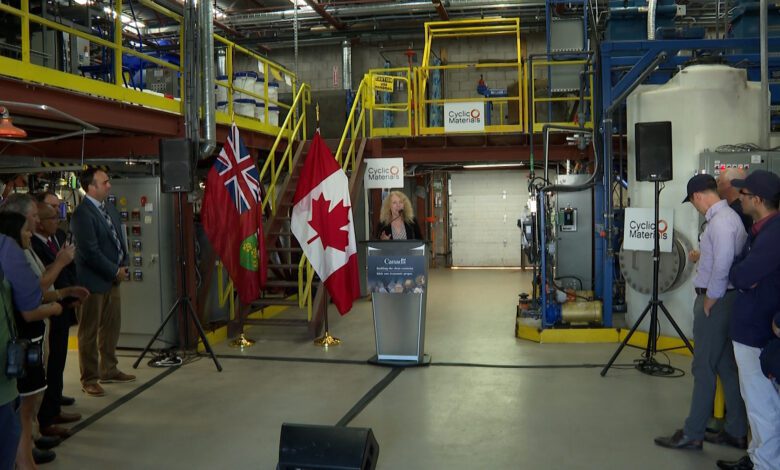
The federal government announced almost C$8.4 million for two Kingston, Ontario, critical-minerals projects in September 2024. The funding supported demonstration work on recycling rare-earth elements for permanent magnets and recovering graphite for lithium-ion batteries, rather than construction of a complete commercial battery factory.
How the funding was divided
Natural Resources Canada allocated C$4.9 million to Cyclic Materials Incorporated and C$3.5 million to Green Graphite Technologies Inc. through the Critical Minerals Research, Development and Demonstration program. Together the amounts total C$8.4 million; describing the package merely as “nearly $8 million” understates the announced support.
Cyclic Materials planned to operate a demonstration plant producing high-purity mixed rare-earth oxide and a cobalt-nickel mixed hydroxide product from recycled material. The project was intended to validate operating conditions, close technical gaps and support decisions about future scaling and commercial operations.
Recovering graphite from secondary sources
Green Graphite Technologies planned to demonstrate its GraphRenew process for recovering and upgrading graphite from secondary sources. The resulting material would undergo battery-cell performance testing, with larger quantities sent to cell manufacturers for certification work.
Graphite is used in lithium-ion battery anodes. Recovering it from spent material could reduce waste and the demand for newly mined input, but laboratory or demonstration success does not guarantee commercial yield, cost, purity or customer qualification. Battery manufacturers impose detailed consistency and performance standards.
Why rare earths and graphite matter
Rare-earth permanent magnets are used in electric motors, wind turbines, electronics and other equipment. Graphite is a key battery material. Canada’s policy sought to build more domestic processing and recycling capability so valuable materials could remain in use and supply chains would rely less heavily on imported primary resources.
A circular economy still has environmental costs. Collection, transport, separation and chemical processing use energy and materials and can create waste streams. Project assessment should compare recovery rates, emissions, water, worker safety and economics with alternative disposal and primary production.
What public investment can and cannot show
Demonstration funding addresses the risky stage between research and a bankable industrial process. It can generate operating data and help a company prove that equipment works at a larger scale. It is not evidence that every target will be met, that a facility will become profitable or that projected jobs and supply-chain benefits are guaranteed.
The announcement framed Kingston as a clean-technology centre and linked both projects to Canada’s critical-minerals strategy. Credible follow-up requires reporting on milestones, public contributions, private financing, technical performance and what happens to intellectual property and recovered material.
The verified scope is specific: federal support went to two recycling demonstrations—one centred on rare-earth and mixed-metal products, the other on battery-grade graphite. That precision is more useful than presenting the money as a general investment in unspecified “battery technology.”
Both projects also sit earlier in the supply chain than a finished electric vehicle. Permanent-magnet material must be separated, refined and manufactured into components; recovered graphite must meet battery specifications and then be incorporated into qualified cells. Progress at one stage does not remove mining or imports overnight. Its potential value is developing Canadian know-how and evidence about which recovered streams can perform reliably at industrial scale.



