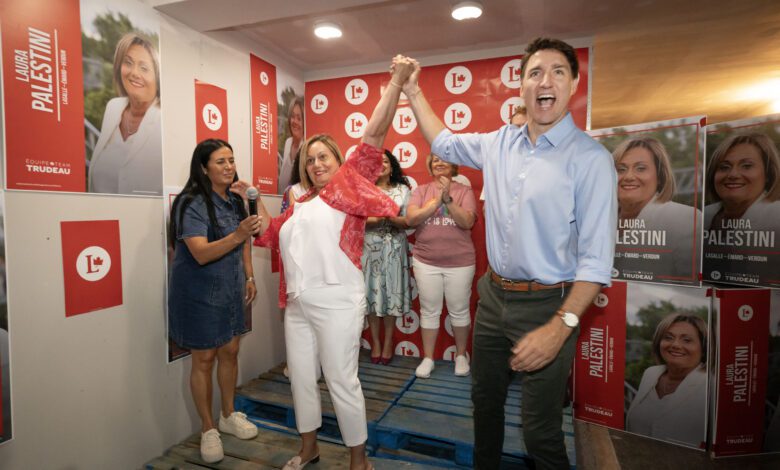
Liberal candidate Laura Palestini insisted that the September 16, 2024 byelection in Montreal’s LaSalle—Émard—Verdun riding should be judged on her local record rather than Prime Minister Justin Trudeau’s popularity. Her effort to personalize the race reflected the difficulty facing a governing party defending a long-held seat after nine years in office.
The riding had usually favoured Liberals
The diverse southwest Montreal constituency includes anglophone, francophone and immigrant communities, with strong Italian roots in parts of LaSalle. It became vacant after former justice minister David Lametti left federal politics.
A long history of Liberal victories made the close contest nationally significant.
Palestini brought municipal experience
A lifelong LaSalle resident, she had served as a city councillor for 19 years and completed five mandates. She told voters that recognition of her neighbourhood work gave her an advantage at the door.
Municipal familiarity did not necessarily transfer automatically to federal party support.
Trudeau’s standing complicated the campaign
National polling placed the Liberals behind the Conservatives, and the party had recently lost Toronto—St. Paul’s, another former stronghold. That defeat intensified questions about Trudeau’s leadership.
Palestini repeatedly stressed that her own name was on the ballot and kept the prime minister out of the foreground.
The contest was effectively three-way
Bloc Québécois candidate Louis-Philippe Sauvé, NDP candidate and Montreal councillor Craig Sauvé, and Palestini all had plausible paths to victory. A limited Mainstreet Research poll placed the Bloc ahead, but analysts warned the result was unusually difficult to predict.
The Conservatives were not expected to contend for first place in this riding.
Party leaders chose different levels of visibility
Jagmeet Singh campaigned repeatedly with the NDP candidate, while Yves-François Blanchet visited with Bloc MPs. Trudeau appeared at local events but maintained a lower profile, and some Liberal campaign material did not feature him.
Those choices reinforced debate over whether the vote was local or national.
A record ballot created a practical challenge
Ninety-one candidates appeared, most associated with a protest group seeking electoral reform. The nearly metre-long ballot forced campaigns and election officials to help voters locate their preferred candidate without compromising secrecy.
Palestini carried a reduced sample while canvassing to show supporters where her name would appear.
Local voters expressed mixed priorities
Some residents cited Palestini’s municipal services and personal accessibility. Others said dissatisfaction with Trudeau made them consider the Bloc or NDP.
A byelection can simultaneously reflect neighbourhood relationships, party organization and a verdict on the government.
The result confirmed how close the race was
Official Elections Canada totals later showed Louis-Philippe Sauvé winning with 8,925 votes, or 28.2 per cent. Palestini received 8,656 votes, or 27.3 per cent, while Craig Sauvé took 8,272, or 26.1 per cent.
The Bloc margin over the Liberals was only 269 votes.
A local campaign still carried national consequences
Palestini was entitled to ask voters to assess her qualifications independently. Yet candidates choose to run under a party label, and federal representation includes confidence votes and national policy.
The outcome did not prove how the entire country would vote, but losing a safe-looking seat gave Liberals another concrete warning. It also showed why responsible reporting should preserve both levels of analysis: the contest involved a respected local candidate, and it served as a test of a weakened national brand. Neither explanation alone accounts for a three-way result decided by fewer than 300 votes.