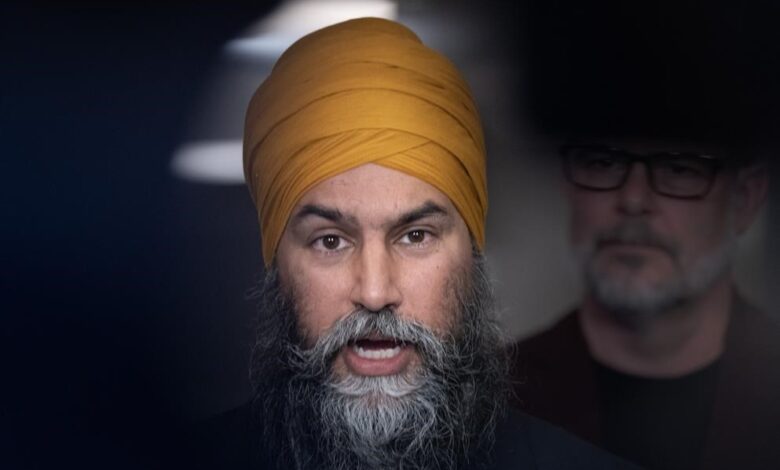
Prime Minister Justin Trudeau accused New Democratic Party leader Jagmeet Singh of yielding to Conservative political pressure after Singh signalled that he was reconsidering the federal consumer carbon price in September 2024. The dispute showed how a policy once defended by Liberals and New Democrats had become politically hazardous during an affordability crisis.
Singh shifted emphasis toward large emitters
The NDP leader said working people should not carry the burden of climate policy while major polluters avoided their fair share. He stopped short of presenting a complete replacement plan but indicated that his party was open to alternatives to the consumer fuel charge.
A signal of review was not yet a fully costed policy.
Trudeau linked the shift to Poilievre
Conservative leader Pierre Poilievre had made “axe the tax” a central message. Trudeau argued that Singh was adopting the Conservative frame instead of defending pollution pricing and household rebates.
That was partisan criticism; Singh said his concern was fairness and effectiveness.
The federal system combined a charge and rebates
In provinces without an equivalent system, the federal backstop placed a price on fuels and returned most proceeds to households through quarterly payments. The intent was to preserve an incentive to reduce emissions while offsetting average household costs.
Individual outcomes varied with fuel use, household circumstances and indirect price effects.
Industrial pricing was a separate instrument
Large-emitter systems set performance standards and costs for emissions-intensive facilities. Focusing only on industry could reduce household visibility and protect trade-exposed sectors, but it would cover a different share of emissions and create different incentives.
A credible replacement needed quantified reductions, not only a promise to make polluters pay.
Affordability changed the politics
Higher food, rent and borrowing costs made any visible fuel increase easier to attack. Rebates arrived separately from purchases, so households did not always connect the payment with the policy.
Communication problems did not settle whether the program reduced emissions or distributed costs fairly.
Provincial differences complicated debate
Some provinces designed their own carbon-pricing systems, while others used the federal backstop. Rural residents, people with long commutes and households lacking affordable alternatives experienced the transition differently.
Policy design could address those constraints without pretending climate costs disappeared.
Ending a price would require substitute measures
Regulations, clean-energy investment, building retrofits and technology standards can reduce emissions, but they also carry public or private costs. Comparing plans requires a common emissions target, timeline and fiscal estimate.
Otherwise, “tax” and “polluter” become slogans detached from outcomes.
The NDP had recently ended its governing agreement
Singh’s decision to leave the supply-and-confidence arrangement with the minority Liberals increased the political significance of every disagreement. Both parties needed to distinguish themselves before an eventual election.
That context helped explain the sharper language from Trudeau.
Voters needed evidence beyond accusations
Whether Singh had “caved” was a judgment about motive. The measurable questions were what policy the NDP proposed, how much it would reduce emissions, who would pay and how lower-income households would be protected.
The exchange revealed a real challenge: durable climate policy must survive economic stress and public scrutiny. Calling a rival weak did not solve it, and promising fairness without detailed design did not solve it either.