
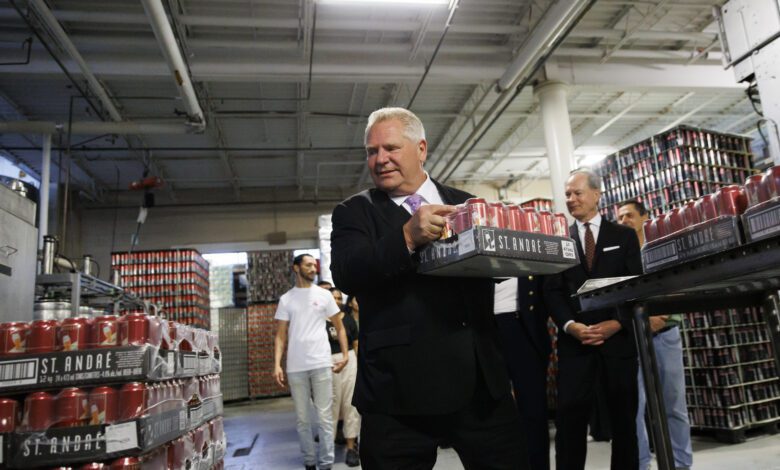
Ontario’s independent Financial Accountability Office opened a value-for-money review of the Ford government’s decision to accelerate expanded alcohol sales in 2024. The review focused attention on the public cost and expected benefits of allowing thousands of additional retailers to sell beer, wine, cider and ready-to-drink beverages earlier than planned.
The rollout began in convenience stores
Eligible convenience stores could begin selling the expanded range on September 5, 2024. Grocery and big-box grocery stores were scheduled to gain broader access by the end of October if they obtained licences.
Participation remained a commercial choice for each retailer.
The province altered an existing agreement
Ontario negotiated with The Beer Store to bring forward market changes that otherwise would have followed the Master Framework Agreement’s scheduled end. The agreement had governed beer distribution and retail rules since 2015.
Ending restrictions early created transition costs as well as new competition.
Up to $225 million was available
The government agreed to provide The Beer Store with as much as $225 million over 19 months for added transition costs. It said the funding would help protect jobs, maintain stores and preserve the provincewide bottle-return system while the market opened.
The maximum authorization was not automatically the final amount spent.
The watchdog’s role was financial
The FAO supplies the legislature with independent analysis of provincial finances. A value-for-money review can examine economy, efficiency and effectiveness without deciding whether wider alcohol availability is politically desirable.
Its evidence would allow legislators to compare government claims with documented costs and results.
Convenience was the government’s main argument
Ministers said consumers should have more choice, more locations and competitive prices. The expansion could allow thousands of convenience, grocery and big-box stores to enter a market once dominated by the LCBO and The Beer Store.
Retail licences, minimum prices and responsible-sale rules continued to apply.
Critics questioned the accelerated timing
Opposition parties argued that Ontario was paying heavily to advance a change that was already approaching under the agreement. They also questioned whether the money could have produced greater public value in health care, housing or education.
Those comparisons required a complete accounting rather than slogans alone.
Public-health costs belong in the assessment
Greater availability can influence consumption and alcohol-related harm. A comprehensive evaluation should examine enforcement, impaired driving, emergency care and addiction services alongside retail revenue and consumer convenience.
Correlation after the rollout would not by itself prove that every change resulted from the policy.
Bottle returns were a practical dependency
The Beer Store operated an established deposit-return network for alcohol containers. Keeping access to returns during store changes mattered for consumers, municipalities and recycling performance.
Transition payments were partly justified on that operational basis and should be tested against actual service delivery.
The audit promised a clearer ledger
The central question was not simply whether people liked buying alcohol at a corner store. It was whether acceleration produced benefits proportionate to compensation, foregone revenue, implementation costs and health risks.
Until the FAO completed its analysis, responsible reporting needed to distinguish committed ceilings from paid amounts and political estimates from audited findings. The review offered a mechanism for that scrutiny while the new retail system was already taking effect.



