Thierry Breton, Top E.U. Commissioner, Resigns, Citing ‘Questionable Governance’
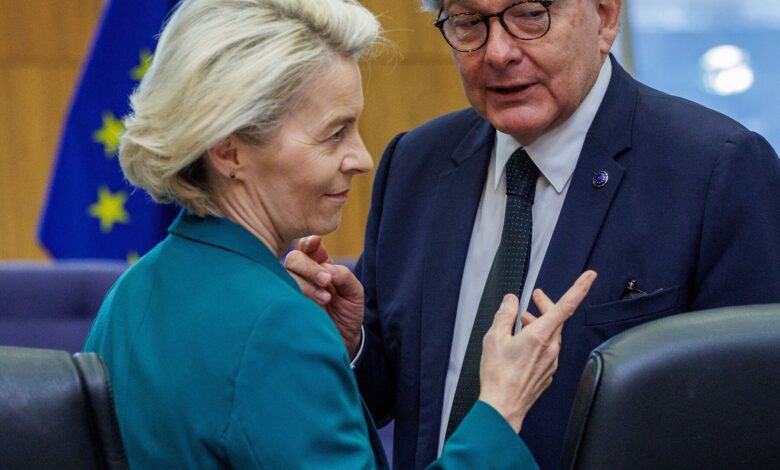
Thierry Breton resigned as the European Union’s internal-market commissioner on September 16, 2024, accusing European Commission President Ursula von der Leyen of questionable governance. His abrupt departure exposed tension over how the next Commission was being assembled and forced France to nominate a replacement.
Breton left with immediate effect
In a public letter, the French commissioner said von der Leyen had recently asked Paris to withdraw his nomination for a second term. He alleged that she offered France a more influential portfolio in exchange.
The Commission president’s office accepted the resignation and thanked him for his work.
France had formally backed him
President Emmanuel Macron had proposed Breton to continue as France’s commissioner. Each member state nominates a candidate, but the Commission president allocates portfolios and the full college requires European Parliament approval.
A national nomination therefore does not guarantee a particular post.
Paris quickly chose Stéphane Séjourné
France replaced Breton with its outgoing foreign minister, Stéphane Séjourné. The rapid switch allowed von der Leyen to present her planned team without a prolonged French vacancy.
The choice also moved a close Macron ally from domestic government to Brussels.
Breton held a powerful policy portfolio
Since 2019, he had overseen the internal market, industrial strategy, defence initiatives, space policy and major digital regulation. His office helped implement the Digital Services Act and Digital Markets Act.
That broad remit placed him in frequent disputes with large technology companies and national capitals.
His relationship with von der Leyen was strained
Breton often advocated more forceful European industrial capacity and strategic autonomy. He also challenged the concentration of decision-making around the Commission president.
Policy disagreement alone did not verify every allegation in his resignation letter.
Gender balance complicated the lineup
Von der Leyen had asked governments to propose male and female candidates where possible as she sought a more balanced college. Many capitals ignored that request, leaving political negotiation over names and portfolios.
The French replacement did not improve the male-female balance, suggesting other considerations shaped the decision.
The Parliament retained a confirmation role
Proposed commissioners faced committee hearings where lawmakers could test competence, conflicts and policy commitments. Parliament could pressure individual candidates to withdraw even though it formally votes on the Commission as a body.
The resignation therefore came before, not after, democratic scrutiny of the new team.
Continuity mattered for digital enforcement
Companies and governments were adapting to new EU rules for online platforms, competition, chips and artificial intelligence. A leadership change could alter tone, but the regulations and institutional enforcement responsibilities continued.
No commissioner can personally erase laws adopted by Parliament and the Council.
The dispute raised a governance question
Commission building necessarily involves negotiation, yet transparency matters when a president asks a national government to replace a nominee. Breton’s account was his allegation, while von der Leyen’s office did not publicly confirm all the claimed details.
Responsible reporting should distinguish those positions and avoid treating a resignation letter as an independently established record. The episode showed the political authority accumulated by the Commission presidency, but Parliament’s hearings and the final approval vote remained the proper tests of the incoming executive’s legitimacy.