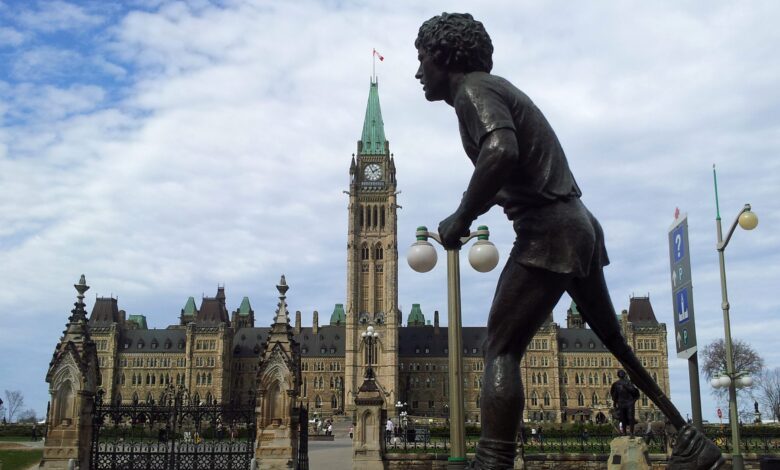
Ottawa formally marked the relocation of the Terry Fox Memorial Sculpture to Sparks Street on September 16, 2024. Fox’s brother Darrell said the new setting carried special meaning because it lies on the route Terry ran through the capital during his 1980 Marathon of Hope.
The sculpture dates to 1983
Artist John Hooper created the group of bronze figures, which depicts stages of Fox’s distinctive running motion. The work has remained a familiar downtown memorial while moving among prominent public locations.
The City of Ottawa continues to own and maintain it.
Construction required another move
The previous site near Parliament Hill was affected by the federal Block 2 rehabilitation project. Block 2 sits immediately south of the Hill between Wellington and Sparks streets.
Specialist heritage masons moved the sculpture and its plaque in June before the formal September ceremony.
Sparks Street connects directly to Fox’s journey
Fox ran along the pedestrian mall during the Ottawa stage of his cross-country campaign. His June 30, 1980 journal recalled an enthusiastic reception there.
That documented connection gave the relocation more than logistical significance for his family.
The new height improves public access
Representatives of Hooper’s family welcomed a pedestrian-level placement that lets visitors engage with the figures more closely. Accessibility was important to the artist’s intention that public work remain part of everyday life.
Interaction should still respect the sculpture and commemorative space.
The Marathon of Hope transformed fundraising
Fox began running across Canada after losing a leg to cancer, seeking money and attention for research. He started in St. John’s in April 1980 and stopped near Thunder Bay in September when cancer returned to his lungs.
His unfinished route became an enduring international movement rather than a failed journey.
The memorial represents motion, not triumphalism
Hooper’s repeated figures show the physical rhythm and effort of Fox’s run. The design emphasizes persistence by a young athlete using an artificial leg rather than presenting a distant, static hero.
Its human scale helps explain why location and visibility matter.
The ceremony involved several partners
Public Services and Procurement Canada, the City of Ottawa, the Sparks Street organization, the Fox family and Hooper’s estate participated in planning. Federal and municipal officials attended the formal announcement.
That collaboration balanced construction needs, conservation and family wishes.
Relocation can preserve context rather than erase it
Moving a memorial risks weakening its association with place, but the Sparks Street site adds an authentic link to the historical route. Clear interpretation can explain both the Marathon of Hope and the sculpture’s own history.
The change also placed the work in a busy public corridor where residents and visitors could encounter it without entering Parliament’s grounds.
The significance rests in continued action
Fox asked Canadians to support cancer research one dollar at a time. Annual runs, school events and research funding continue that public mission decades after his death.
The sculpture’s new home was therefore not simply an urban-design adjustment. It connected a national memorial to the street where Fox once received a powerful welcome, while keeping his story accessible during the long reconstruction of Canada’s parliamentary precinct.