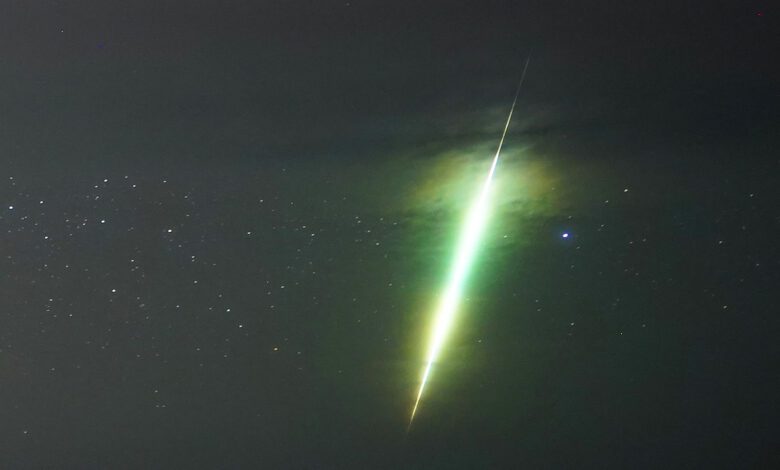
The Draconid meteor shower offered Canadians a convenient evening skywatching opportunity around October 8, 2024. Unlike showers that peak before dawn, the Draconids are best sought after nightfall, when their radiant in the northern constellation Draco is highest.
Comet debris creates the display
The shower occurs when Earth passes through dust left by comet 21P/Giacobini-Zinner. Small particles enter the atmosphere at high speed, compressing and heating the air around them until a brief streak becomes visible.
The flash is a meteor. Material that survives to the ground is called a meteorite, but ordinary Draconid particles are generally too small to do so.
Draco marks the radiant
Tracing the streaks backward makes them appear to emerge from Draco, giving the shower its name. Observers did not need to stare directly at the constellation; longer trails often appeared some distance away.
From much of Canada, Draco is circumpolar and remains above the horizon. The geometry made early evening useful, particularly before fatigue and overnight cloud changes reduced the chance of watching.
2024 was not forecast as a major storm
Under ordinary conditions, observers might see only a handful of Draconids per hour from a dark location. The shower has occasionally produced dramatic outbursts when Earth crosses a dense filament of comet dust, but those rare episodes should not become the expectation every year.
A quoted theoretical rate assumes a dark sky, a high radiant and an unobstructed view. A city observer looking through cloud or light pollution will see fewer.
Darkness matters more than equipment
The best site has a broad view away from streetlights, buildings and traffic. Observers should give their eyes roughly 20 to 30 minutes to adapt, avoid phone screens and dress for temperatures colder than the daytime forecast suggests.
Binoculars and telescopes narrow the field and are not helpful for meteor watching. A reclining chair, warm layers and patience improve the experience more than magnification.
Cloud and local light decide visibility
Canada spans several time zones and weather systems, so a national peak date never guarantees a local view. People should check an hour-by-hour cloud forecast and try more than one evening while the shower remains active.
The waxing Moon in early October 2024 produced less interference than a full Moon, particularly after it set. Local artificial light was likely the larger obstacle for many viewers.
Photography needs a wide field
A camera on a stable tripod can use repeated wide-angle exposures aimed at a large section of sky. Manual focus on a bright star, a high sensitivity setting and an interval timer improve the chance of catching an unpredictable streak.
Aircraft, satellites and lens flare can resemble meteors in a single frame. A sequence helps distinguish an atmospheric streak from an object moving steadily across several images.
A modest shower can still be rewarding
The Draconids are slow relative to many showers and can produce conspicuous trails. Their family-friendly timing makes them accessible even when the count is low.
No special app, telescope or dangerous travel was necessary. A clear, dark northern sky after dusk, several layers of clothing and realistic expectations offered the best chance. The attraction was not a guaranteed “light show,” but the possibility of seeing comet dust end a long solar-system journey in a momentary line of light.