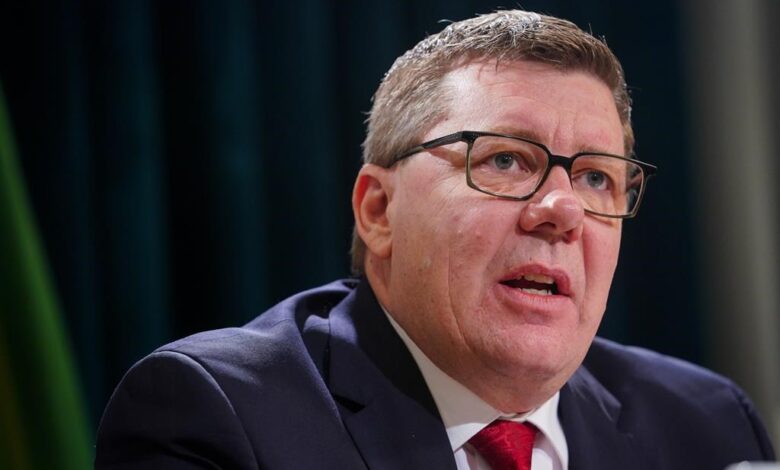
Saskatchewan Premier Scott Moe said after his party’s 2024 re-election that a promised school change-room restriction was no longer his government’s top priority. He acknowledged that his campaign statement describing it as his first order of business had been mistaken and said consultations with school boards would come after local elections.
The campaign promise
During the campaign, Moe said a re-elected Saskatchewan Party government would direct schools to prevent students he described as “biological boys” from using change rooms with “biological girls.” He linked the proposal to a complaint involving a southeast Saskatchewan school.
The language and proposal directly affected transgender and gender-diverse students. Reporting should quote the premier accurately while not adopting contested political terminology as an uncontested medical or legal category.
The post-election change in emphasis
After the October 28 election, Moe said the practical first steps were meeting the lieutenant-governor, appointing a cabinet and setting a legislative agenda. He said he sometimes spoke before thinking and needed to take a breath.
He did not say the policy had been abandoned. Instead, he proposed consultation with school boards to determine what a future approach might look like. “No longer top priority” therefore meant a change in timing and process, not necessarily a reversal of intent.
Political context
The Saskatchewan Party won a fifth consecutive majority but returned with a smaller caucus. It lost every seat in Regina and all but one in Saskatoon, while the NDP won the remaining 27 seats. That geographic division gave the government reason to reconsider how campaign priorities were received.
The province had already used the Charter’s notwithstanding clause for legislation requiring parental consent before students under 16 could use different names or pronouns at school. Critics argued that policy could out or misgender vulnerable children. The change-room debate therefore occurred within an existing conflict over student rights and provincial authority.
What a responsible consultation needs
Schools must provide privacy, safety and equal access for all students. A consultation should include school boards, educators, parents, medical and human-rights experts, and transgender students whose daily lives would be directly affected. Listening only to the most politically organized voices would not establish representative evidence.
Options can include private changing stalls available to any student who wants them, clear anti-harassment rules and individual accommodation. Policies should avoid forcing a child to disclose private information or isolating one group under the guise of universal safety.
Evidence before directive
A province considering restrictions should publish the problem it is trying to solve, the number and type of reported incidents, the legal analysis and the expected outcome. One complaint can warrant investigation but does not by itself establish a province-wide pattern.
Human-rights and constitutional scrutiny is not a technical obstacle to policy; it is part of governing. Schools also need practical guidance on supervision, facilities, athletics and confidentiality rather than a slogan that transfers difficult decisions to staff.
Moe’s acknowledgment corrected the claim about immediate priority, but it did not resolve the substantive issue. The next test was whether consultation would be open, evidence-based and respectful of every student. A policy affecting children’s dignity and safety required more care than a campaign announcement—and a clear explanation of why any restriction was necessary and proportionate.