New UPI Charges Explained: What Changes for Merchants From October 15—and What Stays Free

India is introducing a new merchant discount rate (MDR) framework for some UPI payments, but the change is narrower than the phrase ‘new UPI charges’ suggests. Customers will not be charged for using UPI, and person-to-person transfers will remain free. The cost is a merchant-side payment-processing charge on specified, higher-value person-to-merchant transactions.
The Ministry of Finance said on 15 September that every person-to-person UPI transaction will remain free, regardless of the amount. Merchant payments up to ₹2,000 will also remain free, as will all transactions covered by the zero-MDR framework for eligible small merchants. The ministry estimates that about 96% of merchant transactions will be unaffected. The framework is intended to create a revenue stream for the payment ecosystem without putting a fee at the checkout screen.
What changes from 15 October
NPCI’s September FAQ, as reported by India Today, puts the implementation date at 15 October 2026. For specified person-to-merchant payments above ₹2,000, the standard MDR is 0.4%. It is not a new government tax. The charge is shared among the banks, payment service providers and UPI application providers involved in processing the payment.
There is a ceiling. For a ₹10,000 merchant payment, 0.4% works out to ₹40. At ₹50,000, it is ₹200. Once the payment reaches ₹75,000, the fee reaches its ₹300 cap; a ₹1 lakh payment would therefore attract ₹300 rather than ₹400. The merchant’s acquiring bank or payment provider will handle the exact settlement and reporting arrangements.
The framework also has special rates. The government says payments above ₹2,000 in essential and thin-margin areas such as railways, telecommunications, insurance, fuel and agricultural inputs will attract a flat ₹5 MDR. Capital-market payments, including those involving mutual funds, securities and stockbrokers, carry a 0.02% rate capped at ₹300. These categories should be checked against the latest NPCI and acquiring-bank instructions before a merchant changes its acceptance policy.
What remains free
A family sending money to a relative, a customer paying a friend back or someone moving money between their own accounts will not pay a UPI fee. There is also no monthly quota or tiered charge for an individual’s free UPI usage. Daily limits set by a bank or NPCI are security and risk controls, not price thresholds.
Small merchants are specifically protected. Street vendors and neighbourhood businesses receiving up to ₹1 lakh a month through UPI QR codes in the person-to-person-merchant category continue with zero MDR on all transactions. Payments up to ₹2,000 to merchants remain free as well. Banks have been advised not to let merchants pass the MDR on to customers, while UPI apps are not allowed to add a platform fee or hidden charge.
What it could mean for merchants
For a grocery shop where most bills are a few hundred rupees, the immediate effect should be limited. The same is true for many food stalls, pharmacies and everyday retail purchases. The pressure is more likely to be felt by businesses that routinely receive larger UPI tickets: some education, travel, luxury retail, professional services and other high-value categories. A 0.4% fee is small on an individual transaction, but it becomes a visible line in a business with thin margins and a high monthly volume.
Merchants will probably review their settlement statements, category classification and contracts with payment providers. Some may compare UPI with cards, bank transfers or other rails for large invoices. That is a commercial decision, not evidence that UPI is becoming expensive for ordinary users. Businesses should be cautious about putting a separate ‘UPI charge’ on a bill: the official framework says customers are not to bear the MDR.
Reactions from government and industry
The government’s case is that a sustainable revenue model is needed to fund resilience, fraud prevention, cybersecurity, customer support and expansion into rural and semi-urban areas. The Finance Ministry has described MDR as a payment-ecosystem charge rather than a tax collected by the government or NPCI. It also says 5% of MDR collections will go into a fund intended to support small-merchant adoption, with details to be settled with the RBI.
The Payments Council of India, in a statement reported by Akashvani News, similarly said consumers and small merchants will remain free of charges. It described any applicable merchant service charge as a commercial arrangement between a merchant and its payment provider. No verified public statement from an individual app or a trade association should be treated as a universal view of all businesses; implementation will depend on each provider’s terms and the final operating instructions.
Could adoption slow?
In the short term, a sharp fall in everyday UPI use looks unlikely because the largest user-facing parts of the system—P2P transfers and small-ticket payments—remain free. NPCI’s statistics show the scale of the network: UPI processed 24,508.96 million transactions worth ₹29,82,355.95 crore in August 2026, across 752 live banks.
The risk is more targeted. High-value merchants may experiment with different payment methods, and customers could see more prompts to use a card or bank transfer for large bills. Whether that becomes a meaningful shift will depend on merchant margins, provider pricing, settlement reliability and how clearly the rules are communicated. At this stage, claims that UPI adoption will collapse—or that every merchant will simply absorb the fee—are predictions, not established facts.
For users, the practical message is simple: a normal UPI payment should continue to show the amount you approve, with no added platform fee. For merchants, the sensible next step is to read the acquiring-bank notice, confirm whether the business falls under a protected category and monitor settlements after 15 October. The policy is designed to change who funds the network, not to turn UPI into a paid service for the public.
Sources
- Ministry of Finance / Press Information Bureau: UPI remains free for P2P and 96% of merchant transactions
- NPCI: UPI product statistics
- India Today: NPCI FAQ details on the October 15 MDR start date and worked examples
- Akashvani News: Payments Council of India clarification
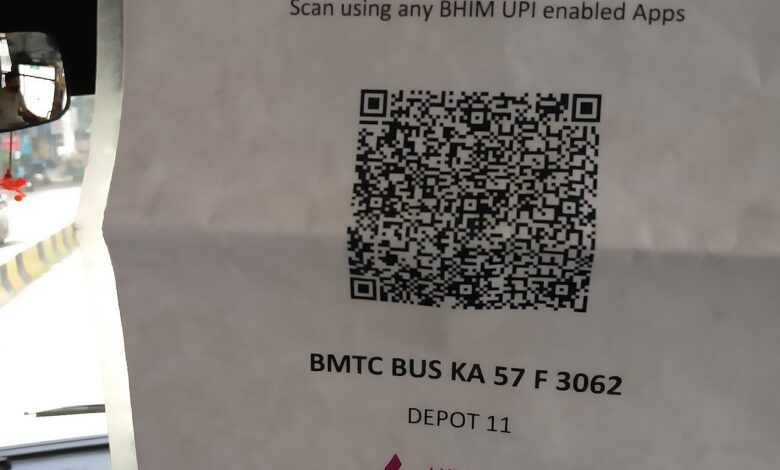
Featured image: Digital Payments initiative — QR code scanning by BMTC Bengaluru, Mallikarjunasj, CC BY-SA 4.0 via Wikimedia Commons. The photograph is illustrative and predates the 2026 MDR framework.