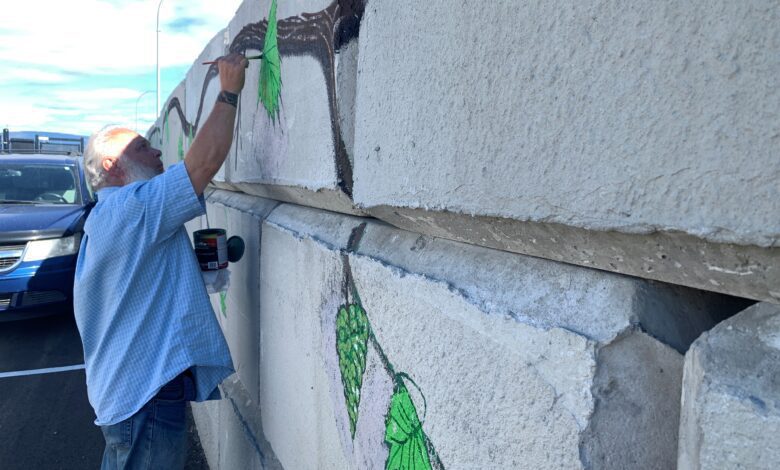
After five years living in homeless shelters, Kelowna resident Clint Allen prepared to move into permanent housing in October 2024. He credited a stay at Trailside transitional housing and its support services with helping him regain stability, while warning that many others still faced large gaps in the system.
Trailside provided a bridge rather than a final home
The 60-unit site opened on Highway 97 North in May 2024. Residents received private temporary accommodation and help identifying the barriers they needed to address before moving into stable long-term housing.
Transitional housing is designed to create movement through the system, not indefinite residence.
Allen made the space his own through art
He painted a mural at Trailside after discovering a passion for art. The project illustrated how privacy and routine can give a person room to rebuild an identity beyond homelessness.
His move meant beginning again in a new space, but this time with a permanent address.
Individual needs are different
Turning Points Collaborative Society, which operated Trailside, said staff worked with people arriving from shelters or outdoor homelessness on the particular steps required for housing. Those could include identification, income, health care, applications, life skills and relationships with landlords.
No single pathway or timetable is appropriate for everyone.
One success did not prove adequate capacity
Allen said his lack of an addiction helped him navigate the available system and called for more transitional units. Other residents may require treatment, harm reduction, mental-health care or permanent supportive housing.
Comparing people morally by the complexity of their needs would reinforce stigma rather than solve homelessness.
Kelowna was expanding rapid housing
The city and British Columbia Housing had opened or announced three 60-unit projects, including Trailside and an Appaloosa Road development. Completion of the third would bring the total to 180 units.
The city said the Appaloosa project completed the existing memorandum of understanding for this housing type at that time.
Every temporary placement needs an exit
Transitional sites cannot reduce shelter pressure if residents cannot find affordable rentals or permanent supportive homes. High rents, low vacancy and limited income assistance can block progress even when a person is ready.
Building the next rung of housing is therefore as important as opening the first.
Neighbourhood concerns deserve evidence and engagement
Some residents oppose supportive or transitional projects because they fear disorder. Operators should respond with contact procedures, maintenance and transparent performance data, while avoiding assumptions that residents cause nearby incidents.
Allen hoped his experience would help people see the life-changing purpose of such sites.
Housing outcomes are the meaningful measure
Counts of units opened show capacity, but governments should also publish how many residents move to stable housing, how long placements take, what support remains after a move and how many people return to homelessness. Personal privacy must be protected.
Allen’s achievement was significant without being presented as a universal formula. It showed what temporary safety, skilled support and a viable permanent vacancy can accomplish together. The policy lesson was not that homelessness is easily solved; it was that a functioning path must connect shelters, transitional support and enough permanent homes for people to leave crisis behind.