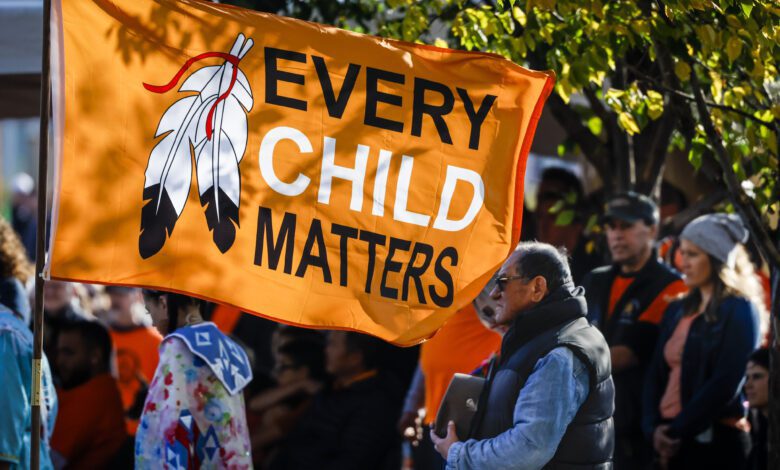
Albertans gathered on September 30, 2024, for the National Day for Truth and Reconciliation and Orange Shirt Day. Walks, ceremonies, performances and educational events honoured residential-school survivors, remembered children who never returned and called attention to the work that remains beyond an annual observance.
The national day answers a Call to Action
Parliament created the federal statutory holiday in 2021 after the Truth and Reconciliation Commission called for a day of public commemoration. The date coincides with Orange Shirt Day, an Indigenous-led movement that began years earlier.
Survivor Phyllis Webstad’s account of having a new orange shirt taken on her first day at residential school became a symbol of the identity and dignity stripped from children. “Every Child Matters” connects remembrance with responsibility.
Alberta holds extensive residential-school history
Dozens of federally funded institutions operated in the province, many run by churches. Children were separated from family, language and community and exposed to forced assimilation, neglect, disease and abuse.
The effects did not end when the schools closed. Survivors and descendants describe continuing consequences for health, parenting, education, culture and trust in institutions.
Communities marked the day in different ways
Events in Edmonton and Calgary included remembrance walks, survivor talks, ceremony, music, film and opportunities to learn. Public buildings lowered flags or displayed orange lighting, while schools and workplaces organized programmes.
The strongest observances followed local Indigenous guidance. First Nations, Métis and Inuit experiences are related but distinct and should not be compressed into generic imagery.
Holiday rules were not uniform
September 30 was a statutory holiday for federal public servants and employees in federally regulated workplaces. Alberta did not make it a general statutory holiday under provincial employment standards.
Some municipalities, schools and employers nevertheless closed or granted leave. That patchwork explains why one Albertan could attend a daytime ceremony while another had an ordinary workday.
Employment status affects participation
A commemorative day is less accessible when workers cannot take time off. Advocates argued that broader recognition would create space for learning and ceremony; others debated cost and whether closure guarantees meaningful engagement.
Whatever the legal model, employers can provide paid time, host Indigenous-led education and compensate speakers properly. A workplace should not place the burden of teaching on Indigenous staff.
Truth requires reliable records
The Truth and Reconciliation Commission documented thousands of children who died, but incomplete school, church and government records prevent a final number. Community-led archival and field investigations continue.
Ground-penetrating radar can locate anomalies; it cannot alone confirm a grave or identify a person. Reporting should use the terminology chosen by the community and avoid both denial and sensational certainty.
Support is available for painful memories
Commemorations and news coverage can trigger trauma. The National Residential School Crisis Line provides round-the-clock support to survivors and families at 1-866-925-4419.
Including support information recognizes that public education has personal consequences for people who lived through the system.
Reconciliation is measurable work
The commission issued 94 Calls to Action covering child welfare, education, language, health, justice, missing children, museums, media and sport. Progress varies widely and cannot be represented by one ceremony.
Albertans can read the calls, learn the treaty history of where they live, support Indigenous language and cultural initiatives and ask institutions to report concrete progress.
September 30 is a beginning, not a completion
The day’s gatherings made survival, grief and Indigenous resilience visible across Alberta. Wearing orange and attending a walk can be meaningful acts of solidarity when they lead to informed action.
Reconciliation requires governments, churches, police, schools, businesses and residents to change relationships throughout the year. The essential sequence remains truth before reconciliation: listen to survivors, protect records, support communities searching for children and turn public memory into accountable policy.