Reporting updated October 8, 2026.
India’s dispute over voter-list revisions has moved from a technical argument about electoral records to a widening street confrontation. Opposition parties and the Cockroach Janata Party (CJP) are demanding Chief Election Commissioner Gyanesh Kumar’s resignation. They allege that the Special Intensive Revision (SIR) risks excluding eligible voters and has been administered unfairly. The Election Commission and the government deny wrongdoing, saying revisions are intended to remove duplicate, deceased or otherwise ineligible entries. The allegations are not established findings; the central question is whether affected voters can be identified, heard and restored in time.
The immediate flashpoint is Delhi. On October 6, opposition lawmakers marched toward the Election Commission headquarters and then held a sit-in near Akashvani Bhawan. The next day, INDIA bloc MPs attempted to reach Jantar Mantar. Delhi Police stopped them at a barricaded intersection, citing prohibitory restrictions under Section 163 of the Bharatiya Nagarik Suraksha Sanhita on unauthorised gatherings and marches in the New Delhi area. The police said 91 leaders and workers were detained on October 7; they were later released. Associated Press reported that Rahul Gandhi was briefly detained and that police also detained other lawmakers and protesters.
The opposition’s account is sharper. Congress leaders said Rahul Gandhi and Priyanka Gandhi Vadra were forcibly removed; Vadra alleged she was shoved and scratched as women MPs sat or lay on the road. Video and eyewitness accounts reported by India Today show the confrontation and her allegation, while AP’s report confirms detention and release. Police say the march was stopped under restrictions; opposition leaders call the force and barricades an attack on the right to protest. The reports reviewed for this article do not establish a judicial finding that police assaulted protesters. That distinction matters: the detentions are documented, while allegations of particular acts of force require independent investigation.
The numbers from earlier demonstrations are not interchangeable. On October 6, The Tribune reported police saying about 260 people, including 10 MPs, were detained after protesters breached barricades and refused directions to disperse. Earlier Delhi actions produced other estimates—some reports count MPs, some count all protesters, and the events took place on different days. They should not be added into one total. On October 8, Congress announced “Black Day” protests at state, district and block levels. INDIA bloc parties also said they planned a larger Delhi mobilisation and sought a meeting with President Droupadi Murmu.
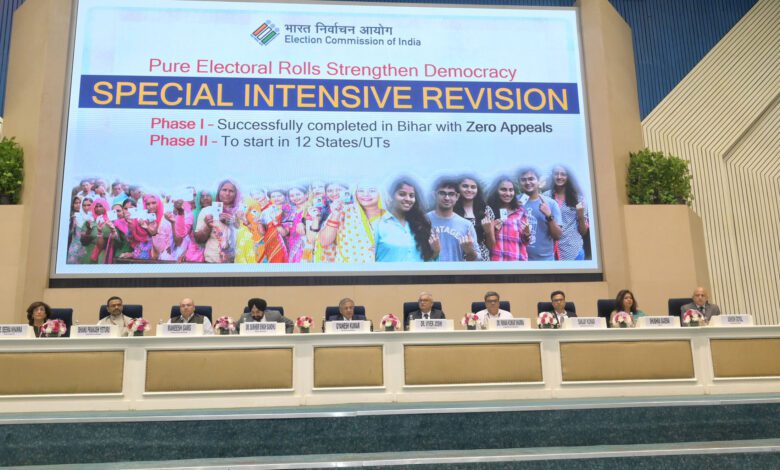
The argument began with the SIR, a nationwide voter-roll exercise. AP reported that more than 130 million names had been removed or affected in the revision process, while the Election Commission says the exercise is designed to clean lists and preserve eligible voters’ registration. The opposition claims the scale and documentation requirements could disenfranchise people and alleges political bias; the government and commission reject that charge. A deletion count alone does not show how many eligible voters were wrongly excluded. That requires transparent state-by-state data on notices, objections, hearings and restored entries.
There are parallel developments beyond Delhi. In Bengaluru, CJP and allied organisers announced a People’s Tribunal on SIR at Freedom Park for 4 p.m. on October 8, followed by a symbolic “chappal protest”; actor Prakash Raj and YouTuber Dhruv Rathee were named among participants. Because the event is scheduled for later today, its turnout, testimony and any police response cannot yet be confirmed. In Mumbai, police did not permit CJP’s October 2 Shivaji Park gathering; hundreds were reportedly named as unidentified persons in a case linked to the unauthorised event. A separate October 4 Shiv Sena (UBT)-MNS rally drew a crowd estimated by The Times of India at 8,000–10,000 and called for the SIR to be scrapped and the chief election commissioner to resign. In Pune, Congress and NCP (Sharadchandra Pawar) groups held separate protests and sought an inquiry into the revision; those demonstrations were earlier, not part of today’s Bengaluru event.
For activists, the next test is October 10, when CJP has announced another Delhi protest at Jantar Mantar. Organisers say they submitted notice; reports say Delhi Police denied permission, while authorities are preparing heightened security. CJP has alleged that preventive notices issued to volunteers in Maharashtra are intended to intimidate them. Police officials have described such notices as routine before protests. Both statements need to be weighed as claims by interested parties, not settled fact. The practical questions are whether a lawful alternative venue is offered, whether organisers and police communicate in advance, and whether detainees are promptly accounted for.
Readers should watch for the Bengaluru tribunal’s published testimony, official SIR objection and restoration figures, and the written basis for Delhi’s restrictions. The strongest evidence will be the roll data and documented treatment of individual voters—not viral claims alone. The right to protest and the integrity of electoral rolls are separate but connected public-interest questions; neither is answered by a slogan or a detention count.