NASA’s COSI Gamma-Ray Telescope Reaches Spacecraft Integration Stage

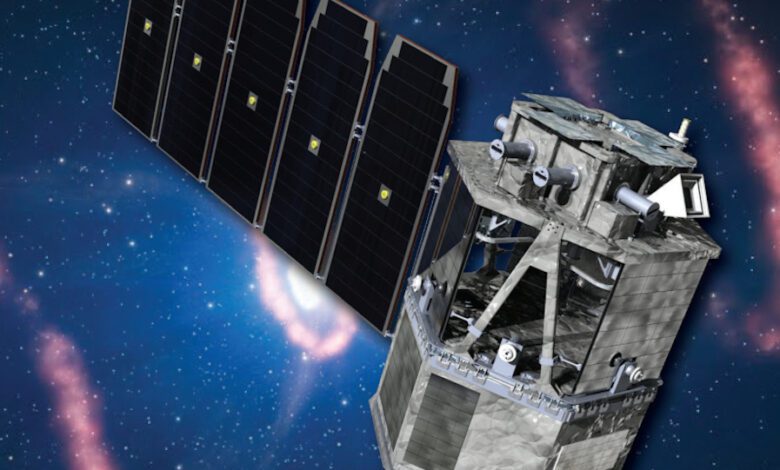
A telescope designed to observe the most energetic light in the universe has reached the spacecraft factory where it will become a satellite. NASA said the scientific payload for the Compton Spectrometer and Imager, or COSI, arrived at Northrop Grumman’s facility in Sterling, Virginia, after assembly at the University of California, Berkeley.
The delivery is a visible milestone rather than a launch. Engineers must integrate the instrument with a LEOStar-2 spacecraft and subject the combined observatory to vibration and thermal testing. NASA currently targets August 2027, and that date can move if testing reveals a problem. Space missions treat discoveries on the ground as successes because finding a weakness before launch is far cheaper than discovering it in orbit.
Why gamma rays require a space telescope
Gamma rays are the highest-energy form of electromagnetic radiation. Earth’s atmosphere absorbs most cosmic gamma rays, protecting life but preventing ordinary ground telescopes from seeing them directly. A satellite can observe this light above the atmosphere and trace some of the universe’s most violent processes.
COSI is designed for a broad view of the sky rather than a tiny field. Its goals include studying the final stages of stellar lives, the production of elements, and the creation and destruction of matter and antimatter. These are not abstract labels: radioactive elements and annihilating particles leave gamma-ray signatures at particular energies.
How a Compton telescope forms an image
Visible-light cameras record photons that travel in nearly straight lines through a lens. High-energy gamma rays do not behave so conveniently. In COSI’s detectors, a photon can scatter from an electron—a process known as Compton scattering—and then interact again. By measuring the positions and energies of those interactions, scientists can reconstruct a range of directions from which the photon likely arrived.
Many events build a map of the sky. The method also provides information about polarisation, the orientation of a light wave’s electric field. Polarisation can reveal magnetic fields and the geometry of extreme events that brightness alone cannot show.
The antimatter puzzle
Our galaxy produces positrons, the antimatter partners of electrons. When an electron and positron annihilate, they create a characteristic gamma-ray signal. Astronomers have mapped a strong signal toward the central Milky Way, but the sources of all those positrons remain uncertain.
COSI’s combination of spectral and imaging capability may help distinguish contributions from exploding stars, compact objects and other sources. It will not simply take a photograph of antimatter. Researchers will compare maps and energy lines with models, and multiple explanations may remain viable.
Tracing the origin of elements
Exploding stars and other energetic events manufacture and disperse elements. Some newly created isotopes are radioactive and emit gamma rays as they decay. Mapping those lines can show where material is produced and how it moves through the galaxy.
This connects the life cycle of stars to the material that later forms planets. The calcium in bones and iron in blood ultimately come from astrophysical processes. A gamma-ray observatory helps examine that history at the stage where fresh elements are still associated with their stellar sources.
From balloon flights to orbit
COSI technology has been tested through balloon missions, which lift instruments above most of the atmosphere for limited periods. An orbital mission can observe for much longer and scan more of the sky. The space environment, however, adds radiation backgrounds, thermal swings, power limits and the impossibility of routine repair.
That is why integration and environmental testing are central to the mission. Vibration tests simulate the stresses of launch. Thermal-vacuum work checks whether the observatory functions across temperatures in near-vacuum. Software and communications testing must show that commands and scientific data can travel reliably.
A collaborative mission
COSI is part of NASA’s Astrophysics Explorers programme. Partners include UC Berkeley, UC San Diego, the US Naval Research Laboratory, NASA’s Goddard Space Flight Center, Northrop Grumman, Space Dynamics Laboratory and the Italian Space Agency, among others.
Explorer missions are designed to pursue focused science questions at a smaller scale than flagship observatories. “Smaller” does not mean simple. Cryogenic detectors, precision electronics and background rejection must work together while the satellite surveys the sky.
What happens next
Engineers will mount the payload, complete environmental tests and resolve any anomalies. Launch preparations will include calibration, ground-system rehearsals and reviews. After launch, commissioning will take time before routine science begins.
The November delivery therefore deserves neither dismissal as a logistics story nor exaggeration as a completed mission. It means a complex scientific instrument has passed one stage and entered the demanding work of becoming a space observatory. If integration and launch succeed, COSI will give astronomers a new way to follow radioactive matter, antimatter and dying stars across the gamma-ray sky.