

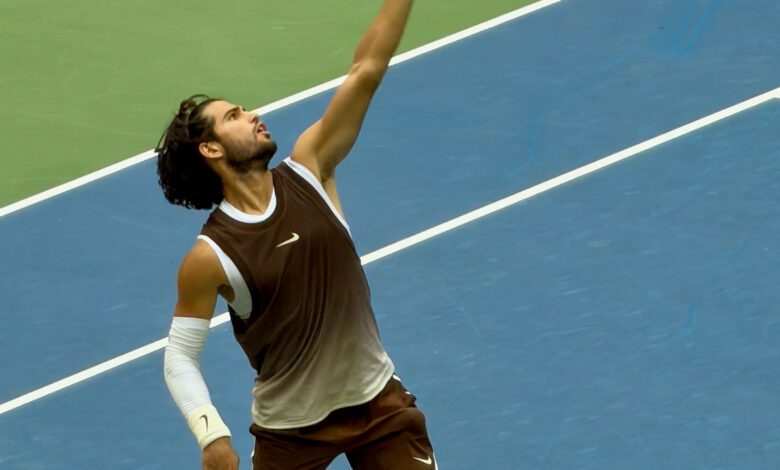
The ATP Finals opened in Turin with several of men’s tennis’s biggest names making immediate statements—and a format that leaves little room for a slow start. Carlos Alcaraz beat Frances Tiafoe 6-2, 6-2 on November 16, while Daniil Medvedev defeated Flavio Cobolli 7-6(4), 6-3. A day earlier, Alexander Zverev beat Rafael Jódar 6-4, 6-4 and Ben Shelton outlasted Arthur Fils 6-2, 3-6, 6-3.
Those results are the beginning of group play, not a knockout round. Eight singles players are divided into two groups, with everyone playing three matches. The top two in each group reach the semi-finals. A player can lose once and still win the tournament, while set and game percentages can become decisive in three-way ties.
Alcaraz starts fast
Alcaraz’s 6-2, 6-2 victory lasted a little over an hour, according to the tournament’s official results. The score suggests control rather than survival. An efficient opening win matters in Turin because it protects energy for repeated matches against elite opponents and builds a favourable games percentage.
Tiafoe’s challenge is to separate a poor result from the next match. Round-robin tennis creates an unusual psychological demand: a player walks off after a heavy defeat knowing the tournament may still be alive. The practical response is to examine serve patterns and return position without rebuilding an entire game overnight.
Medvedev manages the tight moments
Medvedev’s first set against Cobolli went to a tiebreak before the Russian pulled away in the second. Indoor hard courts reward a reliable serve, flat groundstrokes and the ability to change direction without wind. Medvedev’s deep return position can look vulnerable, but it also gives him time to neutralise pace and start rallies.
Cobolli’s opening set showed that a debutant can pressure an experienced Finals player. The difference was execution in a handful of points. At this level, a match can feel close for an hour and still finish in straight sets.
Zverev’s serving foundation
Zverev beat Jódar 6-4, 6-4 in the opening round. A straight-sets win without a tiebreak gives the top seed a clean base in the standings. Jódar began the season far outside the leading group and reached Turin after a rapid rise, making his presence one of the tournament’s less expected stories.
A newcomer does not need to overpower every opponent to be competitive. Holding serve, extending return games and avoiding clusters of errors can bring pressure late in a set. Zverev prevented that pressure from turning into a decisive opening.
Shelton and Fils supply the first three-set battle
Shelton’s win over Fils was the opening weekend’s most changeable singles match. The American dominated the first set, Fils answered in the second, and Shelton recovered in the third. Three-set matches can be costly in a group tournament, but the winner gains both a match and evidence that momentum can be reversed.
Fils’s set victory could still matter in tie calculations. Players and coaches track not only wins but sets and games, especially before the final round. Fans should wait for the tournament’s official scenario calculation rather than rely on simplified social-media tables.
The absent defending champion
Jannik Sinner is not in the field because of injury, removing the home favourite and defending champion from the draw. His absence changes the atmosphere and competitive balance without creating an easy path for anyone. The field still includes contrasting styles and players capable of beating one another indoors.
Injury reporting deserves care. A player’s team and official tournament information are better sources than speculation based on a training clip. Recovery timelines can change, and an athlete’s absence does not reveal a precise diagnosis unless it is disclosed.
Why the Finals format produces unusual tactics
In a standard tournament, the only objective is to win the current match. In round-robin play, a player may reach a late stage knowing that winning a set, or avoiding a lopsided score, affects qualification. That does not make individual games less competitive; it makes the arithmetic part of the contest.
Players must also manage recovery. The event runs from November 15 to 22, with doubles competition alongside singles at the Inalpi Arena. Short matches can preserve legs, but too little court time may leave a player under-tested before the semi-finals.
What to watch in the next round
The first question is whether the opening winners can secure a second victory and remove much of the qualification uncertainty. The second is how the defeated players adjust their return positions and serving patterns. Indoor conditions offer fewer weather excuses, putting tactics and execution under a bright light.
Readers following live scores should use the tournament’s official results because schedules and standings update during the day. The opening round has established the broad picture: Alcaraz and Zverev began efficiently, Medvedev controlled a tight first set, and Shelton survived the event’s first major swing. The group format ensures none of those performances is the final word.
Sources
- Official Nitto ATP Finals results and match times
- Official ATP Finals order of play
- Tournament format, schedule and standings