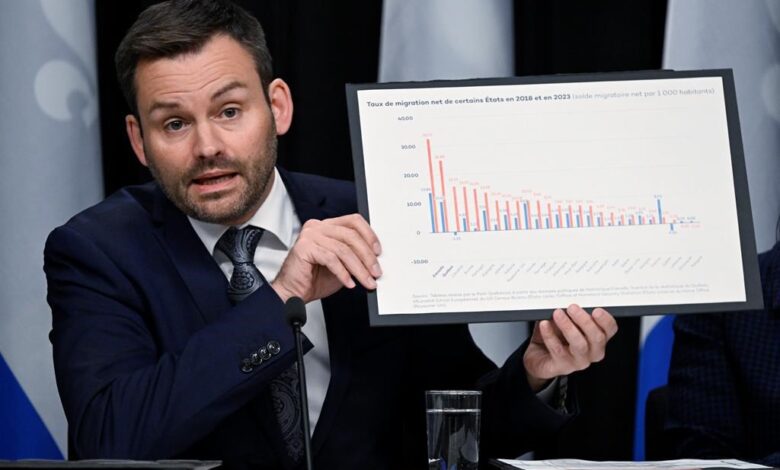
The Parti Québécois proposed in October 2024 that Quebec sharply reduce temporary immigration and help employers adopt robotics and automation in sectors facing labour shortages. The opposition party said the plan would relieve pressure on housing and public services and protect French; critics questioned its economic feasibility and effect on migrants.
The numerical proposal
A 97-page policy paper called for reducing Quebec’s non-permanent resident population from roughly 600,000 to between 250,000 and 300,000 within four years of taking government. Temporary foreign workers would fall from about 270,000 to 40,000 under the proposal.
These categories require care. Non-permanent residents include people with different permits and circumstances, and a population stock is not the same as annual arrivals. Refugee claimants, students and workers cannot all be treated as one labour programme.
Automation as the alternative
Leader Paul St-Pierre Plamondon argued that labour shortages should encourage investment in equipment, artificial intelligence and robotics rather than continued reliance on temporary workers. The party proposed a special automation fund for sectors including manufacturing and retail.
Automation can raise productivity and reduce dangerous or repetitive work. It cannot immediately replace every role, particularly jobs requiring care, judgment, dexterity or human interaction. New systems also require capital, training, maintenance and workers with different skills.
Housing and language arguments
The PQ connected rapid temporary-population growth with housing scarcity and pressure on services. It also argued that high migration levels made protection of French more difficult.
Population growth adds demand, but rent and service outcomes also reflect construction, zoning, funding and productivity. Language integration depends on education, workplace practices and access to French instruction as well as admission levels.
Rights and human consequences
Temporary residents are workers, students and families, not interchangeable inputs. Many have established communities, paid taxes and planned their lives around valid permits. Reductions need lawful transition rules, protection from exploitation and clear communication.
Describing workers as people to be “replaced by robots” risks dehumanizing them even if the intended policy is economic modernization. Employers remain responsible for wages and conditions and should not use either migrant status or automation to weaken labour standards.
Testing the economic claim
A credible plan would identify which occupations could automate, adoption cost, time to deployment and expected output. It would also model food prices, elder care, construction and regional employers that rely on seasonal or specialized labour.
Productivity gains should be compared with transition costs and distribution. Automation can produce higher output while displacing some employees, so training and income support matter.
A proposal, not government policy
The Parti Québécois held four seats in the National Assembly when it released the paper, despite leading some polls. Its targets had not become Quebec law.
The proposal raised a legitimate question about whether businesses should invest more in productivity rather than depend indefinitely on a vulnerable workforce. Its answer required more than a slogan. Sound policy would combine evidence-based admission levels, humane treatment of current residents and automation where it genuinely improves work, instead of assuming machines and people can be exchanged on a fixed numerical schedule.