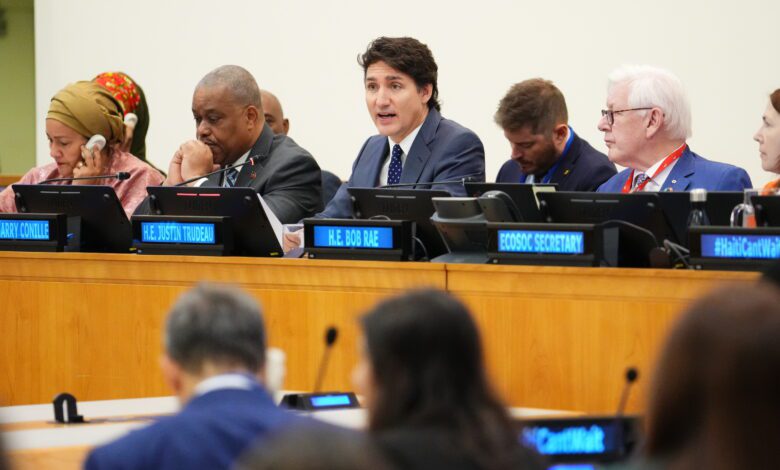
Prime Minister Justin Trudeau met Ukrainian President Volodymyr Zelenskyy in New York on September 24, 2024 as leaders gathered for the UN General Assembly and US President Joe Biden delivered his final address to the body while in office. Ukraine sought sustained military and diplomatic support.
The meeting occurred on the UN sidelines
Leaders frequently use General Assembly week for bilateral talks that are separate from formal UN proceedings. Trudeau and Zelenskyy discussed battlefield needs, humanitarian issues and efforts toward peace.
A meeting readout records the hosts’ account and does not reveal every private exchange.
Canada reaffirmed support for sovereignty
Trudeau condemned Russia’s invasion and attacks on civilians and energy infrastructure. Canada promised continuing military, financial, humanitarian and development assistance.
Commitment statements should be matched with appropriations, delivery dates and independently verified outcomes.
Ukrainian children were a specific subject
Canada co-led an international coalition seeking the return of Ukrainian children transferred or deported during the war. Family tracing, documentation and safe return require cooperation across jurisdictions.
Children’s identities and locations must be protected even while governments publicize the issue.
Long-range weapons remained controversial
Ukraine asked suppliers to relax limits on strikes against military targets inside Russia. Trudeau supported greater latitude, while the United States and others weighed escalation, targeting and operational plans.
Canada could advocate but could not change conditions on another country’s weapons.
Biden defended international alliances
In his final UN address as president, Biden emphasized support for Ukraine and cooperation through international institutions. His administration was approaching an election and eventual transition.
Future US assistance depended on Congress, policy decisions and the next administration, not one speech.
Zelenskyy needed attention beyond immediate crises
Escalation in the Middle East competed for diplomatic focus and resources. Ukraine sought to prevent fatigue as its forces faced Russian pressure and another winter.
Different crises should not be framed as a contest over which civilians deserve protection.
Peace language contained major disagreement
Ukraine insisted on sovereignty and territorial integrity, while Russia demanded conditions favourable to its occupation. Diplomatic proposals varied over sequencing, security guarantees and accountability.
A “peace plan” label does not establish that both parties accept it or that it complies with the UN Charter.
The tangible follow-up mattered
Canada planned a ministerial meeting on the human dimension of the war and continued coalition work. The United States announced further assistance around Zelenskyy’s visit.
The New York meeting demonstrated political alignment, but the useful audit was concrete: weapons delivered, children returned, energy systems protected and credible diplomacy advanced. Ceremonial access alone could not meet Ukraine’s needs.
Canadian support also required parliamentary oversight, clear valuation and monitoring of military exports. Aid figures can combine commitments, loans and delivered equipment, so dates and categories matter. Officials should disclose enough for accountability without revealing information that assists Russian targeting. That balance would let Canadians assess cost and effectiveness while preserving the security of Ukrainian operations and the people implementing them.
Independent public audits could verify timely delivery and lawful end use without exposing sensitive operational or tactical details.