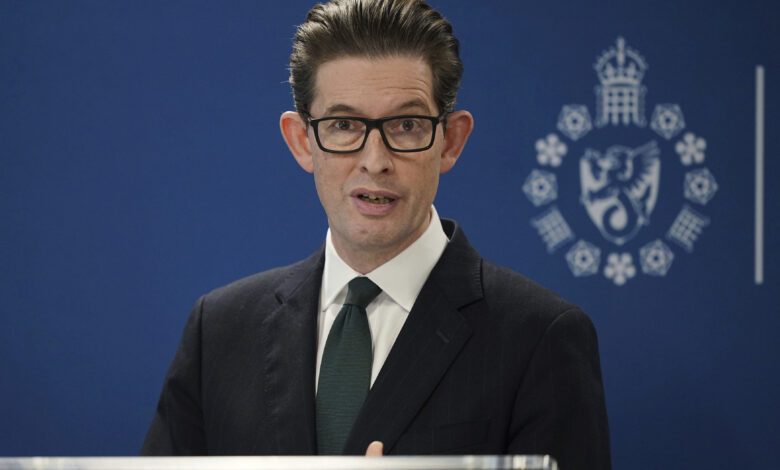
MI5 Director General Ken McCallum warned in October 2024 that the threat from ISIS and other terrorist networks was worsening as overseas groups renewed efforts to inspire or direct attacks. He described a security environment in which online radicalization, lone actors and hostile states increasingly overlapped.
Overseas connections were appearing more often
McCallum said more than one-third of MI5’s highest-priority investigations during the preceding month had some connection to an overseas terrorist organization. ISIS no longer controlled the territory it held a decade earlier, but its affiliates had spread across Africa, the Middle East and South and Central Asia.
He cited the March 2024 attack on a Moscow concert hall, claimed by ISIS-K, as evidence of operational capability. Austrian authorities had also arrested teenagers accused of planning an attack connected with a Taylor Swift concert in Vienna.
Online activity changed the pathway to violence
Propaganda can cross borders instantly and reach people without a formal introduction to an organization. McCallum said the internet had become central to MI5’s counterterrorism work as individuals assembled beliefs from extremist material, conspiracy theories and violent subcultures.
Thirteen per cent of subjects in MI5 terrorism investigations were under 18, roughly three times the share three years earlier. That figure described investigative subjects, not a rate among all young people and not proof that everyone viewed online would commit violence.
Ideological labels did not capture every case
McCallum said about three-quarters of plots disrupted since 2017 were associated with Islamist extremist ideology and about one-quarter with the extreme right. He cautioned that actual motivations could be mixed and unstable.
Accuracy requires distinguishing violent extremist ideology from religion. Muslims as a community are not responsible for ISIS, and stigmatizing them can weaken the trust needed for families and local organizations to report genuine risks.
MI5 also warned about state-directed activity
The agency reported a 48-per-cent rise in state-threat investigations over the previous year. McCallum accused Russia of seeking arson and sabotage through proxies and said MI5 and police had addressed 20 potentially lethal plots backed by Iran since 2022.
Those were intelligence assessments and disrupted allegations, not a finding that every named state-linked person had been convicted. Public agencies must protect operational sources while providing enough evidence for democratic and judicial oversight.
Canadian cases added relevance but required due process
Canadian authorities had recently arrested suspects in separate alleged ISIS-linked plots involving Toronto and a proposed attack in New York. The accusations prompted scrutiny of screening and intelligence sharing.
An arrest is not a conviction. Reporting should use “alleged,” avoid identifying uninvolved relatives or communities and follow court outcomes rather than leaving the original suspicion as the last searchable record.
Prevention must be targeted
Security services can investigate mobilization, financing, travel and attack planning. Schools, mental-health providers and community organizations can provide earlier help when a young person becomes isolated or fixated on violence.
Warning signs should be behavioural and specific—credible threats, attack preparation, attempts to obtain weapons—not a person’s faith, ethnicity or unpopular political views. Broad surveillance creates false positives and can divert resources from real danger.
A complex threat needs lawful resilience
McCallum said British authorities had disrupted 43 late-stage plots since 2017. Prevention successes are difficult to evaluate publicly because evidence is often classified, making independent oversight and later court scrutiny essential.
The warning’s central point was not that ISIS had rebuilt its former state. It was that a dispersed network could exploit conflicts and online channels while states used criminals as proxies. Responding effectively required international cooperation and early intervention without abandoning due process or treating entire populations as suspects.