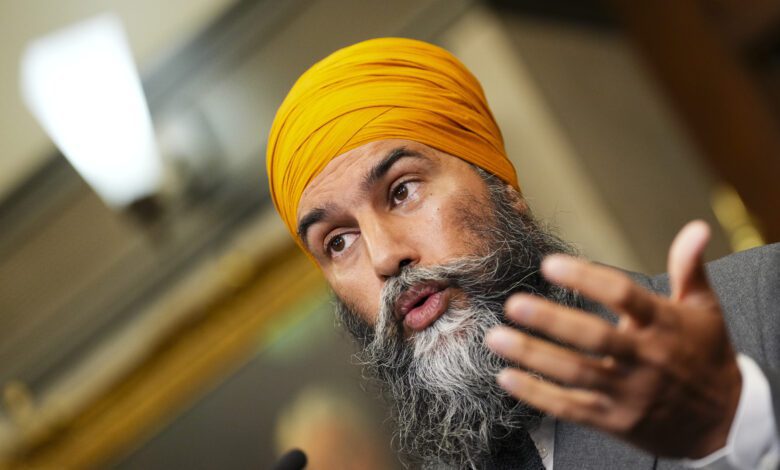
New Democratic Party leader Jagmeet Singh declared in September 2024 that Canadians were “done” with Prime Minister Justin Trudeau, days after ending the NDP’s supply-and-confidence agreement with the minority Liberal government. The statement sharpened partisan positioning as Parliament returned from its summer break.
The parliamentary agreement had ended
Since 2022, the NDP had promised to support the Liberals on confidence and budget votes in exchange for progress on agreed policies. Singh withdrew from that arrangement on September 4.
The decision did not automatically defeat the government or trigger an election.
Future votes became case by case
Without guaranteed NDP support, Liberals needed to negotiate with the Bloc Québécois, NDP or other MPs to survive confidence matters. Singh said his caucus would examine legislation and votes individually.
Opposition rhetoric alone was not a binding commitment to support every no-confidence motion.
Affordability drove Singh’s message
He blamed Liberal policy for high grocery bills, rents and pressure on household budgets. He also argued that Conservatives under Pierre Poilievre would cut health, pension and social programmes.
The NDP sought to present itself as an alternative to both governing Liberals and Conservatives.
Polling showed Liberal weakness
An Ipsos survey released as Parliament resumed found only about one-third approving of the federal government’s performance. Respondents were more likely to identify Poilievre than Trudeau or Singh as the person who would make the best prime minister.
One poll is a snapshot shaped by sampling, wording and timing, not an election result.
The NDP also defended achievements
Singh argued that the agreement had produced dental-care expansion, initial pharmacare legislation and other affordability measures. Ending cooperation did not require his party to disown policies it had demanded.
The strategic challenge was claiming results while separating from an unpopular government.
Conservatives pressed for an early election
Poilievre called on the NDP to vote down the government and framed continued support as hypocrisy. A confidence motion, however, still required enough opposition votes, and other parties retained their own calculations.
The fixed election date did not prevent an earlier vote after a loss of confidence.
Jurisdiction complicated campaign promises
Singh listed health care among his priorities even though provinces administer most delivery. The federal government influences care through transfers, national standards, taxation and legislation in defined areas.
Credible proposals therefore needed to explain the instrument, not only the desired outcome.
Byelections increased pressure
Losses in Toronto—St. Paul’s and later LaSalle—Émard—Verdun showed Liberal vulnerability in formerly secure urban seats. They also demonstrated that anti-government voters could divide among Conservatives, Bloc and New Democrats.
A national election would bring a different electorate and campaign.
The quotation was a political claim
No leader can speak literally for every Canadian. Singh’s wording summarized his reading of public frustration and his party’s new strategy.
The concrete constitutional story was narrower: the NDP ended predictable support, the Liberal ministry remained in office, and every confidence vote gained greater uncertainty. Voters would ultimately decide whether frustration benefited the NDP, Conservatives, Bloc or another party. Until then, Parliament’s recorded votes mattered more than any leader’s declaration about the public mood.