Pope Says Both Trump and Harris Are ‘Against Life’
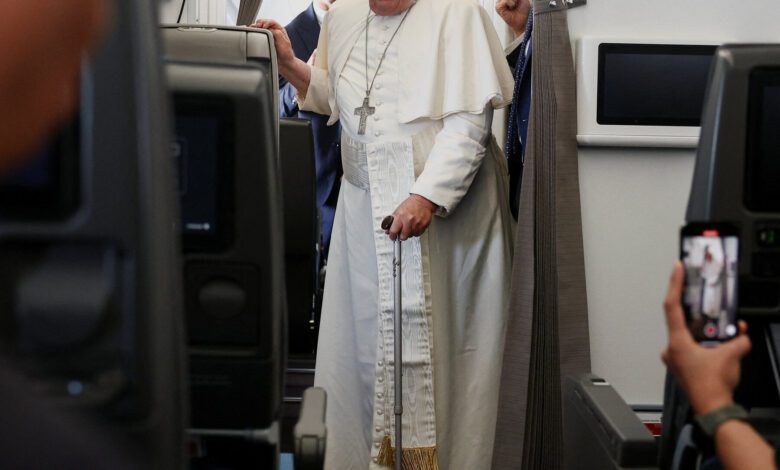
Pope Francis said both major candidates in the 2024 United States presidential election held positions that were “against life,” criticizing Donald Trump’s proposed mass deportations and Kamala Harris’s support for abortion rights. He urged Catholic voters to participate and choose according to conscience rather than endorsing either candidate.
The remarks came during an airborne press conference
Francis spoke to journalists on September 13 while returning to Rome from a 12-day journey through Indonesia, Papua New Guinea, Timor-Leste and Singapore. A reporter asked how a Catholic should choose between a candidate favouring abortion rights and one proposing to deport millions of migrants.
The question framed two moral issues the pope frequently addressed.
Francis condemned both policies
He described rejecting migrants as a grave moral failure and repeated the Catholic Church’s categorical opposition to abortion. His phrase placed the protection of unborn life and the dignity of migrants inside one broad ethic of human life.
It did not claim that the policies were identical in law, scale or circumstance.
He did not name the candidates directly
The references plainly concerned Republican nominee Trump and Democratic nominee Harris, but Francis answered in terms of their stated positions. He did not tell Catholics which name to mark on the ballot.
Headlines that presented the remarks as a formal Vatican endorsement would therefore be wrong.
The pope said voters should choose the lesser evil
Francis said abstaining from civic responsibility was not a satisfactory response and advised voters to examine conscience. “Lesser evil” did not mean either policy became morally good; it described a judgment between imperfect alternatives.
Individual voters could weigh the candidates differently while remaining responsible for their reasoning.
Trump made deportation central to his campaign
He proposed a large-scale operation to remove undocumented migrants. Francis had repeatedly argued that countries may regulate borders but must welcome, protect and integrate people fleeing danger and treat every migrant humanely.
Due process, family unity and protection from return to persecution remained relevant legal duties.
Harris supported legal abortion access
She campaigned to restore protections lost after the United States Supreme Court overturned Roe v. Wade. Francis reiterated the Church’s belief that abortion ends a human life.
Many voters, including Catholics, understand reproductive rights, maternal health and state power differently; the pope’s statement expressed Catholic doctrine rather than civil law.
A consistent-life frame challenged partisan categories
American politics often treats abortion as a conservative concern and migrant welfare as a progressive one. Francis refused that division, judging both through human dignity.
That approach also raises questions about war, poverty, capital punishment and health care beyond the two issues in the reporter’s question.
Religious guidance and democratic choice remain distinct
Church leaders may teach moral principles, while citizens in a pluralistic democracy evaluate candidates, policies, competence and likely consequences. Public officials govern people of many faiths and none.
Voters should neither misrepresent doctrine nor assume it automatically resolves every policy tradeoff.
The statement was criticism, not equivalence
Francis’s words were deliberately uncomfortable for both campaigns. Their meaning is lost when used only to attack one side or to claim that every issue carries the same weight.
His central message was that concern for life cannot stop at a partisan boundary. Catholic voters were asked to confront the harms in both platforms, make a conscientious choice and remain accountable for vulnerable people after election day.