
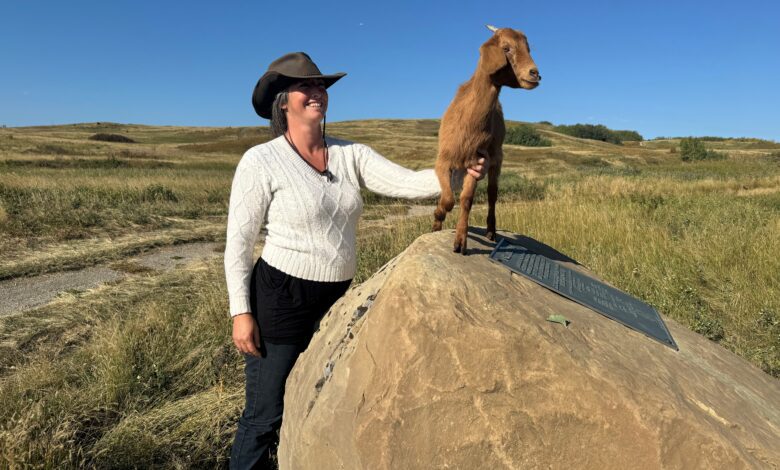
A three-legged goat named Lady Gaga became the most recognizable member of a herd helping Calgary manage invasive vegetation in September 2024. The approximately 800 goats grazed selected areas of Nose Hill Park as part of a targeted, lower-chemical approach to grassland care.
Goats can reach plants machinery misses
Goats browse leaves, flowers and seed heads across uneven terrain and can eat plants that cattle avoid. Handlers direct the herd toward particular patches, using repeated grazing to weaken unwanted vegetation before it spreads seed.
The animals are a management tool, not simply released into a park without supervision.
Nose Hill contains sensitive grassland
The large natural area preserves native prairie within the city and faces pressure from invasive species, recreation and surrounding development. Some introduced plants can crowd out native grasses and alter habitat.
Management has to control weeds without causing excessive soil disturbance or harming desirable vegetation.
The 2024 herd covered a defined area
Operators planned grazing across roughly 58 hectares for about two weeks. Timing, density and movement were selected to put pressure on target species while allowing grassland recovery.
Results depend on follow-up over multiple seasons; goats do not permanently eradicate every weed in one visit.
Lady Gaga was born with a contracted tendon
Her handler said the goat had used three legs from birth and kept pace with the herd. Caregivers were working with splints in an effort to straighten the affected limb.
Her story drew attention, but welfare should be judged through veterinary condition and ability, not sentiment alone.
Managed grazing has several potential benefits
It can reduce herbicide use in appropriate locations, work on steep ground and recycle plant material as manure. A visible herd can also help the public understand that urban parks are actively managed ecosystems.
Those benefits vary with plant species, weather, soil and execution.
There are risks to control
Overgrazing can damage native plants, compact soil or expose erosion. Goats may eat non-target species, spread some seeds or encounter toxic plants, dogs and park traffic.
Professional herders, fencing, guardian animals, water, rest and monitoring are therefore essential.
It is not automatically chemical-free
A city may combine grazing with hand removal, mowing, prescribed fire or carefully targeted herbicide where necessary. Calling the entire programme “eco-friendly” should not end comparison of cost, efficacy and ecological impact.
Before-and-after vegetation surveys provide a stronger measure than public enthusiasm.
A charismatic goat opened a useful conversation
Lady Gaga’s resilience made the project accessible to residents and news audiences. The wider value lay in testing whether adaptive grazing could restore native grassland with fewer unintended effects than other methods.
Calgary should track target-plant density, native species, soil condition, repeat treatment, animal welfare and total costs. If the evidence remains favourable, managed browsing can be one component of integrated weed management rather than a novelty.
Visitors also have responsibilities: observe closures, keep dogs away from working animals and follow staff directions. A successful programme protects the herd and park while turning an appealing story into measurable ecological improvement.



