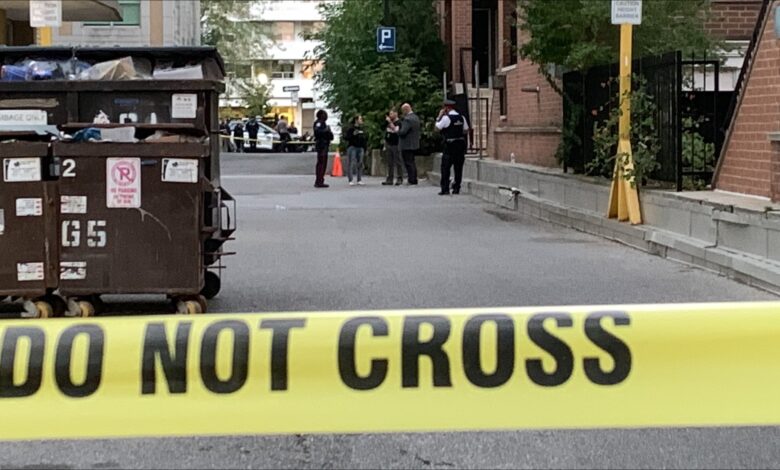
A Toronto police officer fired one shot at an armed man who was fleeing a robbery investigation on October 2, 2024, moments after another officer had been shot. No one was struck by police gunfire, and Ontario’s Special Investigations Unit later concluded there were no reasonable grounds to charge the officer who fired.
The investigation began with a stolen vehicle
Plainclothes officers from Toronto police’s 53 Division major-crime unit located a Honda Civic associated with a series of robberies in an underground garage near Yonge Street and Eglinton Avenue. They secured it and arranged for a tow.
At about 5:30 p.m., two men approached the vehicle. Officers believed both were connected to the robberies and moved to arrest them.
A struggle preceded the gunfire
Security footage reviewed by the SIU showed one man comply and be handcuffed while the other ran. A second plainclothes officer pursued him, and the two struggled after the fleeing man was struck by an unrelated moving vehicle in the garage.
During that struggle, the man reached toward his waistband and produced a handgun fitted with a light. The pursuing officer was shot through the abdomen but remained conscious and survived with injuries described as non-life-threatening.
The armed man ran toward the second officer
After the shooting, the man fled in the direction of the officer guarding the person already detained. Video showed him carrying the handgun as he approached.
The police officer drew his own firearm. The man dropped the handgun a fraction of a second before the officer discharged one round, then escaped in another vehicle. The police bullet did not hit him or anyone else.
Both men were arrested
Police arrested the person detained in the garage and later apprehended the man who fled. Neither suffered a serious injury during the incident, according to the SIU’s initial release.
Descriptions such as suspect and complainant identify roles in an investigation; they do not establish criminal guilt. Any related charges required their own evidence and court process.
The SIU investigated the police shot
Ontario’s civilian police watchdog automatically examines certain incidents involving officers, including a firearm discharge at a person. Investigators collected video, communications records, witness accounts, cartridge material and firearms evidence.
The subject officer exercised his legal right not to be interviewed and not to provide his notes. The SIU said the available independent evidence was nevertheless sufficient to reconstruct the relevant sequence.
No criminal charge was laid against the officer
In a report dated January 30, 2025, SIU director Joseph Martino found that the officer reasonably perceived an imminent lethal threat. The director emphasized the armed approach, the warning that another officer had been shot and the speed of the event.
Although video indicated the man had just dropped his gun, the report found that reaction time and the rapidly unfolding circumstances made the single shot reasonable in self-defence. Retreat was not considered a realistic option in the available time.
“Runaway suspect” needs precise context
The man was not merely running away when the officer fired; the SIU evidence showed that he was moving toward that officer with a firearm immediately after the first officer was shot. That distinction is central to understanding the watchdog’s conclusion.
It is equally important not to convert the SIU decision into a general endorsement of every police action. The finding addressed one firearm discharge under a specific sequence of evidence.
Independent review supplied the completed record
The initial report appropriately said the watchdog was investigating. The later public decision added video timings, physical evidence and a legal assessment unavailable during the first hours.
The final account is that a robbery investigation became an armed confrontation, one officer was wounded, a second officer fired without striking anyone, and the SIU closed its file without charges against that officer. Keeping each fact within its evidentiary scope protects both public accountability and due process.