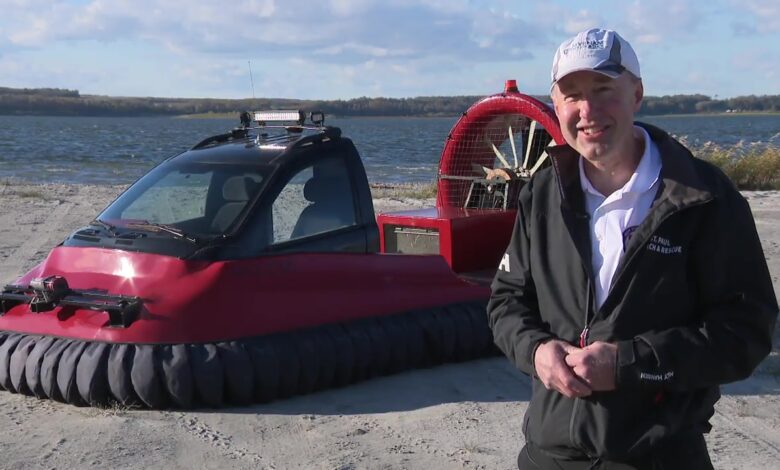
Robert Tymofichuk, a longtime teacher in the Alberta village of Myrnam, spent about 1,800 hours over one year building a working hovercraft from salvaged and custom-made parts. He hoped the project would show his students how persistence, experimentation and practical skills can turn an unusual idea into a real machine.
A childhood fascination returned
Tymofichuk said he became interested in inventions while growing up with limited television. Seeing a hovercraft move from land across a skim of lake ice and onto water left a particular impression.
He and his father later spent five years trying to build one, but that early craft never became airborne. The failed attempt remained part of the story rather than evidence that the idea should be abandoned.
The second build occupied a full year
By 2024, Tymofichuk had taught for 35 years and was responsible for mathematics, science and shop classes at New Myrnam School. Outside school hours, evenings and weekends went into the new craft, with help from his wife on parts of the project.
The reported 1,800 hours was his estimate of the work involved. It communicates the scale of the build but is not a time sheet or a claim that every hour produced visible progress.
Ordinary materials became specialized components
The cab came from a 1997 Jeep Cherokee, while other pieces were sourced from vehicle salvage yards and nearby repair shops. Many components could not simply be ordered for a standard consumer model.
Tymofichuk first shaped the steering control in papier-mâché around his hands, then reinforced it with fibreglass and foam. That iterative process combined ergonomics, fabrication and problem-solving.
The craft crossed several surfaces
A hovercraft rides on a cushion of pressurized air retained by a flexible skirt. Lift reduces contact with the surface, while a separate thrust system moves and steers the vehicle.
Tymofichuk’s machine could travel from solid ground over ice, snow and water. That versatility was what had captured his imagination decades earlier, though handling and stopping differ from a wheeled road vehicle or conventional boat.
Failure was useful engineering evidence
The first family project did not fly, but it exposed design problems and the practical difficulty of balancing weight, airflow, power and control. The later craft benefited from accumulated teaching and fabrication experience.
That is a more realistic lesson than saying determination guarantees success. Persistence works best when it includes measurement, redesign, outside knowledge and a willingness to stop an unsafe test.
Home construction still requires safety discipline
A successful demonstration does not by itself establish regulatory approval, seaworthiness or suitability for passengers. Operation on public land or water can involve vessel, environmental, insurance and local rules.
Builders should protect exposed machinery, test controls incrementally, use appropriate flotation and protective equipment, and avoid thin ice, traffic or bystanders. Celebrating ingenuity should not turn a complex machine into an invitation for careless imitation.
The classroom message was practical
Myrnam has only a few hundred residents, so a teacher’s project can make engineering unusually visible. Students could see that mathematics, science and shop work are connected rather than isolated subjects.
Tymofichuk’s hovercraft was impressive because it joined an old ambition with thousands of small decisions. Its strongest lesson was not that anyone can instantly build anything, but that curiosity, repeated testing and learned skill can carry an idea far beyond its first unsuccessful version.