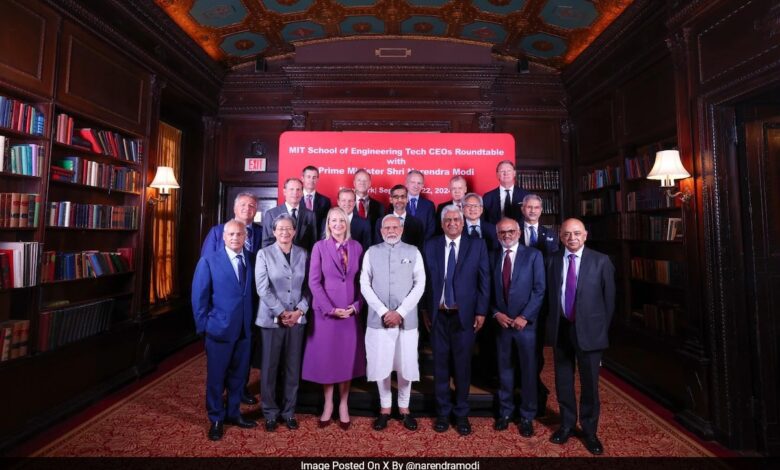
Prime Minister Narendra Modi met the leaders of 15 technology and life-sciences companies at a roundtable hosted by the Massachusetts Institute of Technology School of Engineering in New York on September 22, 2024.
The discussion focused on artificial intelligence, quantum computing, biotechnology, life sciences, semiconductors, computing and communications. It took place during Modi’s visit to the United States and was presented by the Indian government as an opportunity to deepen technology cooperation and encourage investment in India.
Who attended the roundtable
The participants named by India’s Ministry of External Affairs were Accenture chair and chief executive Julie Sweet; Adobe chair and chief executive Shantanu Narayen; AMD chair and chief executive Lisa Su; Biogen chief executive Chris Viehbacher; Bristol Myers Squibb chief executive Chris Boerner; Eli Lilly chair and chief executive David A. Ricks; Google and Alphabet chief executive Sundar Pichai; HP chief executive Enrique Lores; IBM chair and chief executive Arvind Krishna; Lam Research chief executive Tim Archer; Moderna chair Noubar Afeyan; Verizon chair and chief executive Hans Vestberg; GlobalFoundries chief executive Thomas Caulfield; Nvidia founder and chief executive Jensen Huang; and Kyndryl chair and chief executive Martin Schroeter.
The list spans software, chips, telecommunications, computing hardware and drug development. That mix allowed the meeting to address both digital infrastructure and research-intensive industries rather than concentrating on consumer technology alone.
India’s pitch to technology companies
According to the official account, Modi emphasised policies intended to support innovation and described India as a partner for co-development, co-design and production. He referred to the country’s semiconductor ambitions, the “AI for All” approach and the BIO E3 policy covering biotechnology for economy, environment and employment.
He also raised intellectual-property protection and the growth of India’s electronics and information-technology manufacturing sectors. These themes matter because companies considering research or manufacturing commitments look beyond market size to skills, power and logistics, regulatory predictability, data rules, patent enforcement and links to suppliers.
What the meeting did not establish
A roundtable is not the same as a signed investment agreement. The Ministry of External Affairs said the executives expressed interest in collaborating with India, but that statement should not be converted into a claim that all 15 companies committed new factories, funding or jobs at the meeting.
Any later project has to be evaluated through a company filing, government approval, construction milestone or other specific evidence. Investment incentives can attract attention, but commercial decisions depend on cost, demand, export controls and a project’s ability to compete over many years.
Why the discussion was significant
India has sought a larger role in semiconductor manufacturing, AI services, pharmaceutical research and resilient supply chains. Access to major technology companies can accelerate training, applied research and local production, while India offers a large market and a substantial technical workforce.
There are also public-interest questions. AI development requires privacy and accountability safeguards; chip fabrication consumes large amounts of water and power; and biotechnology policy must balance innovation, affordability and safety. A durable partnership needs measurable commitments and transparent regulation, not only high-level expressions of confidence.
Source: Ministry of External Affairs account of the Technology CEOs Roundtable.