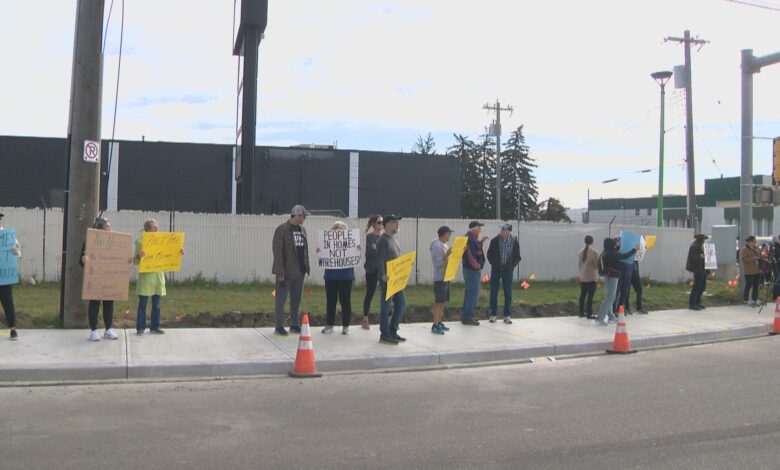
About 50 people protested outside a planned emergency shelter at 149th Street and 124th Avenue in Edmonton in September 2024, raising questions about safety, services and the suitability of an industrial location. Some residents also argued that placing unhoused people far from supports failed to respect their rights.
The site sat near Dovercourt
The building was under construction across from a Costco and among warehouses, a church and a thrift store. Neighbours worried about what would happen when clients left the shelter and how residents should respond to someone needing help.
Location concerns should be assessed with transport and service data rather than fear alone.
Protesters described a service gap
Patrick Scanlan said the area was difficult to reach and lacked services. Emergency accommodation works best when people can access meals, health care, income assistance, treatment, identification, employment and routes to permanent housing.
A bed isolated from those systems may prevent immediate exposure without resolving the crisis.
Residents wanted clear accountability
Dovercourt community member Ashley Speer said general directions to call 211 or 311 did not answer who would be responsible. A good-neighbour plan should identify a staffed contact, response times, complaint tracking and regular meetings.
It should also tell neighbours how to summon appropriate outreach instead of treating every concern as a police matter.
Governments pointed to different roles
The city said it handled zoning, while Alberta funded and regulated emergency shelters. The province said operators must secure municipal approvals and public consultation.
Those statements illustrated divided responsibility that can leave practical questions unanswered unless agencies publish a joint plan.
Hope Mission was expected to operate the site
The province said funded operators used good-neighbour practices, but Hope Mission had not answered the news outlet’s questions before the initial deadline. Early engagement could have supplied details about capacity, staffing, transport and supports.
Silence during planning can deepen distrust even when an operator intends to respond later.
Safety includes shelter users
People experiencing homelessness face high rates of violence, theft, exposure and health emergencies. An industrial area can create pedestrian, transport and isolation risks for them as well as questions for nearby residents.
Public consultation should include people likely to use the shelter, not only property owners.
Evidence should guide mitigation
Before opening, agencies could publish a transit and walkability assessment, service map, security model, overdose response, storage policy and pathway to housing. After opening, aggregate incident and outcome data could test assumptions.
Privacy rules must prevent the shelter from becoming a site of public surveillance.
The debate should not become displacement
Opposing every location leaves people outdoors, while accepting any building without services can institutionalize poor care. Penelope Moon Walker’s question—why place unhoused people in an industrial area—deserved a substantive answer.
A responsible opening would connect the shelter to transport and supports, establish accountable neighbourhood communication and treat clients as residents with rights. The goal is not merely moving visible homelessness away from another district; it is helping people move from danger toward permanent homes.
Publishing an opening review after several months would show whether promised safeguards worked.