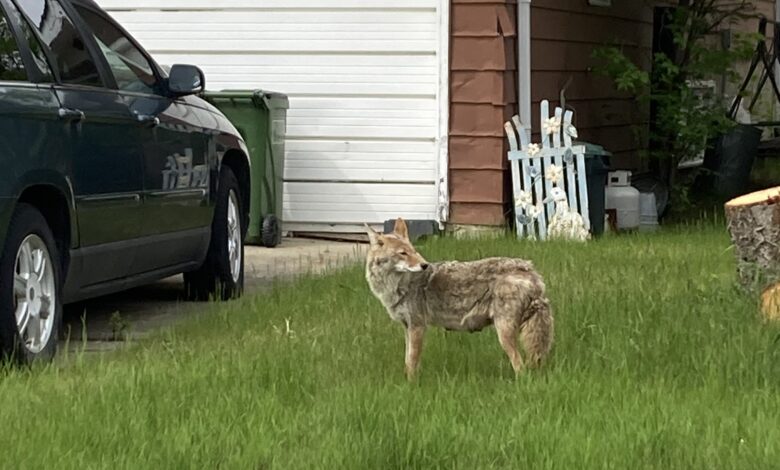
A resident of Edmonton’s Sweet Grass neighbourhood called for action in September 2024 after frequent coyote sightings and the discovery of a dead cat. The incident renewed debate over when coexistence measures are sufficient and when an individual animal’s behaviour justifies removal.
A family of coyotes used residential spaces
Kinia Romanowska said she had seen adults and pups moving among cul-de-sacs, approaching windows and entering her fenced yard. She believed the animals had become unusually comfortable around homes.
Repeated sightings alone do not prove aggression, but reduced wariness can increase conflict.
The remains of a cat intensified concern
Romanowska and her son found parts of a dead cat on neighbourhood grass. Wildlife biologist Colleen Cassady St. Clair said cats are vulnerable prey and that adults may use prey to teach young coyotes to hunt.
Without direct evidence, the exact sequence could not be reconstructed.
Dogs had previously been confronted
Romanowska described an earlier incident in which a coyote attacked two neighbourhood dogs and bit one. She worried about pets and children as the animals moved through spaces used for play.
Serious attacks on people remain uncommon, but close encounters should be reported.
Edmonton favoured coexistence where possible
The city and university wildlife project emphasized reducing attractants and restoring coyotes’ fear of humans. Park rangers investigate reports and assess location, frequency and behaviour.
Removal can occur after repeated dangerous encounters, but is not the automatic response to presence.
Food sources draw wildlife into yards
Accessible garbage, compost, fallen fruit, pet food, birdseed and rodents can reward coyotes. Open spaces beneath sheds or stairs may offer shelter.
Residents can reduce risk by securing waste, cleaning fruit, feeding pets indoors and closing denning spaces.
Supervised pets are safer
Cats should be kept indoors or within secure enclosures, particularly from dusk to dawn. Dogs should remain close on a leash, and owners should scan the area before entering a dark yard.
A retractable lead may offer too much distance during a sudden encounter.
Hazing must be consistent
If a coyote approaches, adults can stand tall, shout, wave, use noise makers and throw objects near—not to injure—the animal while maintaining an escape route. Neighbours need a consistent response so bold behaviour is never rewarded.
People should not haze an animal that is cornered, injured or protecting a den.
Relocation is rarely a simple solution
Moved coyotes may die, return or leave an open territory for another animal. Targeted lethal removal may sometimes be justified for persistent dangerous behaviour, but broad culls do not remove urban food and habitat.
Evidence about the specific animal is essential.
Community response works best collectively
Residents should record time, location and behaviour, report aggressive encounters and inform neighbours without sensational claims. The city can map patterns and explain its intervention threshold.
The Sweet Grass concern was real, especially after a pet’s death. A durable response combined prompt investigation with attractant control, pet protection and carefully applied aversive conditioning. Removal should remain available when evidence shows escalating risk, but fear alone should not determine wildlife policy.