
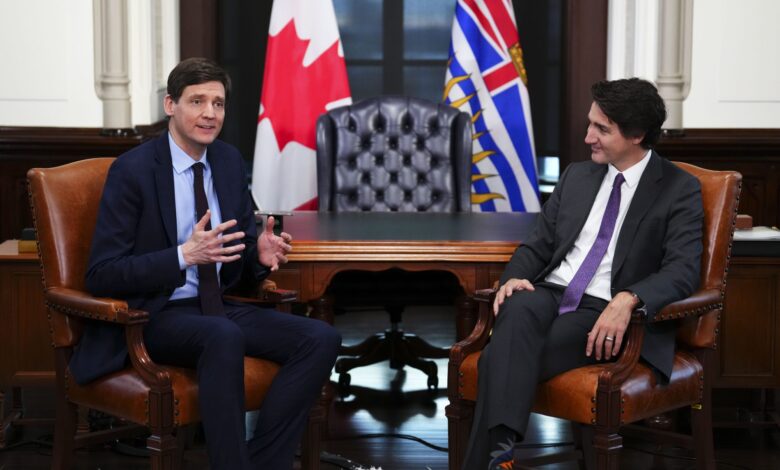
British Columbia’s 2024 provincial election began amid unusually close competition between Premier David Eby’s New Democratic Party and John Rustad’s rapidly growing Conservative Party of B.C. Political observers described the campaign as a possible test of messages, voter coalitions and organizing methods that federal parties would later confront across Canada.
The provincial contest had its own parties
The Conservative Party of B.C. is legally and organizationally separate from Pierre Poilievre’s federal Conservative Party, even though voters and campaign workers may support both. The B.C. NDP is more formally connected to the federal New Democratic Party, but provincial leaders make independent strategic decisions.
Those distinctions mattered when interpreting a provincial result as a federal signal.
A realignment made the campaign competitive
Rustad’s party gained support as the established B.C. United organization collapsed and withdrew its candidates. Many centre-right voters consolidated behind the Conservatives, turning what had once appeared to be a comfortable NDP contest into a close race.
The change reflected provincial leadership and party organization as well as national dissatisfaction.
Cost and public services dominated
Housing affordability, health-care access, public safety, taxation and the cost of living featured heavily. Both leading parties promised change, but differed over regulation, climate policy, spending and the role of government in housing construction.
These issues also appeared in federal debate, making campaign language useful to national strategists.
Carbon pricing created an Ottawa connection
Rustad promised to eliminate B.C.’s consumer carbon tax if the federal government removed its legal requirement. At the time, a province without a compliant pricing system could face the federal backstop.
The promise therefore depended partly on federal law and invited arguments about affordability, rebates and emissions policy beyond the province.
The federal NDP faced a delicate relationship
Eby had incentives to defend his own government’s record rather than campaign as a proxy for federal leader Jagmeet Singh. A provincial loss could weaken perceptions of NDP strength in a region that had long supplied important federal seats.
A provincial win would not automatically transfer to the federal party because leaders, candidates and ballot choices differ.
Federal Conservatives watched Rustad’s coalition
The B.C. campaign tested whether messages about crime, parental rights, resource development and government competence could combine traditional conservatives with voters frustrated by housing and living costs. It also exposed risks when candidates made unsupported or polarizing claims.
National parties could study both turnout gains and reputational costs without treating the organizations as identical.
The final result was exceptionally narrow
After judicial recounts, the NDP won 47 of 93 seats, the Conservatives 44 and the Greens two. That gave Eby the smallest possible majority and confirmed that the campaign had captured a genuine political shift rather than a temporary polling story.
The outcome also showed why close-riding organization, advance voting and candidate vetting matter.
A trial run is not a prediction
Federal elections use different boundaries and are influenced by national leadership, Quebec, Ontario and regional contests across the country. Voters can support different parties at different levels, and events after October 2024 could change priorities.
B.C.’s election was valuable as evidence of a competitive electorate, not as a forecast with a guaranteed result. It demonstrated that affordability and institutional trust could reorder established loyalties, while the final seat count showed the power of local campaigns. Federal strategists could learn from it, but still had to earn each vote in a separate election.



