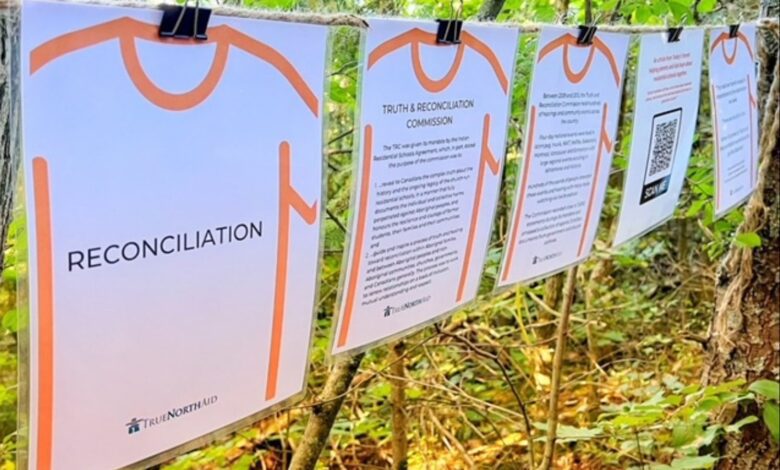
A public Reconciliation Walk at Guelph’s Riverside Park on September 29, 2024 invited residents to learn about Indigenous history and the continuing effects of residential schools. The event supported Orange Shirt Day, but organizers framed walking together as an opening for education rather than proof that reconciliation had been achieved.
The event was free and open to families
True North Aid and the Rotary Club of Guelph organized activities at the park’s Green Pavilion from 10 a.m. to 3 p.m. Registration was not required, and volunteers helped guide participants along the route.
The walk itself took about an hour. Information placed along the path allowed people to move at a reflective pace and discuss difficult material with family or friends.
Orange shirts carry a specific history
Orange Shirt Day grew from survivor Phyllis Webstad’s account of having a new orange shirt taken from her when she entered residential school. The symbol now recognizes children who were separated from families, survivors and those who did not return home.
Wearing orange has meaning when participants understand that origin. Generic merchandise or a photograph without learning can turn a survivor-led symbol into a seasonal gesture.
The walk centred truth before reconciliation
Canada’s residential-school system was funded by the federal government and largely administered by churches. It forced Indigenous children away from home and subjected many to neglect, abuse and suppression of language and identity.
The Truth and Reconciliation Commission recorded survivor testimony and issued 94 Calls to Action. An educational walk can introduce that history, while institutional responsibilities continue far beyond the event.
Public space made learning visible
Holding the event in a familiar city park lowered barriers for people who might not attend a formal lecture. It also placed Indigenous history within the everyday geography of Guelph rather than treating it as distant or exclusively western Canadian.
Visibility should not become spectacle. Participants can respect instructions about photographs, ceremonies and conversations and avoid demanding that Indigenous attendees disclose personal experiences.
Local relationships deserve attention
Reconciliation becomes more concrete when residents learn whose lands they occupy, the treaties and agreements that apply, and the Indigenous organizations serving the region today.
A territorial acknowledgement has limited value if it is recited without that knowledge. Schools, clubs and municipal institutions can connect language to decisions about partnerships, procurement, education and cultural support.
Healing cannot be assigned to survivors alone
Organizers emphasized that truthful recognition is necessary before healing. Survivors and families should determine their own paths, which may include public testimony, private life, ceremony, anger, forgiveness or none of those.
Non-Indigenous participants have a different responsibility: to learn the documented history and press institutions to fulfil commitments without expecting survivors to perform emotional labour for them.
Participation could continue after the walk
Residents could read the commission’s reports, support Indigenous-led groups, attend local cultural programs and examine present inequities in child welfare, health, education and justice. These actions make the annual observance part of a sustained practice.
Accuracy also matters. Ground-penetrating radar findings, archival records and survivor testimony are different forms of evidence and should be described precisely without using uncertainty to deny the well-established system.
The route was symbolic; the work is ongoing
The Riverside Park event offered a welcoming way to stand with survivors and learn. Its public value came from connecting remembrance to honest information.
Reconciliation is ultimately measured by relationships, restitution and policy, not distance walked. The most respectful outcome was for participants to leave the park better informed and prepared to act throughout the year.