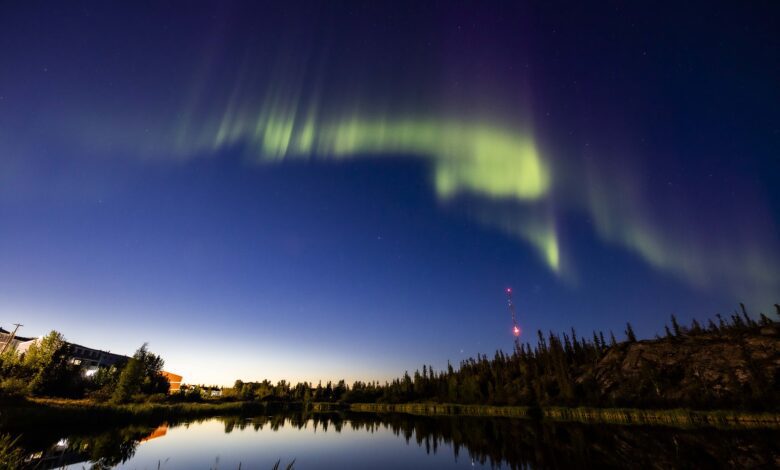
A series of solar eruptions prompted forecasters to issue a strong geomagnetic-storm watch for October 4–6, 2024, raising the possibility of northern lights across much of Canada. The forecast described potential space-weather conditions, not a guarantee that every community would see an aurora.
A strong storm was possible
The U.S. Space Weather Prediction Center used a G3 watch, the third level on a five-level geomagnetic scale. The agency was monitoring coronal mass ejections that left the Sun, including material associated with a powerful X9-class flare from active region 3842.
Solar-flare strength and geomagnetic-storm strength are separate measures. A flare is a burst of electromagnetic radiation; a coronal mass ejection carries plasma and magnetic field that may disturb Earth’s magnetosphere if its path and orientation are favourable.
Canada had the broadest viewing opportunity
Northern communities routinely sit closer to the auroral oval, while a stronger disturbance can push visible activity south toward the provinces and northern United States. In this forecast, clear parts of western, central and eastern Canada all had a chance.
A national possibility did not mean identical conditions. Latitude, cloud, moonlight, local light pollution and the timing of a solar arrival could produce a bright display in one place and no visible colour a few hundred kilometres away.
The forecast contained substantial uncertainty
Coronal mass ejections take time to cross interplanetary space, and their speed can change. Instruments closer to Earth provide better information only shortly before arrival.
The direction of the incoming magnetic field is especially important. Strong solar material can produce a weaker-than-expected response when its field does not couple efficiently with Earth’s magnetic field, while a favourable orientation can intensify activity.
Aurora begins high in the atmosphere
Charged particles guided along Earth’s magnetic field collide with oxygen and nitrogen in the upper atmosphere. Those interactions release light, commonly green from oxygen and sometimes red, blue or purple under different conditions.
A camera may record more colour than a person sees because it can collect light over a longer exposure. Photographs are useful evidence of a display, but highly processed images should not define what viewers should expect with unaided eyes.
Darkness and patience improve the odds
Observers should find a safe location away from streetlights with a clear view toward the northern sky. The period around local midnight is often useful, although an active band can appear earlier or later.
Checking cloud forecasts and live geomagnetic data shortly before travelling is more reliable than acting on a multi-day headline. Drivers should park legally, avoid stopping on highway shoulders and dress for the weather.
Geomagnetic storms affect technology too
A G3 event can require voltage corrections on some power systems and affect satellite navigation, high-frequency radio or spacecraft operations. Grid and satellite operators monitor those risks and can take protective steps.
That possibility was not a prediction of a widespread blackout or communications collapse. The G scale describes a range of potential effects, and actual impact depends on storm duration, location and system resilience.
The weekend watch was an invitation, not a promise
Solar activity was approaching the active phase of its roughly 11-year cycle, making notable auroras more frequent than during a quiet solar minimum. Even so, exact local visibility remained hard to forecast.
For Canadians under clear, dark skies, the sensible plan was to watch updated forecasts and look north. The science supported a genuine opportunity for a display while also explaining why a forecast map could never guarantee what appeared overhead.