
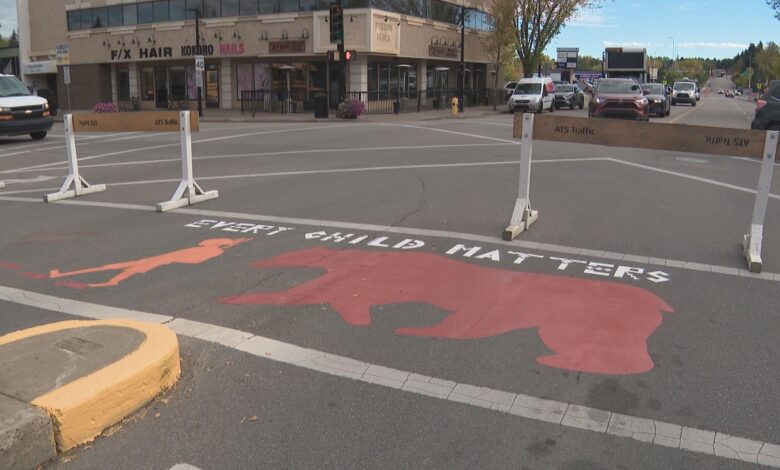
St. Albert unveiled an orange Every Child Matters crosswalk in September 2024 to honour residential-school survivors and the children who never returned home. The downtown public artwork was intended as a daily reminder of local history and an invitation to continued reconciliation.
The installation used a familiar national symbol
Orange has become associated with residential-school remembrance and Orange Shirt Day. The phrase Every Child Matters centres the value of children whose culture, language and family bonds were targeted by the system.
Communities should explain the origin rather than use the design as decoration detached from survivors.
Local Indigenous participation was essential
A respectful municipal project requires consultation with First Nations, Métis people and survivors connected to the area. Their knowledge helps determine imagery, language, ceremony and the location’s meaning.
Government approval alone cannot confer cultural legitimacy on Indigenous remembrance.
The crosswalk placed history in everyday space
People encounter a street marking during ordinary trips rather than only at a museum or annual ceremony. That visibility can prompt questions from children and newcomers.
It also creates a duty to maintain the work when traffic and weather cause damage.
Residential schools affected the region
Alberta contained numerous institutions within Canada’s residential-school system, which separated Indigenous children from their families and exposed many to neglect, abuse and death. Survivors and descendants continue to live with those effects.
Accurate local interpretation should identify nearby institutions and communities without generalizing individual experiences.
Commemoration is not policy completion
A crosswalk cannot replace records, searches, health support, language revitalization, land relationships or implementation of the Truth and Reconciliation Commission’s Calls to Action.
Symbols are meaningful when accompanied by budgets and sustained institutional change.
Public art can face misunderstanding
Some residents may not know the design’s purpose, while vandalism can inflict renewed hurt. Signs, school resources and prompt maintenance help protect both the artwork and its educational role.
Police response to damage should be evidence-based and avoid premature assumptions about motive.
Events should be survivor-centred
Ceremonies can involve testimony and grief, so organizers should obtain consent, provide cultural and emotional support and avoid turning survivors into a public spectacle. Media must respect requests about photography and names.
The people remembered are more important than municipal branding.
The measure of reconciliation is relationship
St. Albert’s annual report described the crosswalk alongside continuing work to strengthen First Nations and Métis relationships. Residents could assess progress through Indigenous participation in decisions, education and concrete commitments.
The crosswalk was a visible act of remembrance. Its lasting value depended on whether people learned from it, cared for it and carried its message into policies affecting Indigenous children and families.
Municipalities should budget for restoration before a symbolic installation deteriorates and consult communities before changing or relocating it. They can also connect the site to verified historical resources, local language and survivor-led education. Those steps turn a brief unveiling into continuing public knowledge. Reconciliation is not completed by agreement on one symbol; it is demonstrated through respectful relationships and measurable institutional action over time.



