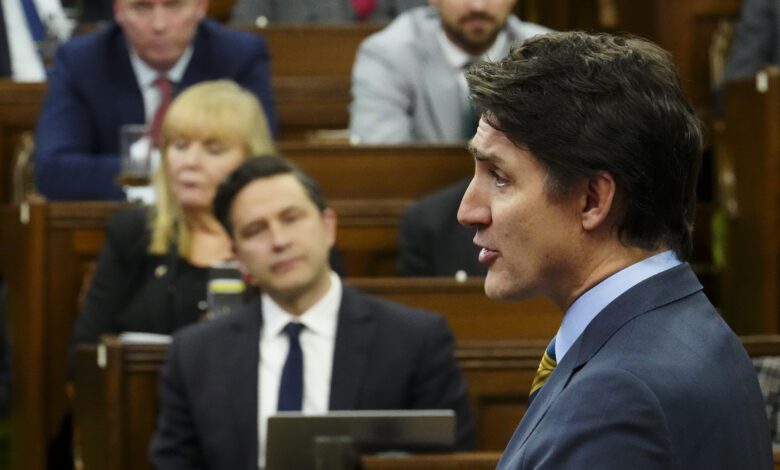
Canadian MPs were scheduled to vote on September 25, 2024 on a Conservative motion declaring no confidence in Prime Minister Justin Trudeau’s government. It was the first such test after the NDP ended its formal supply-and-confidence agreement with the minority Liberals.
The wording made the consequence clear
The motion stated that the House had no confidence in the prime minister and government. If adopted, constitutional convention would normally require the government to resign or seek an election.
It did not need to pass legislation or specify an alternative government to have that effect.
Conservatives wanted an immediate election
Pierre Poilievre framed the vote around housing, food prices, taxes and dissatisfaction with Trudeau. His party led many polls but lacked enough Commons seats to pass the motion alone.
Campaign readiness and parliamentary arithmetic were separate realities.
The NDP agreement had changed the calculation
Jagmeet Singh ended an arrangement that had supported the Liberals on confidence matters in exchange for progress on policies including dental care and pharmacare. Ending it restored case-by-case decisions.
It did not require New Democrats to vote for every Conservative attempt to bring down the government.
The Bloc held additional leverage
Bloc Québécois MPs could help either side in close divisions and were pressing demands on seniors’ benefits and supply management. Supporting the government on one vote did not promise support on the next.
Minority parties use that flexibility to advance distinct priorities.
Advance predictions needed caution
Statements from party leaders indicated the motion was likely to fail, but the official division remained the decisive evidence. Attendance and last-minute changes can matter in a minority House.
Responsible reporting described commitments while waiting for the recorded result.
The motion was defeated
House records show 120 MPs voted for the motion and 211 voted against it. The Liberal government therefore remained in office and continued parliamentary business.
The clear result corrected any impression in the pre-vote headline that defeat was equally probable.
Survival did not mean stability
The government still needed opposition support on future budgets, supply bills and confidence motions. Liberal polling weakness and caucus concern also continued after the vote.
A parliamentary win establishes legal authority, not popular approval or immunity from a later election.
The vote created a public record
Every participating MP’s position was published in Vote 858. That record allowed constituents to evaluate the decision without relying on partisan summaries.
The immediate outcome was straightforward: Trudeau survived 211–120. The larger political significance was that support would now be negotiated vote by vote, leaving the minority government alive but exposed to repeated tests.
Future articles needed to identify whether a motion was explicitly a confidence matter, record which parties supported it and avoid presenting every contentious vote as capable of automatically causing an election. Canada’s governor general, not a party leader, formally dissolves Parliament on constitutional advice. These procedural facts help readers separate campaign rhetoric from the actual conditions under which a government can fall.
They also make later political updates easier to verify against official records.