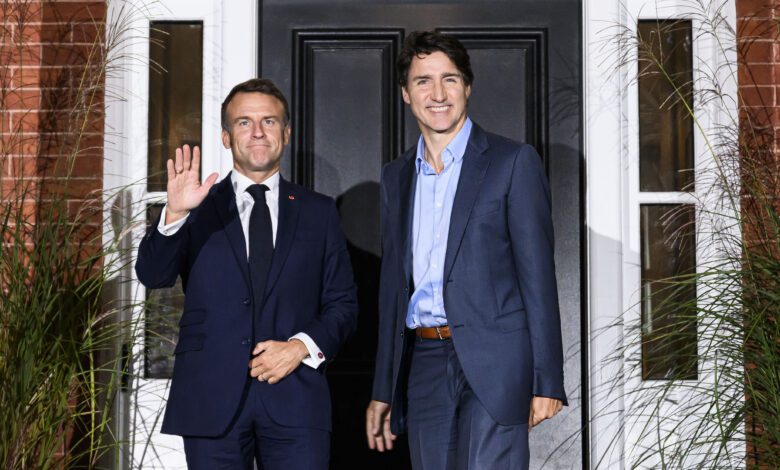
Prime Minister Justin Trudeau hosted French President Emmanuel Macron in Canada on September 25 and 26, 2024 for talks spanning defence, Ukraine, artificial intelligence, climate policy, trade and the French language. The visit included meetings in Ottawa and Montreal before the next Francophonie summit in France.
The relationship has deep institutional roots
Canada and France are NATO allies, G7 members and partners through the Organisation internationale de la Francophonie. Quebec also maintains a distinctive direct relationship with the French government.
Shared language and history create regular contact, but the countries do not hold identical positions on every security or economic question.
Defence cooperation received a formal declaration
Trudeau and Macron called for a stronger bilateral defence and security partnership. Priorities included interoperability, procurement, research and cooperation in the North Atlantic and Indo-Pacific.
Announcements require budgets and implementation. A declaration establishes direction but does not itself deliver equipment or readiness.
Both leaders reiterated support for Ukraine
Canada and France had signed long-term security agreements with Ukraine following Russia’s full-scale invasion. They emphasized military assistance, economic resilience and deterrence against future aggression.
Support also involved sanctions and diplomacy. Its effectiveness depended on coordination with other European and North American allies.
The Middle East crisis was urgent
The visit occurred as France and the United States proposed a 21-day ceasefire across the Israel-Lebanon border. Canada joined other governments endorsing space for negotiations.
France’s historical connections to Lebanon and Canada’s large Lebanese diaspora gave the escalation immediate domestic as well as foreign-policy consequences.
Artificial intelligence linked research and business
The leaders discussed responsible AI and innovation cooperation. Canada was named Country of the Year for the Viva Technology 2025 conference in Paris.
Commercial promotion was accompanied by questions about safety, privacy, labour and cultural diversity. Shared standards can help firms operate across markets while protecting rights.
Oceans and climate formed another partnership
The governments announced an intention to strengthen cooperation on ocean science, conservation and sustainable maritime activity. Both countries have extensive coastlines and interests in polar and Atlantic governance.
Credibility requires progress on emissions, biodiversity and financing beyond high-level language.
Trade had grown under the EU agreement
The Canada-European Union trade agreement had provisionally applied since 2017. The joint statement noted substantial growth in bilateral merchandise flows over the following seven years.
Businesses still faced regulatory differences, procurement barriers and uncertainty, areas where political meetings can direct technical work.
The visit combined symbolism with a work programme
Macron met federal and Quebec leaders and Francophone representatives. Public ceremonies reinforced ties, while declarations created commitments that could later be measured.
Meetings with civil society and business leaders also allowed concerns to reach the agenda beyond the two executive offices. In a bilingual federation, discussion of French-language institutions carried cultural and constitutional significance as well as diplomatic symbolism.
The lasting public value of the visit depended on whether defence projects, sustained Ukraine support, responsible AI governance and ocean cooperation moved from joint statements to funded action. Diplomatic warmth opened doors; practical delivery ultimately determined the result.