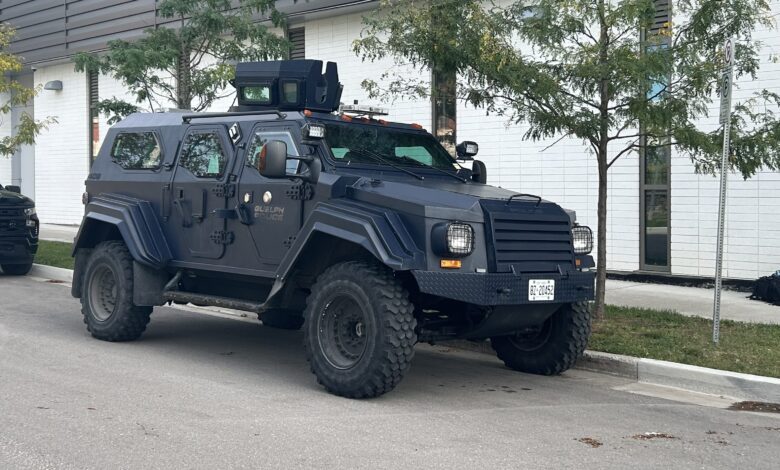
Guelph Police added a used armoured vehicle to its fleet in 2024 for calls involving firearms and other high-risk situations. The service paid Waterloo Regional Police C$20,000 for the Ford-based Gurkha, far less than the cost of a new tactical rescue vehicle.
The vehicle had served two previous owners
The 2005 light armoured patrol vehicle was built by Ontario-based Terradyne Armoured Vehicles. It had originally been used by Bruce Power and later by Waterloo Regional Police before Guelph acquired it.
Buying third-hand reduced the purchase price but made inspection, maintenance history and remaining service life important. A low initial cost does not eliminate future repair and training expenses.
Police described it as protective transport
The vehicle can shield officers while they approach an armed scene and can help extract injured people or residents from an exposed area. Its purpose is protection and movement, not the deployment of a weapon.
Police said high-risk calls involving firearms had become more common and that ordinary cruisers did not provide ballistic protection. Waterloo officers were expected to assist with training.
The price comparison required context
Guelph’s C$20,000 purchase came from an approved fleet budget. Contemporary purpose-built replacements used by other police services could cost more than half a million dollars.
Comparing sticker prices alone can mislead. A newer vehicle may offer a warranty, modern safety systems and longer life, while a used one may provide acceptable capability at lower cost if its condition is sound.
Supporters emphasized officer and civilian safety
In an active-shooter call, hostage event or armed standoff, protected access can allow a tactical team to reach people who would otherwise remain exposed. The same protection can carry paramedics closer when ordinary ambulances cannot enter.
That capability may be rarely needed, but emergency equipment is often justified by the severity rather than frequency of a scenario.
Critics questioned police militarization
Armoured vehicles can resemble military equipment and may intensify public anxiety, especially in communities that already experience disproportionate police intervention. Critics ask whether acquisition normalizes a tactical response to incidents that could be de-escalated.
The concern cannot be answered merely by calling the vehicle a rescue tool. Written deployment thresholds, supervision and public reporting help demonstrate how it is actually used.
Policy should define appropriate deployment
The vehicle is most defensible where officers have credible information about weapons, gunfire or a need for protected rescue. It should not appear at peaceful demonstrations or routine warrants solely because it is available.
After-action review can examine whether deployment reduced risk, whether less intrusive options existed and whether residents received clear instructions.
Training extends beyond driving
Operators need to understand weight, visibility, braking, clearance and safe positioning. Tactical teams must practise loading, medical extraction and communication around a vehicle that can block sight lines.
Maintenance staff also need access to compatible parts and armour inspection expertise. A protective vehicle that cannot be relied on mechanically can create false confidence.
Accountability determines public value
The discounted purchase may be prudent if the Gurkha remains safe, is deployed narrowly and extends useful service for years. It would be a poor bargain if maintenance becomes excessive or the equipment is used unnecessarily.
Transparent costs, policy and deployment statistics allow Guelph residents to judge that record. The central question is not whether the vehicle looks intimidating, but whether it provides proportionate protection under rules the public can evaluate.