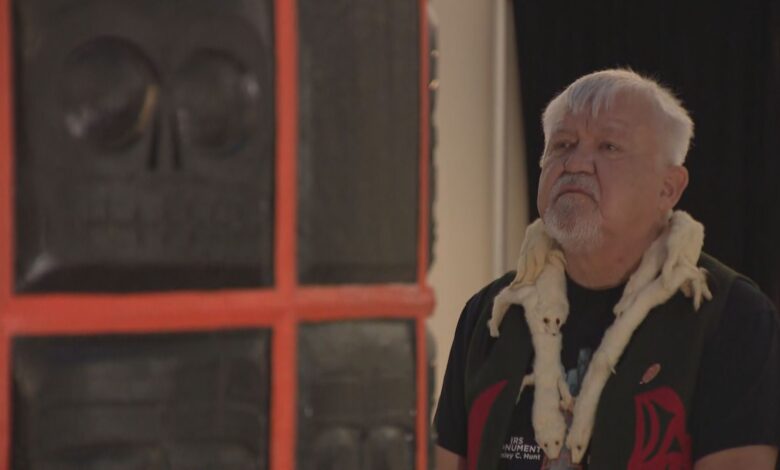
Kwakwaka’wakw artist Stanley C. Hunt created the Indian Residential School Memorial Monument to ensure that the experiences of Indigenous children and families remain visible. The towering black work, marked by orange outlines and more than a hundred solemn faces, turns remembrance into a demand for truth.
Hunt comes from generations of Kwagu’l artists
Hunt is a Kwagu’l artist from Tsaxis, also known as Fort Rupert, in British Columbia. He belongs to a family known for carving and other Northwest Coast artistic traditions, and his work carries cultural knowledge shaped by community and kinship.
The residential-school monument is not a detached historical illustration. It is an Indigenous artist’s response to a system whose harm continues through survivors, descendants and communities.
The 2021 Kamloops announcement prompted the work
Hunt began developing the monument after the Tk’emlúps te Secwépemc announcement about ground-penetrating-radar findings near the former Kamloops Indian Residential School. The findings identified possible burial locations and renewed national attention to children who never returned home.
Careful language matters: radar anomalies are not the same as excavated and forensically confirmed remains. That distinction does not negate survivor testimony or the documented history of deaths and missing children within the residential-school system.
The monument gives individual faces to collective loss
Completed in 2023, the work stands roughly 5.5 metres, or 18 feet, high. Its dark surface contains 130 unsmiling faces outlined in orange, evoking children whose identities, stories and futures were taken or disrupted.
A raven appears at the top. In Hunt’s conception, it carries meanings of creation and protection and holds the seed of life, calling children’s spirits home. Viewers encounter grief, but also continuity and cultural survival.
Its journey brought the message to public institutions
The monument travelled to several locations, including Vancouver and the RCMP Heritage Centre in Regina. Each setting placed the work in conversation with institutions and audiences that have responsibilities for understanding Canada’s colonial history.
It later arrived at the Canadian Museum of History in Gatineau and entered the museum’s national collection. Its presentation around the National Day for Truth and Reconciliation expanded access while retaining the artist’s direct message.
Truth extends beyond a single commemorative date
Canada’s residential schools separated Indigenous children from families, languages and cultures for generations. Survivors documented abuse, neglect and attempts at forced assimilation, and the Truth and Reconciliation Commission issued 94 Calls to Action.
A memorial cannot itself locate missing children, release records, support survivors or reform public systems. It can insist that those tasks remain visible when public attention moves elsewhere.
The work is distinct from another planned national monument
Hunt’s sculpture at the museum should not be confused with the separate national residential-schools monument planned for the Ottawa area. Similar names and shared themes can blur distinct projects, artists and institutional processes.
Identifying the work accurately respects both its maker and the communities it addresses. It also prevents commemoration from becoming generic.
Its message asks viewers to carry responsibility forward
Hunt has emphasized that the truth needs to be told. The faces make that idea difficult to reduce to an abstract statistic, while the raven and seed of life refuse to define Indigenous people only through victimhood.
The monument’s power lies in that combination: mourning children who were harmed or never came home, affirming living cultures, and asking institutions and individuals what they will do after they have looked.