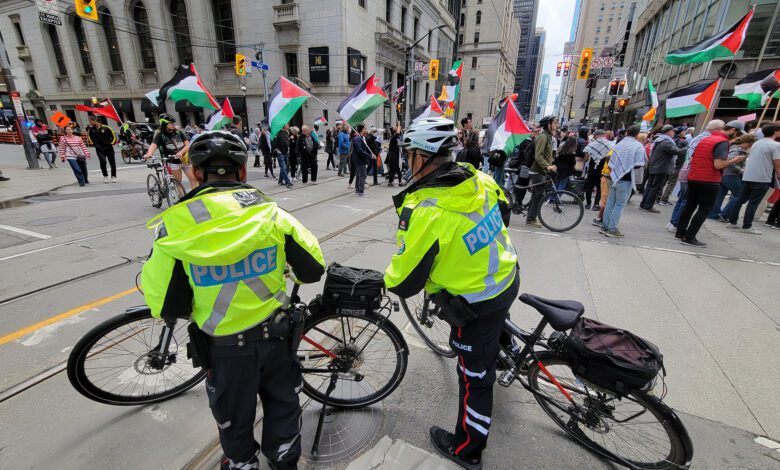
Canadian police services increased visible security around places of worship, community centres and demonstrations as the first anniversary of the October 7 Hamas-led attack approached amid escalating war in the Middle East. Toronto’s police chief said emotions were high and officers were preparing for both lawful protest and possible violence.
The anniversary carried different forms of grief
Jewish communities planned commemorations for the people killed and taken hostage in Israel on October 7, 2023. Palestinian and allied groups continued demonstrations over the enormous civilian death toll and destruction caused by Israel’s campaign in Gaza.
By October 2024, intensified fighting between Israel and Hezbollah in Lebanon and Iran’s direct missile attack on Israel had heightened fear. Canadian families had close connections to people across the region.
Toronto announced a visible deployment
Chief Myron Demkiw said residents would see additional uniformed and plainclothes officers, public-order units, mounted officers and police-liaison teams. Mobile command posts were assigned to Jewish neighbourhoods and rotated among mosques.
Marked vehicles used static roof lights to make officers easier to identify. The stated purpose was reassurance, rapid response and contact with communities rather than evidence of a specific attack at every location.
Police had managed sustained protest activity
Toronto police said officers had handled more than 1,500 demonstrations during the year and made thousands of proactive visits to schools, worship sites and community organizations. A specialized operation tracked conflict-related events.
The volume explained operational planning, but the number of demonstrations should not be treated as a number of crimes. Most participants exercise protected freedoms peacefully.
Hate crime was a serious concern
Jewish, Muslim, Palestinian and Arab communities reported threats, harassment and property offences after the war began. Police urged residents to report suspected hate-motivated incidents and said investigators could lay charges after reviewing evidence gathered at an event.
An allegation, offensive sign or political slogan does not automatically satisfy a criminal offence. Police must apply the law consistently and distinguish protected expression from threats, incitement and targeted violence.
Protest rights still applied
Public authorities have a duty to facilitate peaceful assembly while managing traffic, access and safety. Restrictions should be based on conduct and demonstrable risk rather than the viewpoint expressed.
People attending a synagogue, mosque, rally or memorial should not be presumed responsible for the actions of a foreign government or armed group. Collective blame is itself a driver of intimidation.
Language could either calm or inflame
Political leaders and institutions needed to acknowledge the Hamas-led killings, hostage suffering, Palestinian civilian deaths and humanitarian crisis without using one community’s pain to negate another’s.
False reports and decontextualized videos could spread rapidly online. Police and news organizations were responsible for verifying claims before amplifying them.
The anniversary passed without a major incident
Toronto police later reported that demonstrations on and around October 7 occurred without major incidents. That outcome did not prove the preparations were unnecessary or that every community felt safe.
It showed that visible presence, liaison work and restraint could coexist when events were planned and participants remained peaceful.
Security should protect a plural city
The immediate task was to prevent an overseas conflict from producing violence in Canada. The longer task was maintaining trust while enforcing the law impartially.
Police preparedness is justified by evidence of risk, not by treating political dissent as disorder. Success means worshippers can gather, mourners can remember, protesters can speak and residents can move through the city without threat. The 2024 operation should be judged against all four responsibilities, with transparent reporting on deployments, arrests, complaints and hate-crime investigations.