
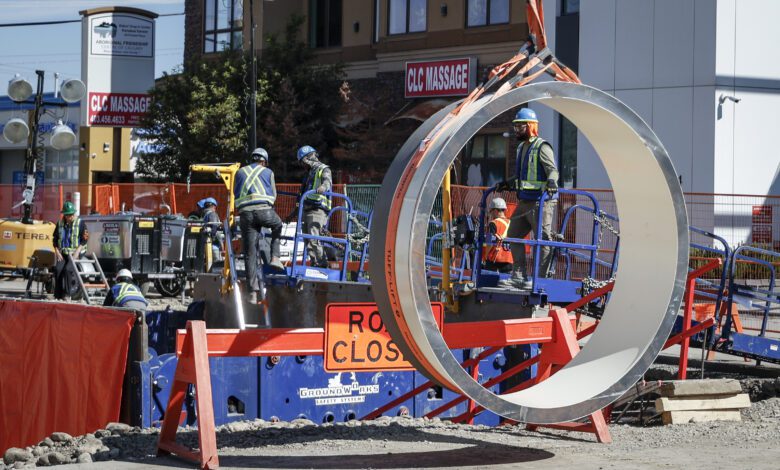
Hamilton accelerated repairs to its largest water transmission main after testing confirmed a substantial leak in the Woodward–Greenhill feeder system. The prestressed concrete cylinder pipe was built in the early 1970s, broadly matching the material and era involved in major 2024 failures in Calgary and Montréal.
The main carries water toward Stoney Creek
The 90-inch transmission line runs from the Woodward Avenue treatment area toward the Greenhill reservoir. It is a high-capacity part of Hamilton’s distribution network rather than an ordinary neighbourhood pipe.
Because other parts of the system can temporarily supply customers, a leak does not necessarily mean taps immediately run dry. It does mean that capacity and redundancy become more limited while the line is isolated.
Monitoring found a hidden problem
City testing identified leakage along the Nash Road section. Water officials treated it as urgent because continuing deterioration in a large pressurized main can lead to a sudden break, flooding, road damage and prolonged service disruption.
A controlled shutdown and planned excavation are safer than waiting for an uncontrolled failure. They also allow crews to arrange equipment, traffic management and alternate water flows in advance.
The pipe type was a warning signal
Prestressed concrete cylinder pipe combines a steel cylinder, concrete and high-strength wire. If protective materials fail and the wire corrodes or breaks, the pipe can lose the strength needed to contain pressure.
Hamilton told councillors that its main was of a similar material and vintage to pipes that failed in Calgary in June 2024 and Montréal in August. Those events illustrated the possible consequence of deterioration in critical infrastructure.
Similarity did not prove an identical cause
The three systems had different designs, soil conditions, operating histories and inspection records. Calgary’s later investigation identified multiple contributing factors in its own feeder-main failure.
It would therefore be inaccurate to say that one common component established the same defect in Hamilton. Material and age justified caution; local inspection and engineering evidence were still required to diagnose the Nash Road leak.
Repairs had a seasonal window
The city needed the feeder main in service during higher water demand, generally from May through October. Work requiring it to be taken out of service therefore had to be performed between October and the end of April.
That schedule placed pressure on procurement, design and construction. Moving quickly did not remove the need for qualified engineering, safe excavation and water-quality controls before return to service.
Customers depended on system redundancy
While the line was unavailable, Hamilton had to route sufficient water through other facilities and valves. Operators also had to monitor pressure so that solving one risk did not cause another failure elsewhere.
Any conservation request should be based on actual system conditions and communicated clearly. Alarmist comparisons can cause unnecessary panic, while vague reassurance can leave residents unprepared.
The repair became a wider asset-management issue
A city cannot excavate every buried main merely because it is old. Utilities prioritize inspection using material, failure history, consequence, pressure and the availability of alternate supply.
Large critical mains warrant particular attention because even a low-probability failure can have extreme consequences. Acoustic monitoring, wire-break detection and internal inspection can help identify deterioration before rupture, though each method has limits.
The lesson was prevention through evidence
Hamilton’s decision was shaped by a confirmed local leak and the cautionary experience of other Canadian cities. The strongest reporting keeps both elements in proportion.
The main was genuinely in need of repair, and its construction made rapid action prudent. It was not proven to be on the verge of failing for precisely the same reason as Calgary or Montréal. Planned isolation, engineering assessment, rehabilitation and long-term monitoring offered the responsible route: address the known defect before it became a city-wide emergency, then use the findings to improve oversight of the rest of the network.



