
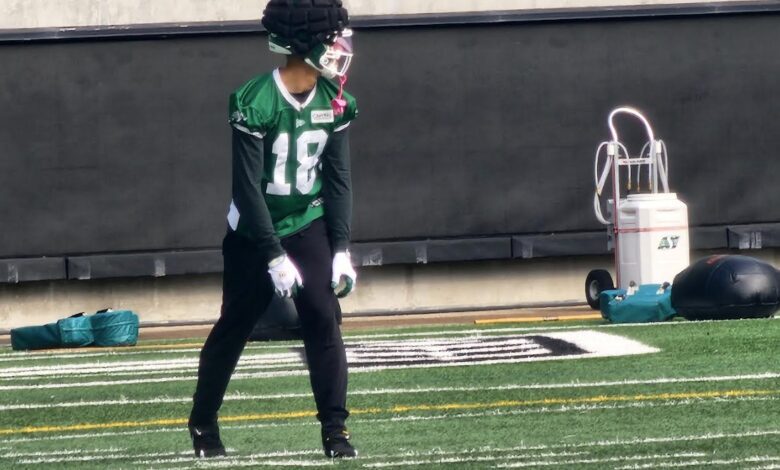
Canadian receiver Dhel Duncan-Busby made an immediate impact in his Canadian Football League debut, catching seven passes for 92 yards as the Saskatchewan Roughriders defeated the Ottawa Redblacks 29–16 on September 28, 2024. His performance gave an injury-tested offence a dependable new target at a crucial stage of the season.
A first reception brought an early test
Duncan-Busby fumbled after making the first catch of his CFL career, but Saskatchewan recovered the ball. The mistake could have unsettled a player appearing in his first professional game; instead, he remained involved and finished as one of the team’s most productive receivers.
Seven receptions indicate more than one isolated long play. Quarterbacks repeatedly trusted him to find space, secure the ball and contribute as Ottawa’s defence adjusted.
The opportunity followed a patient start
The Vancouver native had spent much of the season learning Saskatchewan’s offence and adapting to the speed of professional football. Injuries elsewhere in the receiving group created an opening, but a roster vacancy alone does not produce 92 yards.
He later said the pace initially surprised him and that practice repetitions helped settle his nerves. That distinction matters for a rookie: athletic ability earns an opportunity, while familiarity with timing, coverage and terminology makes a player usable within the whole offence.
Saskatchewan had invested a draft pick
The Roughriders selected Duncan-Busby in the third round, 23rd overall, of the 2024 CFL Draft. As a Canadian player, he also offered roster flexibility under the league’s nationality rules, but his debut production stood on its own.
He had played college football at Bemidji State, where he developed as a physical receiver. Moving from the American college game to the CFL meant learning a wider field, pre-snap motion and different spacing.
The numbers need game context
Saskatchewan’s 29–16 victory improved its playoff position and reflected contributions from multiple phases. Duncan-Busby’s catches helped sustain drives and gave the offence another option; they did not make him solely responsible for the result.
A one-game sample also cannot establish a player’s long-term level. Opponents obtain film, injured veterans return and weekly game plans change. The more meaningful early sign was that he responded after the fumble and continued to earn targets.
His role demanded work without the ball
Receivers are judged not only by catches. Route depth, blocking, motion, coverage recognition and special-teams assignments determine whether a young player remains in the lineup.
Those responsibilities are less visible than yardage, yet coaches depend on them to preserve play design. A successful debut therefore creates another examination rather than a permanent starting role.
The next game offered a different challenge
Saskatchewan prepared to face the Edmonton Elks with Duncan-Busby expected to receive another opportunity. Edmonton could now study his Ottawa routes and alter leverage or coverage.
For the rookie, the task was to repeat sound assignments instead of chasing another headline total. Reliable execution can help an offence even when the ball goes elsewhere.
The debut became a genuine foundation
Duncan-Busby remained with the Roughriders and developed into a larger receiving threat. Later performances demonstrated that the Ottawa game was not simply a statistical accident, although his career continued to require the normal competition and adjustment faced by any young professional.
The most accurate reading of September 28 is therefore measured but positive. A Canadian draft pick survived an early error, produced seven catches and 92 yards in a victory and showed he could contribute when Saskatchewan needed depth. It was an impressive beginning, not a guarantee—and exactly the kind of opportunity a developing player must turn into sustained work.



