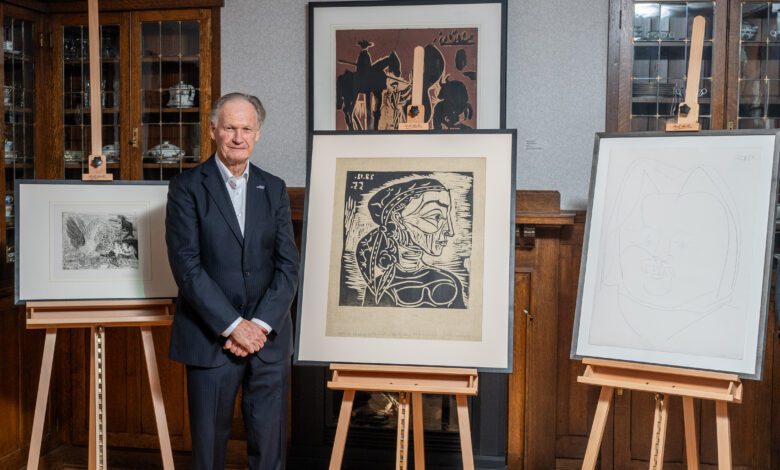
International print dealer and University of Saskatchewan alumnus Frederick Mulder donated three original Pablo Picasso prints to the university in 2024. The works broadened a public collection in Saskatoon and offered students direct access to distinct printmaking techniques from different periods of Picasso’s career.
The gift contained three different works
The donation included the 1931 etching Harpy with Head of a Bull, and Four Little Girls on a Tower Surmounted by a Black Flag, made for the celebrated Vollard Suite. It also included the 1952 lithograph Balzac and the 1955 linocut Profile of Jacqueline with a Scarf.
Together, the works allow viewers to compare an incised plate, a planographic printing process and a relief-cut block rather than seeing “a Picasso print” as a single category.
An original print is not a poster
Printmaking enables more than one impression, but an original print is conceived and produced as an artwork within an edition under the artist’s authority. It differs from a later photographic reproduction of a painting.
Edition, paper, condition, signature and documented ownership all affect scholarship and value. A university accepting such a gift must verify those details and preserve the record for future researchers.
Mulder’s connection began as a student
Mulder graduated from the University of Saskatchewan in 1964 before studying at Oxford and building an international career in historical and modern prints. He has described buying his first Picasso print while a student for about C$35, an experience that helped begin decades of collecting and dealing.
His expertise later made him an important figure in the market for Picasso editions. The 2024 gift honoured university president Peter Stoicheff and Kathryn Warden.
It was not his first donation
Mulder had previously given six Picasso prints to the university in 2012. The later works strengthened an existing group rather than arriving as isolated prestige objects.
Building a coherent collection helps teaching. Students can examine how line, pressure, ink and revision vary between impressions and techniques—evidence that is difficult to understand from a small digital image.
Location changes who can study the work
Major European modernist art is concentrated in large metropolitan museums and private collections. Placing significant prints in a Prairie university makes them available to local students, researchers and public audiences without requiring costly travel.
Access still depends on exhibition schedules, study-room policies, conservation limits and useful digital cataloguing. Ownership by a public institution is an opportunity, not an automatic guarantee of visibility.
Conservation is an ongoing obligation
Works on paper are sensitive to light, humidity, handling and acidic storage material. Museums normally limit display duration, use appropriate glazing and maintain stable environmental conditions.
These precautions can make a valuable work appear less frequently, but they protect it for future classes. The university must balance present access with the duty to preserve the sheets over generations.
Interpretation should be broad and candid
Picasso’s influence on twentieth-century art is substantial, while his treatment of women and the power dynamics surrounding his life have generated serious criticism. Responsible interpretation can examine both artistic achievement and uncomfortable biography without turning either into a slogan.
The title and imagery of each print also need context. Curatorial material should identify the print process, date, edition and relationship to the artist’s wider practice so that fame does not replace analysis.
The gift’s value lies in sustained use
Market price may attract attention, but a university collection earns its public value through teaching, scholarship, careful stewardship and meaningful access. Mulder’s donation gives Saskatchewan audiences three technically and historically different objects with which to do that work.
The arrival of the prints was therefore not simply a celebrity-art story. It connected an alumnus’s expertise with a regional collection and created a long-term educational responsibility: authenticate and conserve the works, explain their context honestly and ensure that students and the public can encounter them as art rather than only as famous names.