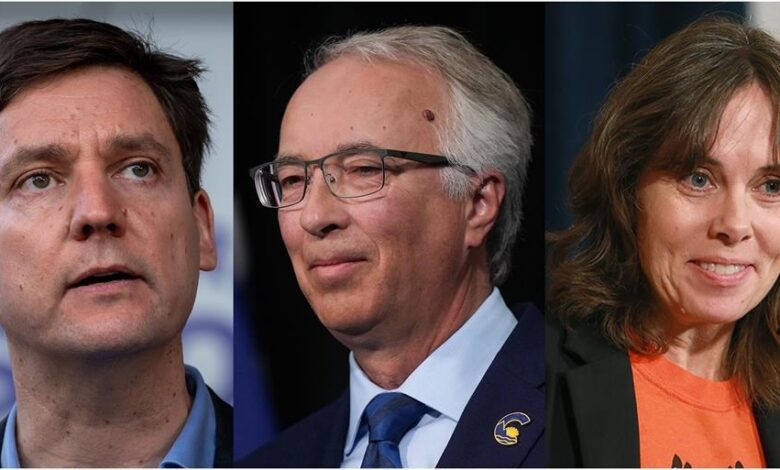
British Columbia’s three major party leaders met for the campaign’s only televised debate on October 8, 2024. The 90-minute programme placed affordability, health care, public safety, housing, the toxic-drug crisis and climate policy before voters less than two weeks before election day.
Three leaders shared the stage
BC NDP leader David Eby, BC Conservative leader John Rustad and BC Green leader Sonia Furstenau participated. Shachi Kurl, president of the Angus Reid Institute, moderated the broadcast produced by a consortium of provincial news organizations.
The event ran from 6:30 to 8 p.m. and was distributed on television, radio and digital platforms. It was the sole televised leaders’ debate of a campaign ending with voting on October 19.
Affordability framed much of the argument
Rustad presented crime, drug policy, taxes and living costs as evidence that the incumbent government had failed. Eby defended public investment and argued that a sharp change in direction would put services and rights at risk.
Furstenau challenged both larger parties to explain how their proposals would address housing and poverty rather than compete mainly through attacks. Viewers still needed to compare complete platform costs because a debate rewards concise claims, not detailed fiscal assumptions.
Health care exposed competing diagnoses
All three leaders recognized shortages and access problems, but disagreed over management, spending and the role of private delivery. Waiting lists and the difficulty of finding primary care were tangible concerns for voters.
A promise to spend more or reorganize care does not itself show that patients will receive faster treatment. Staffing numbers, training timelines, retention and regional distribution determine whether a plan can work.
The toxic-drug crisis produced sharp differences
The leaders debated decriminalization, treatment, public consumption and the province’s response to overdose deaths. Rustad argued for a more restrictive approach, while Eby defended parts of the public-health response and acknowledged changes where implementation had failed.
Furstenau criticized both for politicizing a crisis involving health, housing and a dangerous illicit supply. Policy should be judged by deaths, treatment access, recovery outcomes and community safety rather than by slogans alone.
Climate and Indigenous rights also divided them
Furstenau pressed the others about fossil-fuel expansion and the urgency of emissions reduction. The candidates also differed over reconciliation, land decisions and how government should work with First Nations.
Climate policy affects employment, energy costs, disaster risk and provincial revenue, so voters needed both transition plans and credible emissions accounting. Indigenous rights are constitutional obligations, not a discretionary campaign theme.
Personal exchanges required verification
Eby challenged Rustad over previous statements involving vaccination and other contested subjects. Rustad said he opposed mandates rather than vaccination itself. Such exchanges can reveal judgment, but clips and rebuttals should be checked against the complete record.
Furstenau used her position as the smaller-party leader to question the assumptions shared by her opponents. Debate time, however, could not establish which promises were legally, financially or operationally feasible.
The result was exceptionally close
Final counting ultimately gave the BC NDP 47 seats, the BC Conservatives 44 and the Greens two. Eby formed a narrow majority government after recounts and delayed results in several close contests.
The outcome also confirmed a major realignment: the Conservatives replaced the former BC United coalition as the principal opposition, while the Greens retained leverage in a closely divided legislature.
A debate is evidence, not a voting instruction
Performance can show how leaders explain pressure, correct one another and prioritize limited time. It cannot substitute for candidate records, platform documents, independent costing and local constituency concerns.
The October broadcast gave voters a common comparison before a consequential election. Its value lay less in declaring a “winner” than in making each leader’s claims visible enough to be checked before ballots were cast.